PET Bottle Design: The Complete Guide From Material Selection to Finished Product
Designing a PET bottle might seem as simple as drawing an appealing shape, but the reality is a complex balancing act of structural engineering and material science. A minor miscalculation in wall thickness can cost thousands in annual production. In this comprehensive guide, we walk you through the entire lifecycle of PET bottle design. From selecting the proper resin grades and optimizing preform stretch ratios to navigating the latest EU sustainability mandates and choosing the right manufacturing path, you will learn how to build containers that perform flawlessly from the filling line to the retail shelf.
What PET Bottle Design Actually Involves
If you think PET bottle design is about sketching an attractive shape and calling it a day, you are about to leave a lot of money on the factory floor. True PET bottle design sits at the intersection of structural engineering, material science, and manufacturing feasibility. And the decisions made at the design stage lock in roughly 60–70% of your final per-unit cost — before a single preform is injected.
The core challenge is deceptively simple: create a container that holds your product safely from filling line to consumer, withstands the physical punishment of transport and stacking, looks good enough to earn shelf appeal, and does all of this at the lightest possible weight. Miss one dimension and the bottle betrays you. Bulging bottoms on a warehouse pallet. Leaking neck finishes that trigger retailer rejections. Wall thickness so thin that consumers perceive your product as cheap before they even taste it.
To understand PET bottle design properly, you need to become fluent in a handful of concepts that will recur throughout this guide: the preform (the test-tube-shaped precursor injected before blow molding), neck finish (the threaded opening that mates with your closure), stretch ratio (how much the preform is stretched — both axially and radially — during blowing), and top load (the vertical crushing force a filled, capped bottle must survive on a pallet). Get comfortable with these four terms, and you will be a dramatically more informed buyer — and a much harder target for suppliers who cut corners.
Material Selection and Preform Design — Where Every Bottle Begins
Before you think about shape, color, or label placement, you need to answer a more fundamental question: what is your bottle actually made of, and how does that material flow from pellet to preform to finished container? This section walks through the material decisions that control transparency, strength, processing behavior, and — increasingly — your regulatory compliance posture.
PET Resin Grades and the Properties That Matter for Design
PET is not one material. It is a family of formulations differentiated primarily by Intrinsic Viscosity (IV) — a measure of polymer chain length that directly translates to mechanical strength and processing behavior. For bottle-grade PET, IV typically falls between 0.72 and 0.84 dL/g, and where your product lands in that range makes all the difference.
Water bottles operate at the lower end: IV 0.72–0.78 dL/g provides sufficient strength for still liquids at ambient pressure, and lower IV means faster cycle times and lower processing cost. Carbonated soft drink (CSD) bottles need more backbone — IV 0.78–0.84 dL/g — to resist the relentless internal pressure of 3.5–4.0 volumes of dissolved CO₂ without creep deformation over a 6-month shelf life. Hot-fill applications (juice, tea, sports drinks filled at 85–95°C) push IV to 0.80–0.85 dL/g because elevated processing temperatures accelerate polymer chain degradation.
Think of IV like the molecular chain length of your PET: longer chains make a tougher bottle, but they also demand tighter process control. Get the IV wrong, and you are asking a material to do a job it was never designed for.
Beyond IV, two other material properties deserve your attention. First, moisture content: PET pellets must be dried to ≤0.005% moisture (50 ppm) at a dew point of ≤−40°C for 4–6 hours at 160–175°C before injection. Failure to hit these numbers causes hydrolytic degradation — the polymer chains break apart in the presence of water at melt temperature — and your new bottle performs like it has already been through five recycling cycles. Second, food-contact compliance: if your product is consumed by humans, your PET must comply with FDA 21 CFR 177.1630 (US) or EU Regulation No 10/2011 (Europe), and your manufacturer should be able to produce current batch-level compliance documentation — not just a generic certificate from five years ago.
Virgin PET vs rPET — What Changes When You Design With Recycled Content
The days of treating recycled PET (rPET) as a cost-saving downgrade are over. Today, 100% rPET bottles run at commercial speeds on global brands’ lines — Coca-Cola’s Aquafina in the Middle East, PepsiCo’s European operations — and the EU regulatory framework is making rPET integration non-negotiable. Under the Single-Use Plastics Directive, single-use PET beverage bottles sold in the EU have been subject to a 25% recycled content mandate since 2025. The Packaging and Packaging Waste Regulation (PPWR) raises that bar to 30% by 2030 and 65% by 2040.
But designing with rPET is not a simple drop-in substitution. Every thermal recycling cycle shaves roughly 0.02–0.04 dL/g off the IV value, and the accumulated thermal history introduces a yellow tint — virgin PET typically measures 1–3 on the Yellowness Index (YI), while food-grade rPET with whitening additives lands in the 5–8 range. More critically, rPET introduces batch-to-batch variability that virgin resin from a single supplier simply does not have. The practical implication for your design: build in a ±15% wall thickness safety margin at stress-critical zones — shoulder, base push-up, neck transition — to absorb material variability without compromising performance.
If your brand markets sustainability credentials, rPET is table stakes. But do not make the mistake of specifying rPET without adjusting your design parameters. The bottle that passed every test in virgin PET may fail drop impact or top load when you switch to 100% rPET without re-engineering the preform geometry.
Preform Design — The Engineering Blueprint That Determines Everything
The preform is the most counterintuitive object in PET bottle design. It looks nothing like a bottle — it is a thick-walled, test-tube-shaped injection-molded part, often no taller than a pen — yet it contains all the engineering information that determines your final bottle’s wall thickness distribution, base strength, and material efficiency.
The governing principle is the stretch ratio. During blow molding, the preform is stretched in two directions simultaneously: axially (lengthwise, typically 2.0–3.0×) and radially (hoop direction, typically 3.0–5.0×). The product of these two gives the total planar stretch ratio — commonly 6–12× for water bottles and 8–15× for CSD bottles. The magic happens when the total stretch ratio exceeds PET’s Natural Stretch Ratio (NSR) of approximately 2.5–3.0×. Beyond the NSR, the material enters a strain-hardening regime: the polymer chains align and crystallize under stress, producing a thinner wall that is paradoxically stronger than a thicker, un-oriented wall.
Preform wall thickness distribution follows a three-zone rule: the label/body zone sets the baseline; the shoulder zone requires approximately 20% more material to survive the sharper curvature; and the base zone needs roughly 50% more material than the shoulder to form a robust foot without thinning through.
Modern lightweight preform designs — such as the EcoBase geometry that shaves up to 2.5% off base resin — use finite element analysis to redistribute material precisely to the active zones, leaving zero grams where they are not needed.
Your choice of manufacturing process also feeds back into preform design. Single-stage (injection and blowing on one machine) suits annual volumes below roughly 5 million units — lower mold investment, faster changeover, ideal for brands with multiple SKUs. Two-stage (injection and blowing on separate lines) is the workhorse for high-speed production above 10 million units per year. The preform geometries are not interchangeable between the two processes, so this decision needs to be locked before the first mold is cut.
Structural Design — The Engineering Behind Shape, Weight, and Performance
With your material and preform decisions made, the next layer is structural: the geometry that turns a preform into a container that survives the journey from filling line to consumer — without using a single gram more PET than necessary. This is a multi-objective optimization problem. No bottle scores perfectly on strength, weight, cost, and aesthetics at the same time. The skill is knowing which dimension you cannot afford to compromise.
Bottle Geometry — Base Design, Sidewall Engineering, and Shoulder Profiles
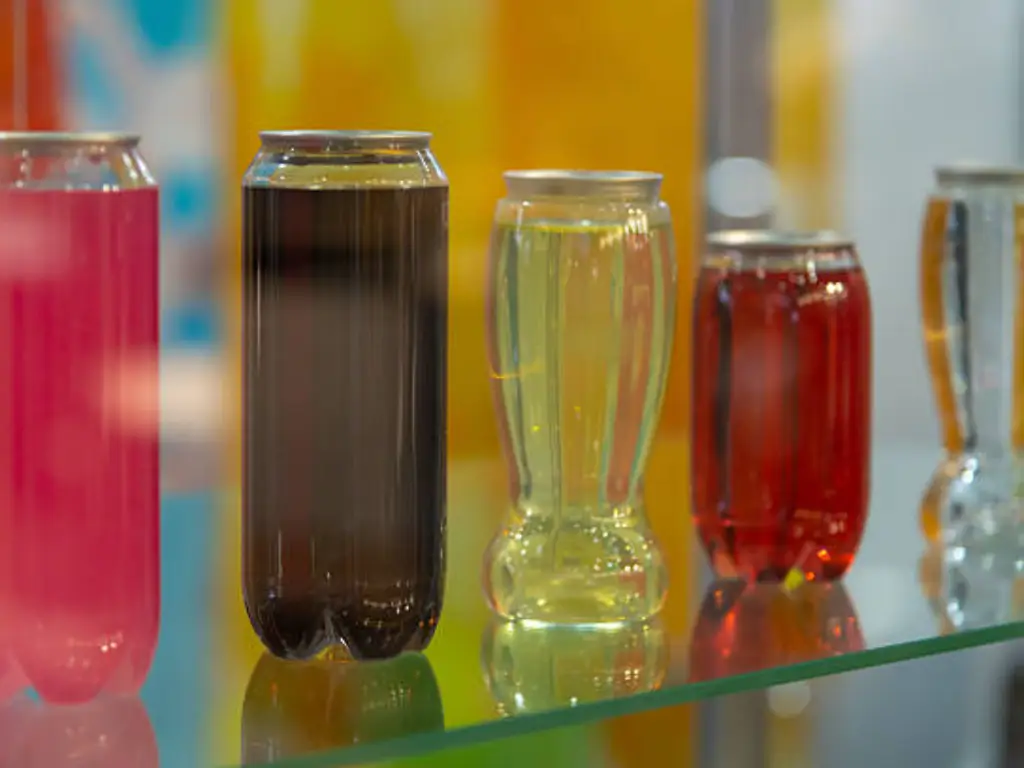
Every PET bottle decomposes into three geometric zones, each with its own engineering logic.
The base is the foundation. For still water and ambient-pressure products, a simple flat or slightly recessed base may suffice. For anything under internal pressure, the petaloid base — the champagne-style bottom with five or six protruding feet — is non-negotiable. The feet distribute vertical stacking loads across multiple points and resist the internal pressure that is constantly trying to invert the base. This failure mode is called base roll-out, and it turns your bottle into an unstable, leaking liability. Five feet is the sweet spot: fewer feet concentrate stress excessively; more feet add mold complexity without meaningful performance gain.
The sidewall is where lightweighting engineering happens. Straight, unadorned walls need thickness for stiffness. Add vertical or circumferential ribs — reinforcement grooves with a depth equal to 2–5% of body diameter — and you can reduce wall thickness while maintaining or improving rigidity. Same principle that makes corrugated cardboard stiff: geometry substitutes for material. The ribs you see on modern water bottles are not decoration. They are structural exoskeletons.
The shoulder — the transition zone from body to neck — is the silent killer in poor designs. A shoulder angle steeper than 25° from vertical creates instability on high-speed filling lines and concentrates mechanical stress right where the neck meets the body. The sweet spot is 12–18°, with a generous transition radius of at least 15–20% of body diameter.
For hot-fill products, an additional geometric element enters the picture: vacuum panels. When a liquid filled at 85–95°C cools to ambient temperature, its volume shrinks by approximately 1.5–3.0%. Without vacuum panels — those familiar recessed rectangles on the bottle body — the negative pressure would collapse the bottle into a distorted, unsightly shape. The panels flex inward to absorb the volume change, keeping the rest of the bottle geometry intact.
Lightweighting — How Thin Can You Go Without Breaking
Lightweighting is the dominant structural trend in PET bottle design, and the numbers tell a remarkable story. A standard 500 ml still-water bottle weighed 12–15 grams two decades ago. By 2020, the benchmark had dropped to 7–8 grams. Today, the bleeding edge — KHS and Husky’s Factor 101 platform — produces a 591 ml bottle at just 5.89 grams, exceeding 220 N top-load strength. That is roughly the weight of a single sheet of A4 paper, formed into a container that survives being stacked 15 pallets high in a warehouse.
The business case is straightforward. At commodity PET resin prices, each gram saved translates to roughly $3,000–5,000 in annual material cost per million bottles. For a brand running 100 million units a year, cutting 2 grams saves $600,000–1,000,000 — before factoring in the reduced carbon footprint and lower transport weight.
Four strategies work together to achieve extreme lightweighting. First, neck downgauging: switching from the legacy PCO 1881 neck finish (~5.0 g) to a 26/22 short neck (~3.4 g) saves 1.6–1.88 g per bottle in the neck alone. Second, geometric reinforcement: ribs and optimized curvature allow wall thickness reduction without stiffness loss. Third, base optimization: designs like EcoBase reduce base material by up to 2.5%. Fourth, stretch ratio maximization: pushing deeper into the strain-hardening regime extracts more strength from less material.
But there is a physical floor. When body wall thickness drops below approximately 0.10–0.12 mm, two failure modes converge: structural buckling under top load, and the squeeze test — consumers perceive the bottle as flimsy and low-quality when it deforms too easily in their hand. No amount of rib engineering fully compensates for that tactile signal.
Performance Validation — Does Your Design Survive the Real World?
A design that has not been validated is a gamble, and in PET bottles, the house usually wins. Every new design should pass four non-negotiable tests before mold production begins.
Top-load testing simulates warehouse stacking: an empty, capped bottle is compressed vertically at 50 mm/min. The minimum acceptable force is 220 N (~22 kg) for water bottles and 280 N (~28 kg) for CSD bottles. Failure here means collapsed pallets and rejected shipments.
Burst and creep testing is specific to pressurized products. A CSD bottle must withstand ≥1.2 MPa (~12 bar) without rupture — a safety factor of roughly 1.5× over nominal carbonation pressure. Creep testing simulates long-term pressure exposure: 40°C accelerated aging for 14 days, equivalent to roughly 6 months at ambient temperature. If the base begins to push out during this test, your bottle will fail on a real store shelf.
Drop testing is the closest simulation of real-world abuse. Fill the bottle with your actual product — not water, which has different density and impact behavior — seal it, and drop it from 1.2 m (retail shelf fall) and 1.8 m (warehouse picking error). Any rupture, leak, or structural failure is a red flag.
Seal integrity testing — typically vacuum decay — verifies that the neck finish and closure form a hermetic seal. Acceptable leakage is ≤0.1 standard cubic centimeters per minute. For products with volatile components like carbonation or aromatics, this is the test that separates looks-fine from actually-works.
In a well-run production environment, the quality target is ≥99.8% yield across all four test categories. Below 99.5%, you are paying for scrap that should have been engineered out at the design stage.
Neck Finishes, Closures, and Barrier Systems — The Critical Interfaces
If the bottle body is the engine, the neck finish, closure, and barrier system are the transmission — the interfaces that connect your container to the filling line, the consumer, and the product’s shelf-life requirements. Get any one of these wrong, and the best bottle design in the world still fails.
Neck finish standards — a quick-reference table:
| Neck Finish | Typical Weight | Primary Application | Key Note |
|---|---|---|---|
| PCO 1881 | ~5.0 g | CSD, water (global standard) | Dominant but being phased down |
| 26/22 GME 30.37 | ~3.4 g | CSD, water (lightweight) | Saves ~1.6 g vs PCO 1881 |
| GME 30.40 | ~3.4 g | CSD, water, tethered caps | ~32% neck mass reduction; EU tethered-cap compliant |
| 38 mm wide-mouth | Varies | Food jars, protein powders | Enables spoon/scoop access |
| Custom + crystallized | Varies | Hot-fill (85–95°C) | Tg raised to ~120°C; shrinkage <1% |
Choosing a neck finish is like choosing a charging standard — it locks you into an ecosystem of compatible closures, capping equipment, and even consumer expectations. The PCO 1881 is the USB-A of bottle necks: ubiquitous but aging. The 26/22 family is USB-C: smaller, lighter, and the direction the industry is heading.
Barrier technologies enter the picture when your product is sensitive to oxygen, moisture, or light:
| Barrier Technology | Mechanism | O₂ Improvement | Recycling | Best For |
|---|---|---|---|---|
| SiOx plasma coating | Glass-like inner layer (<100 nm) | 10–30× | Fully compatible | Juice, tea, wine, dairy |
| Active O₂ scavengers | Additive reacts with O₂ | 5–20× | Conditional | Beer, wine |
| Multilayer (EVOH) | Buried high-barrier polymer | 20–50× | Low compatibility | Legacy; being phased out |
| UV absorber | Blocks UV wavelengths | N/A (light) | Conditional | Dairy, supplements |
The trend is clearly toward separable, recycling-compatible barriers. SiOx plasma coating — at less than 100 nanometers thick, roughly 1/1000th the diameter of a human hair — delivers the barrier performance of a multilayer structure without contaminating the PET recycling stream.
Designing PET Bottles for Sustainability and Recycling
Sustainability in PET bottle design is no longer a nice-to-have page in the brand book. It is a design constraint with the force of law behind it. The EU Packaging and Packaging Waste Regulation (PPWR), in effect as of February 2025 with full applicability from August 2026, mandates that all packaging placed on the EU market be recyclable by design by 2030. For PET bottles specifically, the Single-Use Plastics Directive already requires 25% recycled content (since 2025), and the PPWR escalates that to 30% by 2030 and 65% by 2040.
But designing for recyclability is more nuanced than “use less plastic.” A bottle with a full-body PVC shrink sleeve, for example, is an environmental disaster in the recycling stream. PVC contamination at concentrations as low as 50 parts per million causes yellowing and structural degradation in the entire batch of rPET, downgrading it from food-grade to fiber-grade — or worse, landfill.
The European PET Bottle Platform (EPBP) maintains the definitive design-for-recycling classification system, covering body color, barrier materials, closure types, label substrates, adhesives, and additives. The rules are clear: clear or light blue PET has the highest recycling value; SiOx plasma coatings are fully compatible; PVC labels and EVOH multilayers are not.
A practical self-assessment for any new PET bottle design: (1) Is the body clear or light blue? (2) Will the label substrate float in water while PET sinks? (3) Is the closure made of PP or PE — materials that separate cleanly in the float-sink tank? Three yes answers mean your design is likely recycling-compatible. Any no is a conversation you need to have with your manufacturer before cutting steel.
Is the body clear or light blue?
Will the label substrate float in water while PET sinks?
Is the closure made of PP or PE?
Beyond basic recyclability, three trends are reshaping the design landscape. Label-free laser marking — using CO₂ or fiber lasers to etch branding, ingredients, and date codes directly onto the PET surface — eliminates labels entirely. Tethered closures, mandatory in the EU since July 2024 for single-use beverage containers up to 3 liters, require the cap to remain attached to the bottle after opening. 100% rPET bottles, once a technical curiosity, now run at 60,000–100,000 bottles per hour on commercial lines.
Design Decisions by Product Application — One Size Does Not Fit All
Everything covered so far is general principle. But when you sit down to actually design your bottle, the first question is not “what IV should I use?” It is “what is my product?” The answer assigns you to one of three design regimes, each with its own physics, its own failure modes, and its own non-negotiable parameters.
- — Carbonated drinks
- — Beer, sparkling water
- — Petaloid base required
- — Burst ≥ 1.2 MPa
- — Hot-fill (60–95°C)
- — Dairy, tea, coffee
- — Vacuum panels needed
- — Crystallized neck
- — Nuts, protein, pharma
- — Wide-mouth 38–70mm
- — Moisture barrier focus
- — Induction seal critical
Before diving in, locate your product: does it generate internal pressure — from carbonation, fermentation, or hot-fill steam? What is your filling temperature? Is your product sensitive to oxygen, moisture, or light? Your answers route you to the correct section below.
Carbonated Beverages and Pressure-Active Products
Designing a PET bottle for a carbonated drink is designing a miniature pressure vessel. It must hold its integrity for six months on a shelf, at temperatures that swing from refrigerated 4°C to a sun-exposed retail window pushing past 40°C. At 4°C, the CO₂ stays politely dissolved. At 40°C, internal pressure can spike to over 0.6 MPa (6 bar), and the bottle must not burst, leak, or permanently deform.
The standard carbonation levels: cola and mainstream sodas operate at 3.5–4.0 volumes of CO₂; beer at 2.5–2.8 volumes; sparkling water at a gentler 2.0–2.5 volumes. Each incremental volume adds roughly 0.1 MPa to the equilibrium pressure at room temperature. The bottle’s burst pressure rating must clear 1.2 MPa — a 1.5× safety factor over nominal — to account for temperature excursions and manufacturing variance.
The petaloid base is the defining geometric feature of the CSD bottle, and its five feet are not an aesthetic choice. Base roll-out, where the center of the base pushes past the plane of the feet, is the classic CSD bottle failure. It happens gradually — creep deformation over weeks or months — and the first visible sign is a bottle that no longer stands flat. The neck-to-shoulder transition radius is the highest stress concentration point on the entire bottle. The minimum safe transition radius is 15–20% of body diameter.
Hot-Fill, Dairy, and Temperature-Challenged Products
Hot-fill design flips the pressure problem inside out. Instead of positive internal pressure pushing outward, the bottle faces negative pressure — vacuum — pulling inward as the hot-filled liquid cools and shrinks. Medium hot-fill (60–75°C) covers pasteurized juices and sports drinks. High hot-fill (85–95°C) covers UHT-treated dairy beverages and ready-to-drink coffee. The volume contraction from 85°C to 25°C is approximately 1.5–3.0% — in a 500 ml container, that means 7.5–15 ml of missing volume.
Vacuum panels are the engineered solution: recessed zones on the bottle body designed to flex inward under negative pressure. The neck finish on a hot-fill bottle requires crystallization — heating the neck area to 180–200°C to raise its glass transition temperature from ~75°C to ~120°C. For dairy and plant-based milks, UV protection becomes essential: milk proteins and fats degrade under UV exposure within days.
Food, Pharma, and Non-Beverage Packaging — Different Rules, Different Designs
When your product is not a liquid, the design logic shifts from “contain pressure” to “keep the environment out.” Solid and powdered products — nuts, protein powder, capsules, dried fruit — are attacked by moisture and oxygen, not by internal CO₂. Wide-mouth formats dominate: 38 mm, 45 mm, 53 mm, even 70 mm openings designed for spoon access or hand scooping.
For food jars, an aluminum foil induction seal bonded at 160–200°C to the bottle rim provides a peelable tamper-evident barrier with seal strength ≥1.5 N per 15 mm of peel width. Pharmaceutical packaging imposes additional regulatory requirements: FDA 21 CFR 211.132 mandates tamper-evident packaging for OTC drugs; child-resistant closure (CRC) certification requires 85% of children under 5 cannot open the package within 5 minutes. Chemical compatibility testing — 40°C chamber for 28 days, weight change ≤0.5%, mechanical property retention ≥90% — is the step most first-time buyers miss.
When evaluating manufacturers for food and pharma-grade PET packaging, look beyond basic ISO 9001. The manufacturers who supply serious brands maintain certifications including FSSC 22000 for food safety systems, BRCGS for packaging, and GMP-qualified clean-room production environments. They back those certificates with quarterly third-party testing through accredited labs like SGS — not just annual spot-checks. The difference between a manufacturer running 99.8% yield with documented seal integrity data and one operating at 99.5% without batch-level traceability is the difference between a supply chain asset and a recall waiting to happen.
From Design File to Finished Bottle — Working With a PET Bottle Manufacturer
You have learned the material science, the structural engineering, and the application-specific design rules. The final question is the one that matters most: how do you turn your design into actual bottles, on time and on budget, without getting burned by a supplier who over-promises and under-delivers?
The journey from concept to container follows five steps.
Step 1 — Prepare your design file. A manufacturer needs three things to quote your project: a 3D CAD model of the bottle (STEP or IGES format), a 2D engineering drawing with critical dimensions annotated — height, diameter, wall thickness targets, neck finish specification, target weight — and a reference sample or photo if you are adapting an existing bottle style. The more precise your specification, the more accurate the quote. Fewer surprises in the sample phase.
Step 2 — Choose your development path. This is the single most important cost decision you will make.
The most common mistake: jumping to full custom before the market validates your product. Start with a stock bottle and a high-quality label. Prove demand. Then scale into customization.
Step 3 — Validate your samples. When samples arrive, do not just look at them — test them. Measure wall thickness at five points: neck, shoulder, label panel, lower body, base. Fill with your actual product and run a seal test. Drop-test from 1.5 m. Check clarity against a backlit white background. Compare the sample against your original specification point by point. One hour of testing at this stage saves months of grief after production.
Step 4 — Production and quality control. In a well-managed factory, quality control happens at four gates: incoming material inspection (IQC), in-process control (IPQC — monitoring preform weight within ±0.1 g), final quality control (FQC — 100% visual inspection plus dimensional sampling), and outgoing quality control (OQC). The yield target should be ≥99.5%, with best-in-class operations hitting 99.8%.
Step 5 — Packaging and logistics. Standard export packaging stacks multiple layers of protection: each bottle bagged or separated, packed in thick-walled corrugated cartons, stretch-wrapped on pallets, with thermal insulation film added for sea freight. If your shipment crosses the equator in a steel container that hits 60°C+ for days, that insulation film is not optional.
The cost of getting this right is modest compared to the cost of getting it wrong. When you are ready to move from design to production, work with a manufacturer that offers one-stop service — from design support and mold engineering through production, quality documentation, and logistics — rather than stitching together separate design and production vendors. The handoff between designer and factory is where specifications get lost and timelines slip. A single partner with in-house design capability, 48-hour sample turnaround, and mold-cost sharing removes the most common friction points that delay product launches by weeks or months.
Ready to turn your PET bottle design into production? Contact Outstanding Pack to discuss your project specifications, request samples, or get a quote with mold-cost sharing and 48-hour sample turnaround.
References
- European PET Bottle Platform (EPBP). “Design Guidelines for PET bottles.” https://www.epbp.org/design-guidelines
- Sidel. “Packaging and PET Preform Design.” https://www.sidel.com/services/packaging-and-preform-design/
- SIPA Solutions. “PET Preforms and Mould Refurbishment.” https://sipasolutions.com/pet-preforms-and-mould-refurbishment
- European Commission. “Packaging and Packaging Waste Regulation (EU) 2025/40.” Published January 2025.
- Brandau, O. “Bottles, Preforms and Closures: A Design Guide for PET Packaging.” 2nd Edition, Elsevier, 2012.
- KHS / Husky Technologies. “Factor 101 Ultra-Lightweight PET Bottle Platform.” interpack 2026.
- Outstanding Pack. Official Website. https://www.outstandingpack.com/
- Outstanding Pack. About Us. https://www.outstandingpack.com/about-us/
- Outstanding Pack. Products. https://www.outstandingpack.com/products/
- Outstanding Pack. Contact. https://www.outstandingpack.com/contact/