A cup is never just a cup. When a customer walks out of your shop holding a drink, that cup is the only part of your brand they carry into the world — onto public transit, into offices, into Instagram frames. Get the size wrong, and you lose more than a sale: you lose the drink experience, the social media moment, and the repeat customer who found their boba-to-tea ratio disappointing.
This guide walks you through every dimension of milk tea cup sizing — from the standard landscape to material trade-offs to the millimeter-level details that can wreck an entire order — so you can make a procurement decision your business won’t outgrow.
Standard Milk Tea Cup Sizes — The Industry Landscape
If you’ve browsed supplier catalogs, you’ve seen the numbers: 12 oz, 16 oz, 20 oz, 24 oz, 32 oz. But knowing the numbers is not the same as knowing what they mean. Here is how the industry actually uses them.
| Size (oz) | Volume (ml) | Industry Role | Common Rim Diameter |
|---|---|---|---|
| 12 oz | ~350 ml | Kids’ drinks, samples, small hot teas | 90 mm |
| 16 oz | ~500 ml | The industry standard — classic milk tea with pearls | 90–95 mm |
| 20 oz | ~590 ml | Medium iced drinks, lighter toppings | 95 mm |
| 24 oz | ~700 ml | Fruit teas, slushes, cheese foam, heavy ice | 95–98 mm |
| 32 oz | ~950 ml | Jumbo formats — niche, mostly US market | 98 mm |
Sixteen ounces is the gravitational center of the bubble tea world. It is not an arbitrary number. A 16 oz cup holds roughly 500 ml of total volume — but after a standard serving of tapioca pearls (75–100 ml) and a normal-ice fill (125–175 ml), the remaining liquid capacity sits at roughly 225–300 ml, which happens to be exactly the volume of a standard milk tea recipe. Anything smaller, and you’re shortchanging the drink. Anything larger, and your tea-to-ice ratio drifts into watery territory.
The two dominant rim diameters — 90 mm and 95 mm — split the market roughly at the 16–20 oz boundary. If you use a cup-sealing machine (and most boba shops do), the rim diameter is the single most important number on your spec sheet. More on that later.
Sizes below 12 oz and above 32 oz exist, but they belong to the world of custom molds — a subject worth its own conversation.
Matching Cup Sizes to Drink Types — What Each Menu Category Needs
Before diving into individual drink categories, establish a simple mental model. Every drink on your menu consumes cup space in three layers: liquid base (tea, milk, juice), solid inclusions (pearls, jelly, aloe — typically 15–20% of volume), and ice (from ~10% for “less ice” to ~35% for “extra ice”). The right cup size is the one that accommodates all three layers while leaving 10–15 mm of headspace at the top for the sealing film to do its job.
The four profiles below cover the vast majority of boba shop menus. Use them as a template, then adapt.
Classic Milk Tea with Pearls — Why 16 oz Is the Gold Standard
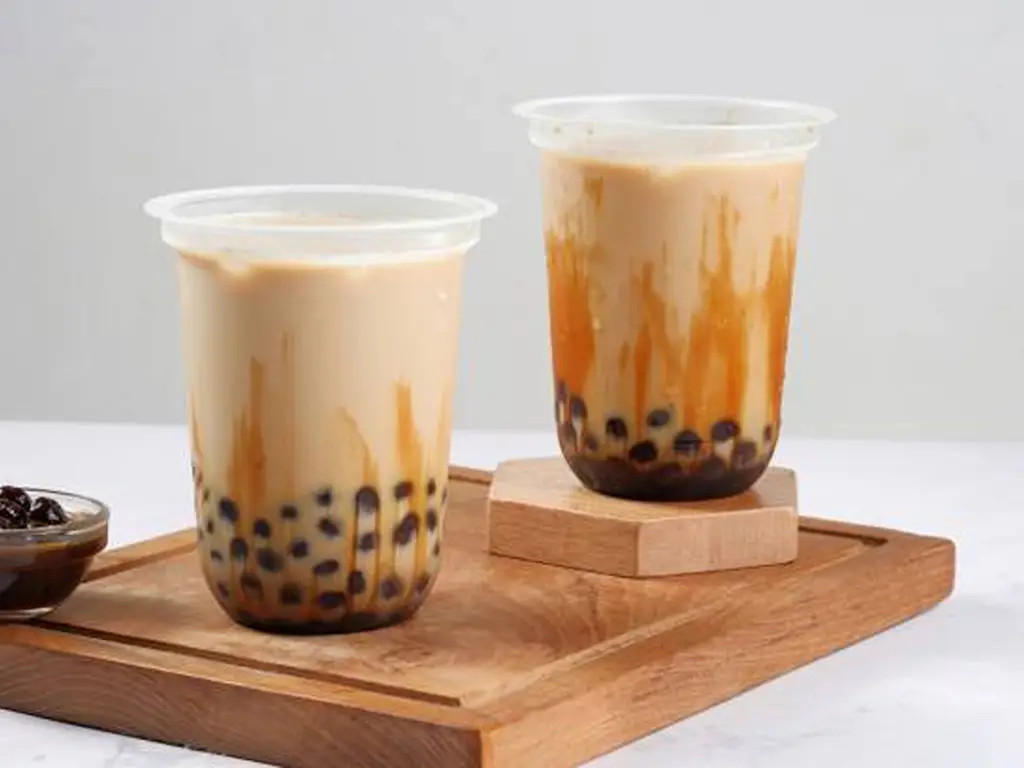
This is the drink that pays your rent. Classic milk tea with tapioca pearls accounts for 50–70% of sales volume at a typical boba shop, and 16 oz is the size it was engineered for.
The math is straightforward: a standard pearl serving weighs 50–70 g dry, swelling to roughly 75–100 ml once cooked and hydrated. Add a normal-ice portion (100–150 g of ice cubes, displacing about 110–165 ml), and your 500 ml cup has roughly 235–315 ml left for tea. That is precisely the range of a standard milk tea recipe — 250–300 ml of brewed tea plus milk, syrup, and flavoring.
If you try to serve this in a 12 oz cup, you are either skimping on pearls (disappointing every customer who ordered “extra boba”) or pouring less tea (creating a drink that tastes like sweet milk, not milk tea). If you use a 20 oz cup, you either over-dilute or overfill — both of which cost you money in ingredients without a proportional price increase.
The 16 oz cup also hits the ergonomic sweet spot: it fits comfortably in one hand, weighs under 500 g when full, and photographs well from above — the angle at which most customers shoot their drink for social media.
Fruit Tea and Slush Drinks — Why 24 oz Is the Go-To Large Format
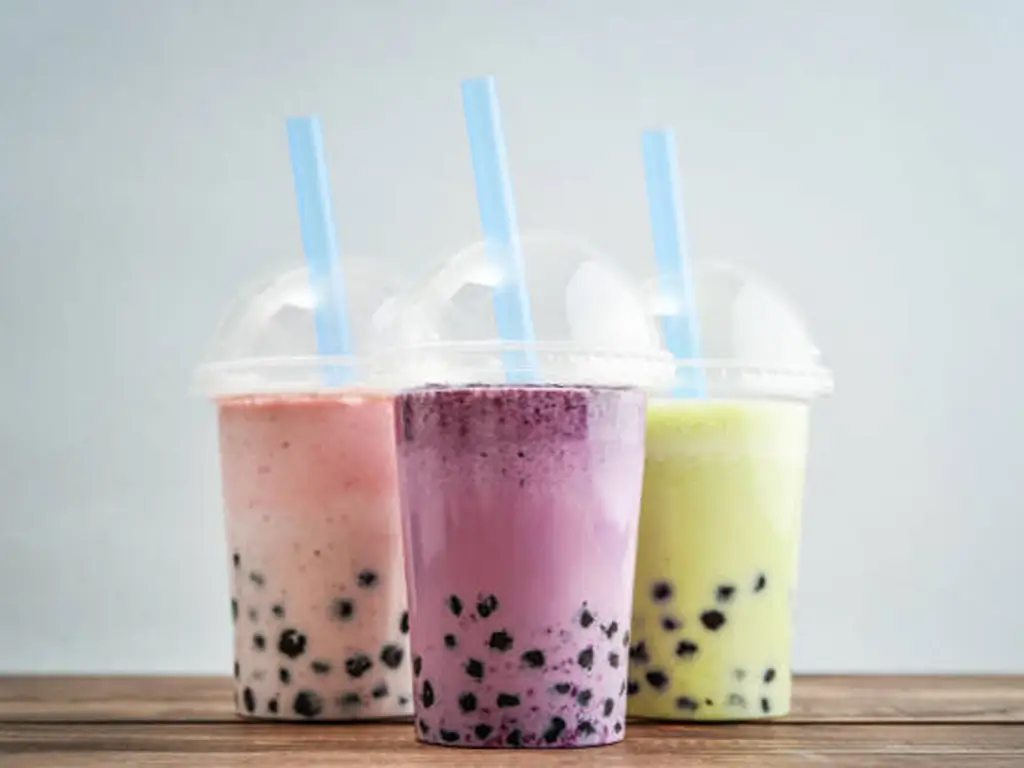
Fruit teas and slushes are the ice-heavy workhorses of the summer menu. Unlike milk tea, where ice is a supporting actor, fruit tea ice is structural: it keeps the drink cold without dairy, and those bright citrus wheels and watermelon wedges need a transparent wall to show them off.
A fruit tea built in a 16 oz cup is a warning sign. Ice occupies 40–50% of the volume in a typical fruit tea — far more than in milk tea — because there is no milk to buffer the cold. A 24 oz cup (≈700 ml) with 40% ice leaves roughly 420 ml for liquid and fruit, which is the volume customers expect for a drink priced at a premium. In a 16 oz cup, that same drink would deliver barely 250 ml of actual liquid — visibly stingy.
There is also the marketing dimension. A 24 oz transparent PET cup loaded with layered fruit, colored tea, and ice is the most Instagrammable object in your store. That cup is doing double duty as packaging and as free advertising. The incremental cup cost between 16 oz and 24 oz is typically under $0.03 — and the price difference on the menu is often $1.50 or more. That is margin you do not want to leave on the table.
One technical note: a 24 oz single-wall PET cup should weigh at least 18–22 g. Budget-tier cups in the 14–16 g range are a gamble: grip a sweating cup too firmly, and the sidewall buckles. That is a customer who does not come back.
Cheese Foam and Topping-Heavy Drinks — Dome Lids and Headroom
Cheese foam, whipped cream, crumbled Oreo, toasted marshmallow — these toppings have reshaped the upper end of boba menus over the past three years. They also break the standard lid system.
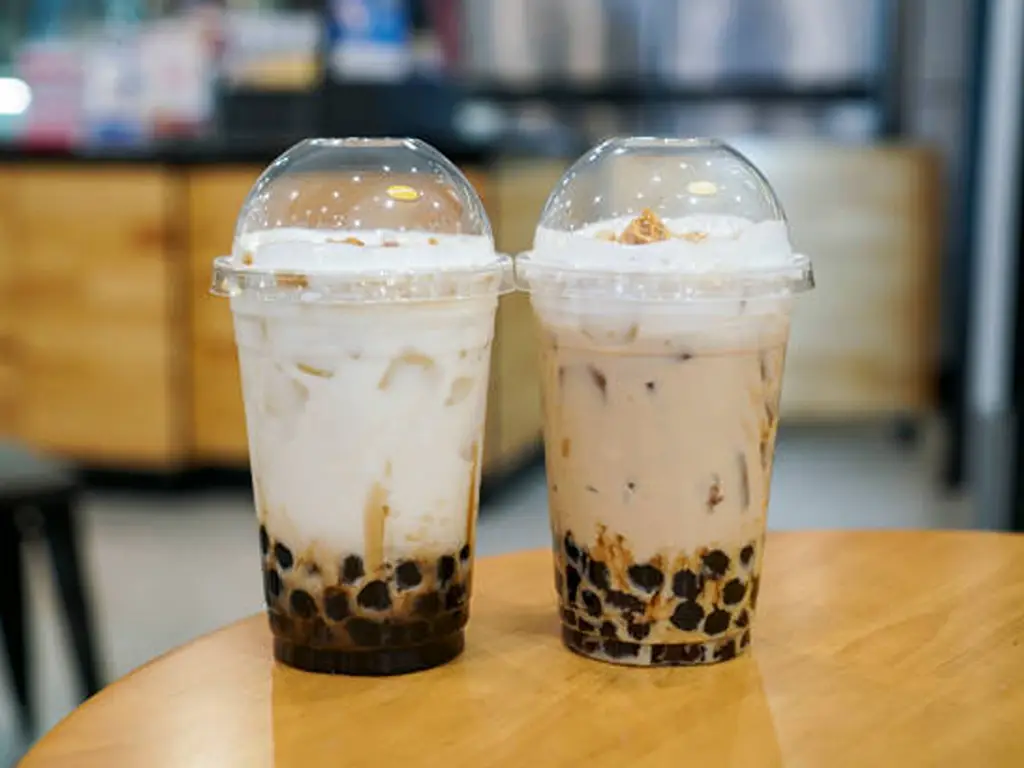
A cheese foam layer is typically 60–80 ml in volume, sitting 2–3 cm above the liquid surface. A flat lid pressed onto that foam destroys the visual appeal and squashes the topping into the tea, turning a premium drink into a muddy mess. The correct solution is a dome lid on a 24 oz cup. The dome adds roughly 80–120 ml of headroom above the rim, letting the foam sit intact and visible through the transparent dome. Customers photograph their drinks from the side when there is a foam cap — the dome is part of the composition.
For the shop operator, the key procurement lesson is this: do not try to save money by ordering dome lids from a different supplier than your cups. A dome lid that is 1 mm too loose pops off in the delivery bag. One that is 1 mm too tight requires a two-handed wrestling match at the pickup counter. Either scenario costs you a customer. Buy cups, flat lids, and dome lids as a matched system from one manufacturer.
Hot Boba Teas — Size Downsizing for Safety and Heat Retention
Hot boba drinks follow an inverted logic. Cold drinks are mostly ice, so the cup needs to be large. Hot drinks have no ice — the cup holds 100% liquid. A 16 oz hot milk tea delivers a full 450–500 ml of beverage, which is already a generous serving. A 24 oz hot drink is not a better value — it is a burn hazard: heavier, harder to grip, and cooling faster across the larger surface area.
Material also flips. PET — the default for cold boba cups — begins to soften at around 70–75°C. Freshly brewed tea lands in the cup at 85–95°C. That is well past PET’s safety margin. Hot drinks require PP (polypropylene) cups, which tolerate sustained temperatures up to 100–120°C, or double-wall paper cups with a PE lining. If your shop runs both cold and hot boba, you are running two material streams — factor that into your SKU planning.
PET vs PP vs PLA — How Cup Material Affects Your Size Decisions
Material choice is a size choice. A PET cup and a PP cup of the same labeled capacity (say, 16 oz) are not physically identical — PP cups typically need thicker walls to achieve the same rigidity, which means slightly different internal volumes and stacking heights. Choose your material first, then lock in your size within that material’s ecosystem.
| Property | PET | PP | PLA | Double-Wall Paper |
|---|---|---|---|---|
| Transparency | Crystal clear | Semi-translucent | Clear (slight haze) | Opaque |
| Heat tolerance | ~70°C max | ~100–120°C | ~50–60°C | ~90–100°C |
| Cold drinks | ✓ Best choice | ✓ Works | ✓ Works | ✗ Not ideal |
| Hot drinks | ✗ Deforms | ✓ Best plastic option | ✗ Deforms | ✓ Industry standard |
| Sealing machine | Requires rim coating | Native compatibility | Requires special film | Requires special film |
| Typical 16 oz cup weight | 14–22 g | 16–25 g | 15–22 g | 12–18 g (plus liner) |
| Relative cost | $ (baseline) | $ (similar to PET) | $$ (1.5–2× PET) | $$ (1.3–1.8× PET) |
| End-of-life reality | Recyclable where facilities exist | Recyclable (limited) | Industrial compost only | Fiber recyclable; liner complicates |
For the vast majority of boba shops, PET is the correct default for cold drinks. It is the clearest, the stiffest per gram of material, and the most widely available across the 90–98 mm rim range. The supply chain for PET cups is deep and competitive — you have leverage as a buyer.
Switch to PP in two scenarios: you are serving hot drinks, or your sealing machine was calibrated for PP cups and you do not want to re-tune it. PP cups seal more forgivingly because PP film bonds to PP rims without the surface treatment that PET rims sometimes need. That said, PP will never match PET’s clarity — if your menu depends on showing off layered fruit teas, factor in the visual cost.
PLA and paper cups come with asterisks. PLA requires industrial composting at 58°C ± 2°C with sustained humidity above 60% for 12-plus weeks — conditions that exist in almost no municipal waste stream. A PLA cup that lands in a landfill behaves essentially like PET, minus the recyclability. Paper cups, meanwhile, carry a polyethylene lining that makes the fiber-recycling story more complicated than the “eco-friendly” label suggests. Neither is a wrong choice, but both require you to understand what actually happens after the customer throws the cup away — and whether your local waste infrastructure supports the story you are telling on the cup.
“Compostable” on the label does not mean compostable in practice. PLA needs 58°C heat, 60%+ humidity, and 12+ weeks in an industrial facility — conditions most cities do not provide. Before paying the PLA premium, check whether your local waste stream actually supports industrial composting. If it doesn’t, a PET cup in a recycling bin may have the lighter footprint.
Lid Compatibility and Rim Diameters — The Millimeter Problem That Can Wreck an Order
Here is a true story that plays out in boba shops more often than anyone admits. An owner orders 5,000 16 oz cups from Supplier A. Separately, they order 5,000 flat lids from Supplier B. Both say “16 oz” on the listing. The lids are 93 mm. The cups have a 95 mm rim. Nothing fits. Five thousand cups become 5,000 pieces of trash.
The rim diameter is the silent spec that governs your entire lid-and-seal operation. Three diameters dominate the market:
| Rim Diameter | Common Cup Sizes | Notes |
|---|---|---|
| 90 mm | 12–16 oz | Narrower mouth; slightly taller profile for same capacity |
| 95 mm | 16–20 oz | The most common boba cup diameter; widest lid selection |
| 98 mm | 22–32 oz | Large-format cups; lids and sealing film less widely stocked |
A lid does not just need to be the “right size.” It needs to achieve an interference fit — the lid’s inner diameter should be 0.3–0.8 mm smaller than the cup’s outer rim diameter. This tiny interference is what creates the friction that keeps the lid on when the cup tips over in a delivery bag. Too little interference, and the lid pops. Too much, and your staff wastes seconds per drink wrestling with it during a rush.
If you plan to use a cup-sealing machine — and for delivery-heavy shops, you should — the compatibility chain is three links long: cup rim coating must match the film material (PP-coated rim for PP film is the lowest-risk combination), the machine’s cutter ring must match the cup’s rim diameter, and the film roll width must cover the full rim with a margin for the heat seal. Get any of the three wrong, and the machine produces either the film curls at the edge, creating a leak path or excess film that looks sloppy and wastes material.
Procurement rule: never buy cups without simultaneously locking in lids or sealing film from the same supplier. Test with your actual machine before committing to volume. If a supplier cannot provide a rim specification sheet with tolerances in millimeters, walk away.
How to Choose the Right Cup Size for Your Business — A Practical Decision Framework
By now you have the lay of the land: what sizes exist, which drinks need what, how materials interact, and where the millimeter-level traps are buried. The question that remains is the one you came here with: what should I actually order?
The answer is never a single size. It is a 2–3 cup portfolio that covers 95% of your menu while keeping your supply chain as simple as possible. The three dimensions below form a decision framework that starts with your menu and ends with your bottom line.
Menu-Driven Sizing — Audit Your Menu Before Ordering Cups
Before you open a supplier catalog, open your own menu. List every drink. For each, note the solid inclusions (pearls, jelly, fruit), the typical ice level (your shop’s “normal”), and the target liquid volume. Then apply this filter: can this drink be served in a 16 oz cup without feeling stingy, or does it genuinely need 24 oz?
For a standard boba shop menu of 25–35 items, the outcome is nearly always the same. You need one 16 oz cup for 60–70% of drinks and one 24 oz cup for the remaining 25–35%. A third cup — 12 oz for kids’ drinks or hot beverages — accounts for the remaining sliver and is worth adding only if you actively market those categories.
Every additional cup SKU compounds your procurement complexity. One cup means one lid. Two cups mean two lids (or two sealing film setups). Three cups mean three of each — and at three cup sizes, you are now managing six to nine stocked items across cups, lids, and straws. Ask yourself whether that third size is earning its shelf space.
Operational Efficiency — Storage, Handling, and Service Speed
Cup sizing is a logistics decision, not just a menu decision. A case of 500 24 oz cups occupies roughly 0.08–0.10 m³ of storage — nearly double the footprint of the same quantity of 16 oz cups (~0.05–0.07 m³). In a standard boba shop back room, where shelf space is measured in centimeters, that difference determines whether you can stock two weeks of inventory or need twice-weekly deliveries.
On the service counter, cup variety slows down your line. A staff member who reaches for the same cup 80% of the time builds muscle memory — they grab, fill, seal, and hand off in one fluid motion. Introduce a second cup size at 30% frequency, and the rhythm holds. Introduce a third or fourth, and every order becomes a decision: which cup for this drink again? In a rush-hour line of 20 customers, those two-second hesitations compound.
Also check whether your sealing machine’s cutter ring physically accepts every cup you plan to order. Most standard machines are built for 90 mm or 95 mm rims. If you order 98 mm cups for a large-format fruit tea, confirm that the machine can accommodate them — or budget for a second cutter ring, which is a $50–150 part but a week of downtime if you discover the mismatch mid-service.
Total Cost of Ownership — Beyond the Per-Cup Price
A supplier quote that shows only the per-cup price is showing you roughly 60% of the real cost. The full picture — total cost of ownership — includes the cup itself plus the lid or sealing film, plus shipping, plus storage, plus the spoilage and breakage rate, plus the management overhead of coordinating across multiple suppliers.
Start with the hidden pairing cost. Every cup needs a closure. If your cup supplier also supplies the matching lid or film, you pay one invoice, deal with one quality issue, and shoulder zero compatibility risk. If you split cups from Supplier A and lids from Supplier B, the per-unit savings — typically $0.005–0.01 per lid — evaporate the first time a batch of lids runs 1 mm small and you lose a thousand cups.
Shipping is the next multiplier. A 24 oz cup takes up roughly 25–35% more container volume per unit than a 16 oz cup. In a sea-freight scenario where you are paying by cubic meter, the larger cup’s unit freight cost is proportionally higher. If your business is price-sensitive and most of your volume is in 16 oz, consolidating around that size reduces your per-cup landed cost across the board.
Then consider spoilage. Industry benchmarks for cup defect rates break down by wall thickness: budget single-wall cups (under 16 g for a 24 oz) run a 2–5% in-box defect rate — cracks, rim deformations, or sidewall thin spots that fail under the sealing machine. Standard-weight cups (18–22 g) cut that to 0.5–1%. The cheaper cup that saves you $0.01 per unit but fails at 3% costs you far more in wasted product, wasted staff time, and — worst case — a customer whose drink leaked in their car.
defect rate
When evaluating suppliers, prioritize those who can provide cups, lids or sealing film, and straws as a matched system. The compatibility guarantee alone is worth more than the per-unit price difference between quotes. Beyond that, look for suppliers with responsive sampling — 48 hours from request to shipped sample is an industry benchmark that signals a well-organized production line — and clear rim specification sheets that list tolerances in millimeters.
When to Invest in Custom Cup Sizes — Scaling Beyond Standard Options
Standard 16 oz and 24 oz cups have taken your business this far. The question is whether they will take you where you are going next. Custom cup sizing — your own mold, your own shape, your own rim profile — is the point where packaging stops being a commodity and starts being a brand asset. But it is also the point where the cost structure shifts from “operational expense” to “capital investment.”
Here is how to think about whether that threshold has arrived.
Signs You Are Ready for Custom Cup Sizes
Not every growing brand needs a custom cup. Five signals suggest you might:
- Your annual cup volume exceeds 500,000 units. Below this threshold, the mold amortization cost per cup ($0.02–0.05) pushes your unit economics into uncomfortable territory. Above it, the math starts to work.
- You operate five or more locations. At this scale, your brand has enough physical presence that a distinctive cup becomes a recognized visual asset — and the volume pools enough to justify the mold.
- Your competitors are already using differentiated cup shapes. In crowded markets, unique packaging is the third-most-powerful brand signal after your logo and your storefront design.
- Customers already photograph your cups. If your social media mentions routinely feature your drink in hand, the cup itself has earned a spot in your brand identity budget.
- Your menu has a signature drink that does not fit standard sizes. A 20 oz “signature” that is cramped in 16 oz and swimming in 24 oz is the product telling you it needs its own cup.
Consumer surveys in the food-and-beverage space consistently show that distinctive packaging increases brand recognition in social media photos by over 40%. If a standard cup leaves your shop and becomes anonymous the moment the customer’s hand covers the logo, a custom cup changes the equation: the silhouette alone does the branding.
The Custom Mold Process — Timeline, Costs, and What to Expect
Custom cup development is not a “place an order and wait” process. It is a collaborative manufacturing project with a 30–60 day timeline. Here is the realistic sequence:
- Design confirmation (Days 1–7): You provide reference images, target capacity, and key dimensions. The manufacturer produces 3D renderings. This is the moment to be specific — “a 16 oz cup with a wider base and a tapered top, 95 mm rim” is actionable. “Something that looks premium” is not.
- Mold development (Days 8–30): The steel mold is machined. A 1-out-of-4-cavity mold (producing four cups per injection cycle) is the typical starting point and costs approximately $5,000–12,000 depending on complexity. Higher-cavity molds (1-out-of-8) reduce per-cup cost but increase upfront investment — the crossover point is around 1 million cups per year.
- Trial molding and sampling (Days 31–45): First-shot samples arrive. Do not approve based on photos. Test them physically: fill with hot water at serving temperature, stack 50 high to check for binding, run them through your sealing machine, and ship a few across town in a delivery bag. First-shot approval rates run 60–70% — expect 2–3 rounds of adjustments before the mold produces cups that meet every spec simultaneously.
- Production and delivery (Days 46–65): Once samples are signed off, mass production begins. Lead time for the first production run is typically 15–20 days plus shipping.
The most common failure points in custom cup development are preventable — and they almost always trace back to the sampling phase. A rim thickness that varies by more than 0.1 mm across the circumference means lids fit inconsistently. A stacking taper cut too aggressively means cups jam when nested. And a rim coating specified for PET but applied for PP means the sealing film will not bond, no matter how many times you run the machine. Every one of these is discoverable during sample testing — which is why the test protocol matters more than the design render.
ROI of Custom Cups — When Differentiation Pays for Itself
Run the numbers before you commit. A five-location chain using 800,000 cups per year might face a mold cost of $8,000 and a per-cup premium of $0.03 for the custom shape — a first-year additional cost of roughly $32,000. If the custom cup supports even a $0.50 price premium per drink (or attracts enough new customers to lift volume by 5%), the math flips decisively: $400,000 in additional revenue against $32,000 in cost.
The financial case gets stronger when you factor in the non-balance-sheet returns. A custom cup photographed 8,000 times per year (a conservative 1% social share rate at 800,000 cups) and seen by an average of 200 people per post generates 1.6 million impressions annually. Buying that reach through Instagram ads — at a conservative $5 CPM — would cost $8,000. The cup earns its media value every year, silently.
For a single-location shop doing 150,000 cups annually, the math is harder. The mold fee amortizes to $0.053 per cup over three years, and the per-cup premium pushes the total differential past what a single-store margin can comfortably absorb. At that scale, customized printing on a standard cup blank — logos, patterns, branded colors — delivers 80% of the brand benefit at 20% of the cost. Save the custom mold for when your volume earns it.
Choosing a cup size is not a one-time decision you make when you open and then forget. Menus change. Delivery grows from 10% of orders to 40%. Your brand crosses into a new market where the standard large is 24 oz, not 16 oz. The cup portfolio that worked two years ago may be quietly costing you money — and customers you never knew you lost. Revisit your cup specs at least once a year, ideally before the summer rush. That is when iced-drink volume exposes every sizing compromise you have been tolerating.
For shop owners ready to move from research to ordering, prioritize suppliers who can deliver samples within 48 hours and turn around bulk orders within 3–5 business days — sampling speed translates directly to speed to market for new menu launches and seasonal promotions.
References
- Fortune Business Insights. “Bubble Tea Market Size, Share & COVID-19 Impact Analysis, 2025–2032.” 2025. fortunebusinessinsights.com
- Research and Markets. “Bubble Tea — Global Strategic Business Report.” 2025. researchandmarkets.com
- Celanese Corporation. “IMPET® HD250 — PET Material Data Sheet.” Material Data Center. materialdatacenter.com
- OUTSTANDING Packaging. “Disposable Plastic Cups — Product Line.” outstandingpack.com
- OUTSTANDING Packaging. “Contact.” outstandingpack.com
- OUTSTANDING Packaging. Homepage. outstandingpack.com