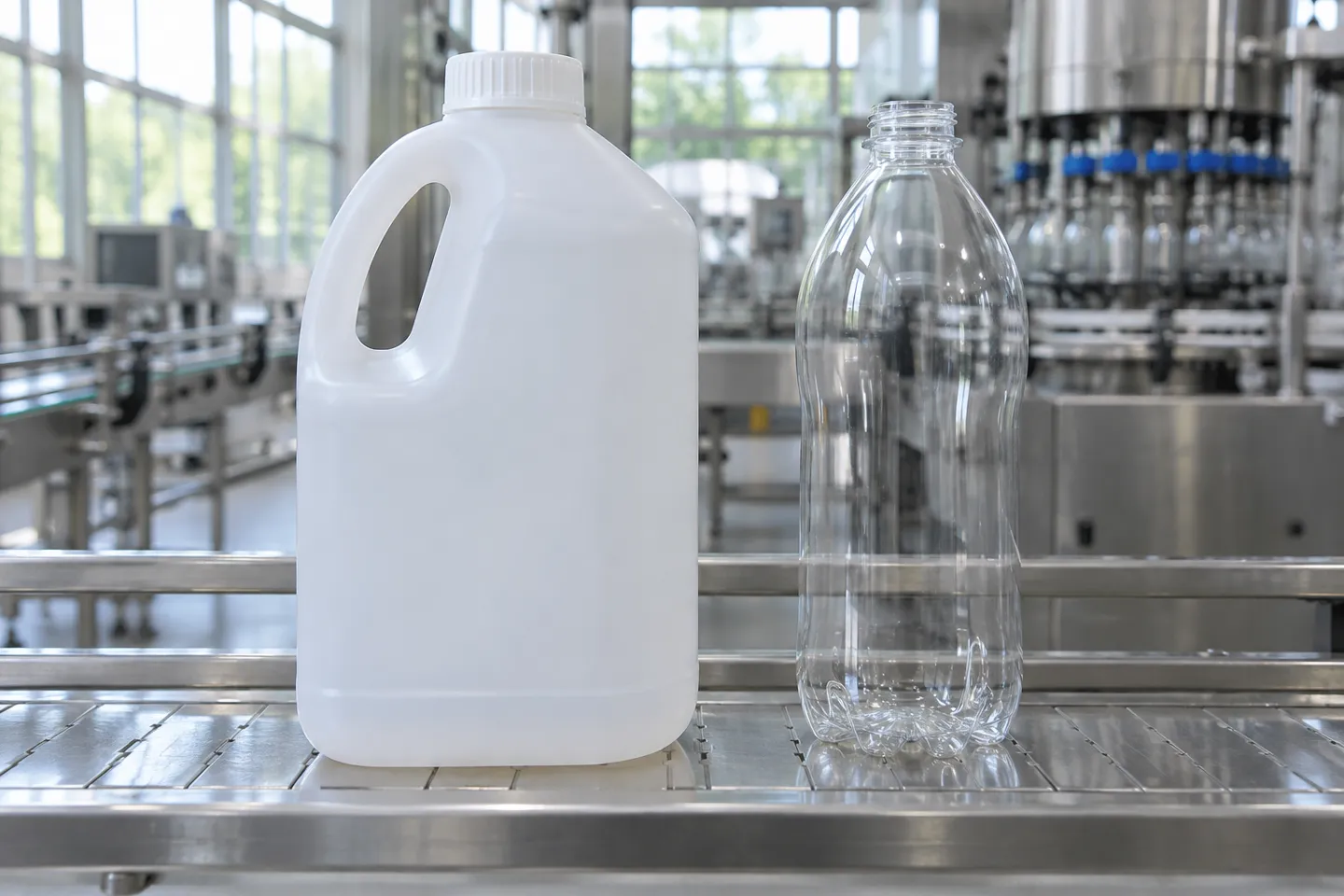
Two bottles sit on the filling line. One is clear enough to read a label through. The other is milky, slightly flexible, and shrugs off a drop onto concrete. They will hold the same product on paper. Only one of them will still look right, and still protect what is inside, after six months of shelf time and one ocean crossing.
That gap is not about brand or price tier. It comes down to a single decision made long before the first order: the polymer. HDPE and PET are the two plastics that dominate bottles, jars and cans, and they win in opposite places. This guide walks the decision in the order a buyer actually faces it. First identification, then the material map, then barriers and shelf life, then heat and freight, and finally cost.
How to Tell HDPE and PET Apart
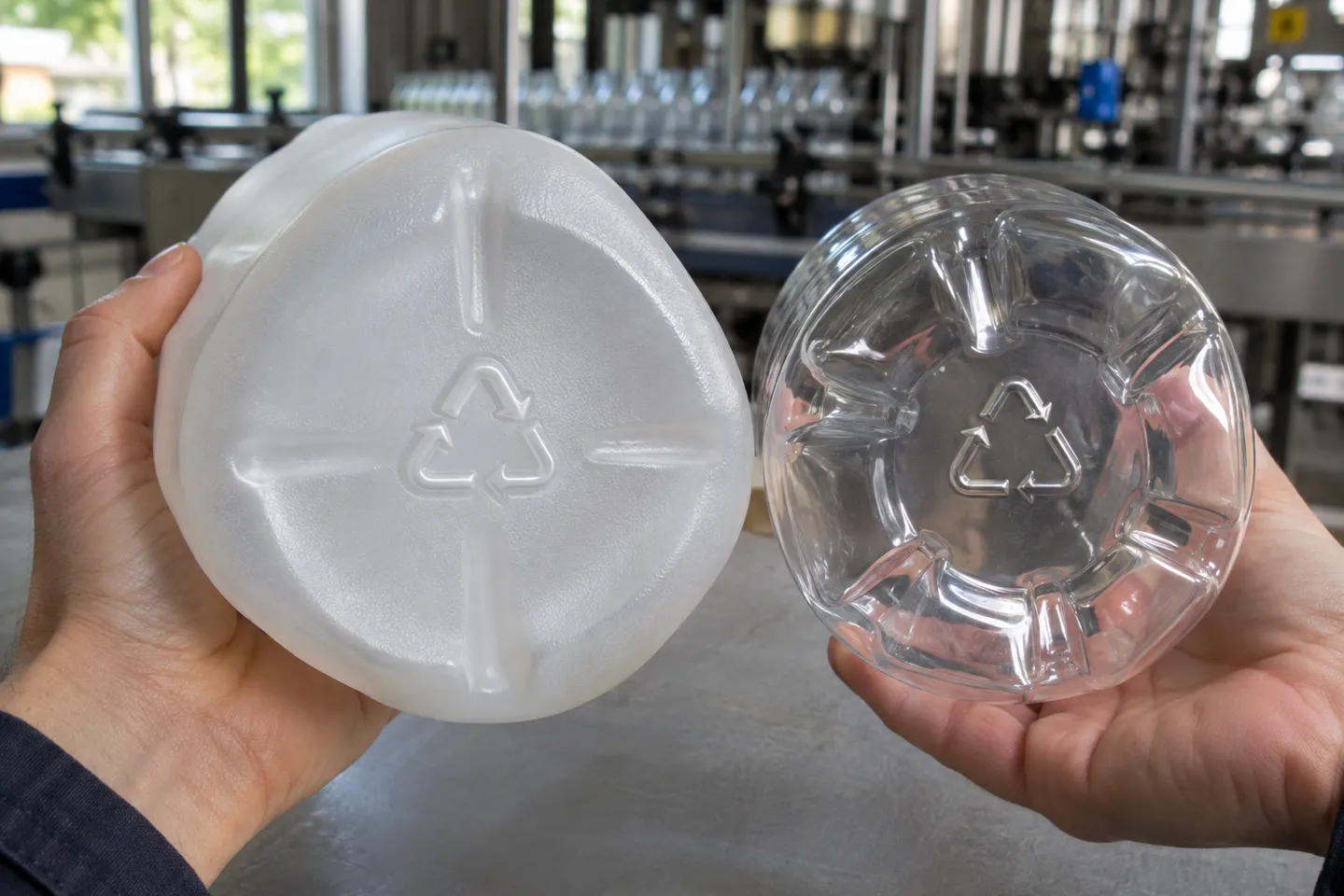
HDPE is high-density polyethylene, resin code 2. PET is polyethylene terephthalate, resin code 1. The codes are molded or printed into most containers, and they are the fastest identification signal on an existing bottle.
Sight and touch do the rest. PET is glass-clear with a glossy surface, which is why it hosts almost every drink on a supermarket shelf. HDPE is cloudy translucent in its natural form, or solid white and black when colored, and it bends a little before it stresses. PET is stiffer and rings harder when tapped.
Their natural habitats follow. Milk jugs, detergent bottles, shampoo and household cleaners are HDPE territory. Water and soda bottles, salad dressing, peanut butter and hand sanitizer live in PET.
Telling HDPE and PET Apart
| Feature | HDPE | PET |
|---|---|---|
| Look | Cloudy translucent or solid colors | Glass-clear and glossy |
| Feel | Slightly flexible, bends before it breaks | Stiffer, shatter-resistant |
| Resin code | 2 | 1 |
| Typical hosts | Milk jugs, detergent, shampoo, cleaners | Water and soda bottles, dressing, peanut butter |
| Recycled at (bottle only, US EPA 2018) | 29.3% natural bottles | 29.1% |
One caution on that little triangle: it is a sorting mark for recyclers, not a food-safety certificate. Regulators ask for considerably more paperwork than a code before a container touches food.
Recyclability is close to a tie. US EPA 2018 figures put PET bottles at 29.1 percent and natural HDPE bottles at 29.3 percent, against 8.7 percent for plastics overall (Container and Packaging, 2025). If a supplier tells you one material “recycles much better” than the other, ask which number and which year they mean.
The Container Material Map
Material is a spectrum, not a coin flip. PET and HDPE are the two most common values on that spectrum, and PP, PLA, rPET and LDPE cover the rest of it. The map below treats each as it actually behaves in production, not as a marketing sheet describes it.
PET: The Clear Front-Runner
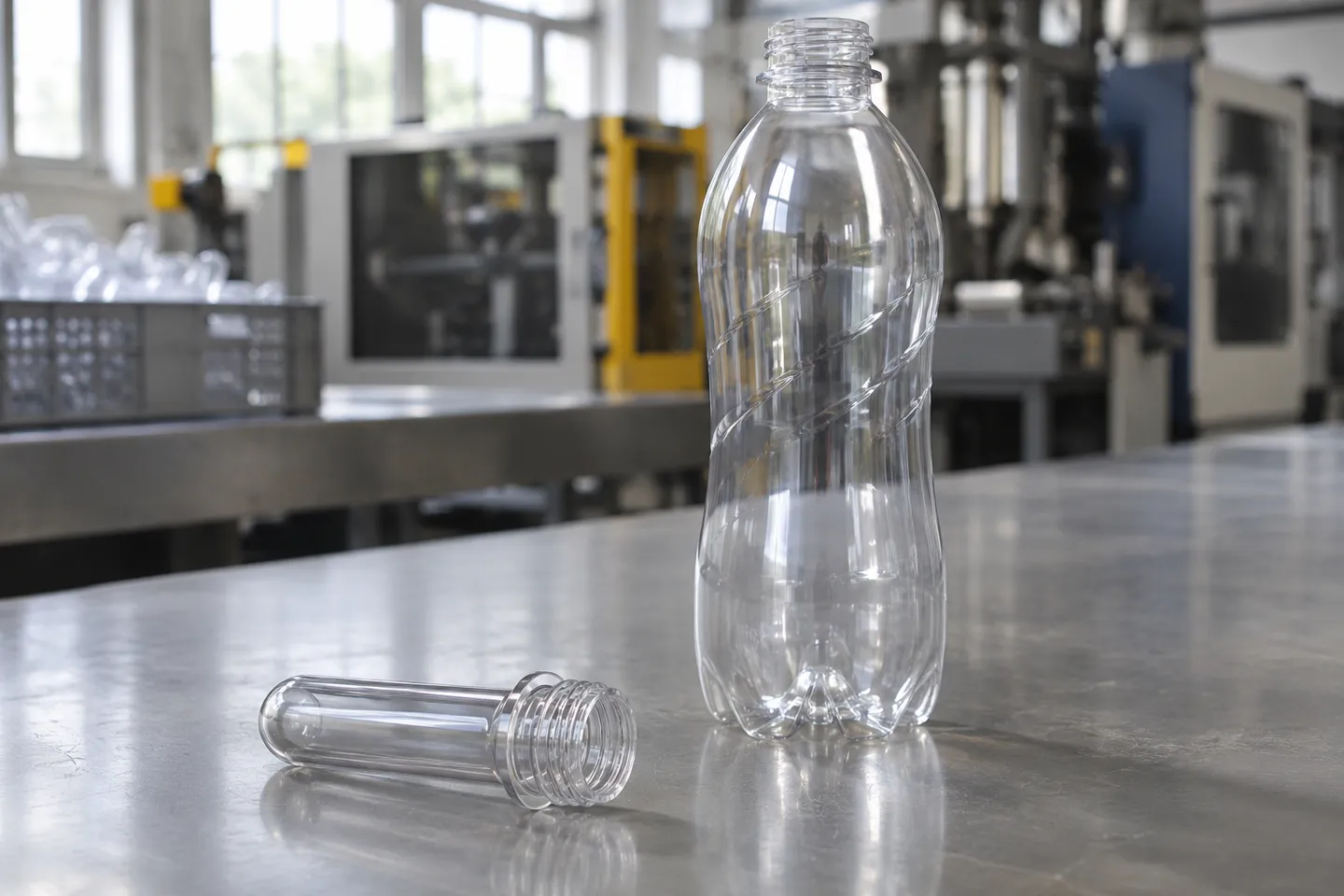
PET earns its volume through three properties at once. Clarity turns the product into the shelf display, which matters for anything a shopper judges by eye. Its oxygen barrier is the strongest of the common bottle plastics, which protects flavor, oils and vitamins. And stretch blow molding orients the material into thin walls, so a finished bottle weighs very little for its size (SIPA).
The boundary is chemistry. PET handles alcohols and mild formulas comfortably, but strong alkaline products wear it down over time. A bathroom-cabinet product is fine; an under-the-sink degreaser is not its job.
HDPE: The Chemical Workhorse
HDPE takes the hits PET cannot. It tolerates a long list of acids, alkalis and alcohols, which is why bleach and detergent brands standardize on it. Its moisture barrier beats PET, its density is lower (0.933 to 0.970 g/cm³ versus PET at 1.33 to 1.45 g/cm³, Ashland Container, 2026), and it survives drops and rough handling better.
Its soft spot is aroma and solvent penetration. Concentrated essential oils and some solvents work into HDPE, causing odor, swelling, or paneling, the slow inward collapse of the bottle wall (Container and Packaging, 2025). Surface treatments such as fluorination exist for solvent-heavy formulas, and suppliers who run them will ask what the formula contains. The operating rule is simple: test the actual formula, not the product category. Two “natural cleaners” with different ingredient lists can behave completely differently in the same bottle.
The Rest of the Map: PP, PLA, rPET, LDPE
PP (polypropylene) tolerates higher heat than either of the two and forms living hinges, which is why flip-top closures and microwaveable containers use it. PLA is plant-based and compostable but rigid-brittle, with poor heat and long-storage behavior. rPET is recycled PET with near-identical properties that can be recycled again. LDPE is the soft squeeze-bottle material when gentle collapse is the feature.
The Container Material Map
| Material | Clarity | Strong at | Watch out for |
|---|---|---|---|
| PET | Glass-clear | oxygen barrier, light weight | Strong alkaline cleaners attack over time |
| HDPE | Milky or solid colors | chemical resistance, moisture barrier, drop strength | Aroma and solvent uptake, paneling |
| PP | Translucent to opaque | heat tolerance, living hinges | Lower clarity for display |
| PLA | Clear | compostable plant-based | Brittle, poor heat and long storage |
| rPET | Clear | recycled content story | Property depends on recycled feedstock quality |
| LDPE | Translucent | soft squeeze feel | Low structure for large formats |
Quick Formula Self-Check
- Strong alkali or bleach points to HDPE.
- Oxygen-sensitive oils, flavors or vitamins point to PET.
- Powders favor HDPE’s moisture barrier, or PET with a genuinely tight closure.
- Anything hot-filled belongs to the heat-set route in the next section.
- If the formula is aromatic or solvent-based, run the paneling test before committing to a pallet.
Barrier, Shelf Life and the Decision Rules
Three barriers decide shelf life: oxygen, moisture and light. Buyers lose the most money on the first one, because oxygen damage is slow and invisible until the reviews arrive.
HDPE can transmit more than ten times as much oxygen as PET at comparable thickness.
That single number is why oils that turn rancid, flavored drinks and oxidation-sensitive vitamins are PET products (Container and Packaging, 2025). Oxygen works slowly, and the damage usually shows up months after launch, right around the reorder decision. A material swap that saved a few cents per unit can then cost a full production run’s reputation.
Moisture runs the other way. HDPE holds water where it belongs, so powders resist clumping and lotions resist drying out. Light is the third axis: white HDPE blocks more light than clear PET, but neither material was designed as a sunscreen, so genuinely photosensitive formulas need purpose-made packaging (Container and Packaging, 2025).
The Oxygen Gap
HDPE lets through more than ten times as much oxygen as PET. If the product can oxidize, the bottle material is a shelf-life decision, not a style decision.
Watch for guides that hand all three barrier wins to one material. Some comparison pages claim PET is excellent against moisture, gas and light all at once, or flip the oxygen direction entirely. The measured direction is consistent: PET for oxygen, HDPE for moisture. When one article gives everything to one side, check the original source before building a spec around it.
Decision Rules by Product Type
| Product type | Material lean | Why |
|---|---|---|
| Oily or flavor-sensitive foods and drinks | PET | Oxygen barrier protects taste and prevents rancidity |
| Powders and dry goods | HDPE, or PET with tight closure | Moisture barrier prevents clumping |
| Detergents, bleach, strong cleaners | HDPE | Alkali tolerance |
| Sanitizers and alcohol-based formulas | PET | Handles alcohols, stays clear |
| Supplements and pharmaceuticals | PET | Barrier plus batch documentation trail |
| Premium shelf display | PET | Glass-like clarity at plastic weight |
| Hot-fill sauces and syrups | Heat-set PET route | Standard PET warps at fill temperature |
Two newer factors now sit in most purchase meetings. First, recycled content: PET accepts high PCR percentages, up to 100 percent in some applications, while staying clear, whereas HDPE color consistency becomes difficult above roughly 50 percent recycled content (Ashland Container, 2026). Second, the carbon ledger. A typical PET soda bottle carries less than half the greenhouse gas footprint of an aluminum can, and about a fifth of a glass bottle (Positively PET, 2026). Brands under sustainability pressure therefore tend to land on a PET-plus-rPET route rather than a material switch.
Microplastics deserve a calm word. A consumer-facing scoring database rates PET bottles as high microplastic release and HDPE as moderate (MicroPlastics, 2026). Food safety authorities, meanwhile, continue to approve PET for food contact, and their position is that detecting particles is not the same as demonstrating harm (Positively PET, 2026). The practical buying stance: keep consumer claims and regulatory claims in separate drawers, ask suppliers for migration test reports, and do not switch materials on a single headline metric, because switching shifts impacts rather than removing them.
If the decision rules above have named your material route, send the formula and the route to OUTSTANDING, and our quotation will answer each requirement line by line.
Temperature Routes and Failure Boundaries
Heat and logistics break more bulk orders than chemistry does. The same bottle that behaves perfectly in a warehouse can arrive from a summer container as a shrunken, wavy pallet. So the route comes first: how the product is filled, where it will be stored, and how it will travel.
Three Temperature Routes Before You Order
The room-temperature and chilled route is the default. Published material ranges put PET at roughly -40 to 70°C and HDPE at -50 to 80°C (Ashland Container, 2026). Individual manufacturer spec sheets are often tighter; PET can pages commonly state -30 to 60°C. Treat the supplier’s own sheet as the real window, because wall design and closure both move it.
The hot-fill route is where standard PET fails loudly. Standard PET softens at fill temperature and can warp or shrink as it cools, and heat-set PET is the purpose-built grade for hot sauces, syrups and balms (Container and Packaging, 2025). HDPE heat tolerance varies bottle by bottle, so the fill temperature needs to be stated in the order, not assumed.
The frozen route is quieter but real. Both materials survive cold; the risks are liquid expansion during freezing and closure sealing at low temperature, both testable with a small sample batch.
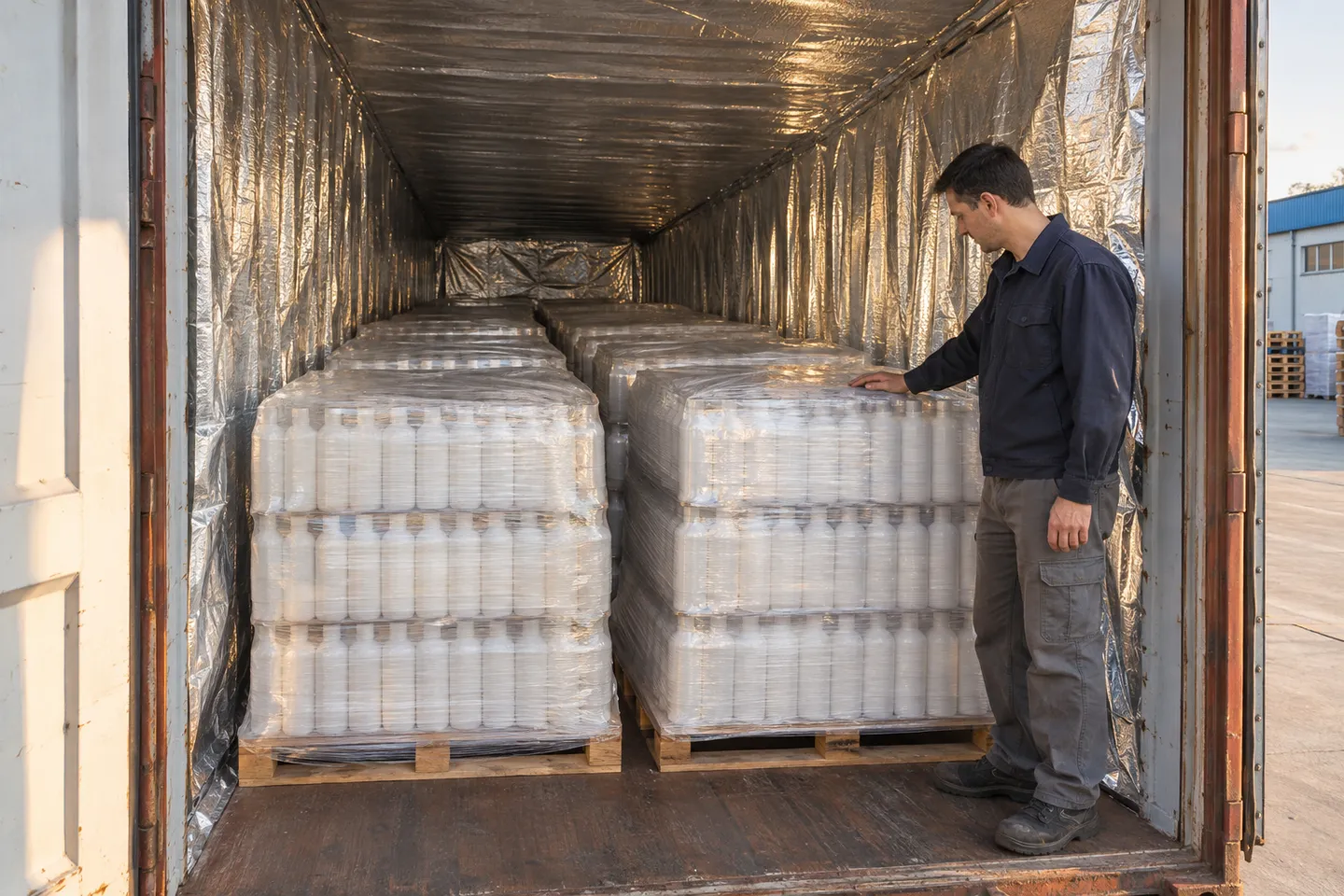
Ocean freight deserves its own line. Containers on summer routes run far above ambient warehouse temperatures, and standard-grade bottles have arrived as visibly deformed pallets often enough that experienced suppliers pack against it, with thermal liners and stowage choices. Ask for the sea-freight protection plan as part of the quote. A supplier who has an answer ready has shipped before.
Impact is the last boundary. HDPE handles drops and rough distribution better; PET has strong tensile strength but can be brittle under sharp impact (Ashland Container, 2026). One detail matters here: an empty-bottle drop test and a filled-bottle drop test are different exams. Acceptance should reference the filled condition, with the actual product inside.
All of this traces back to process. PET bottles are light because stretch blow molding stretches and thins the wall; HDPE bottles are heavier because extrusion blow molding runs thicker walls. That single manufacturing difference explains the weight, the impact behavior, and half of the cost story in the next section.
Hot filling into standard PET warps the batch. Confirm the heat-set grade and your fill temperature in writing before the order, not after the pallet arrives.
The Failure Matrix: What Breaks, What to Confirm First
Every boundary above becomes actionable in one table. The right-hand column is written as buyer actions on purpose: each one can be copied into a request for quotation as-is.
Failure Matrix: Scenario by Material Route
| Scenario | Material route | Failure boundary | Confirm first |
|---|---|---|---|
| Hot-fill sauces and syrups | Heat-set PET, or confirmed HDPE grade | Standard PET warps and shrinks on cooling | Supplier’s measured temperature window vs your fill temperature |
| Oily or flavor products | PET | HDPE oxygen transmission shortens shelf life | Oxygen barrier claim and shelf-life test data |
| Powders and dry goods | HDPE, or PET with tight closure | Clumping from moisture ingress | Moisture barrier claim and closure seal method |
| Essential oils and aromatics | Fluorinated HDPE, or alternate material | Paneling, odor and swelling | Two-week real-formula paneling test |
| Strong alkaline cleaners | HDPE | PET degrades over time | Formula pH against the material compatibility chart |
| Export by sea | Any grade plus protection plan | Container heat deforms standard grades | Sea-freight protection plan and packing spec |
Used properly, the matrix ends the “which plastic is better” argument in a purchasing meeting. The question changes from an opinion to a checklist, and the supplier who answers the right-hand column fastest has usually earned the trial order.
What the Material Actually Costs
Material cost arguments usually fail because each side quotes a different line of the bill. There are three lines, and they point in opposite directions.
Resin price favors PET in recent published ranges. HDPE sits at roughly $1.20 to $1.80 per pound against PET at $0.80 to $1.50 per pound, and both swing on oil prices and regional demand (Ashland Container, 2026). Process-side estimates agree on direction, putting HDPE raw material 15 to 20 percent above PET (SIPA). The folk claim that HDPE is the cheaper plastic dates from other market periods; any resin number quoted without a date is decoration.
Unit weight reverses the story. Because PET bottles stretch into thin walls, the same volume weighs less: a 5-liter container weighs about 200 g in HDPE against 85 to 115 g in PET (SIPA). Freight bills follow weight and cube, so for anything shipped far, PET’s weight advantage is a standing discount.
Processing swings back toward HDPE: simpler tooling and shorter cycle times, particularly for opaque containers (Ashland Container, 2026). Its per-unit production cost runs lower even as its resin costs more.
The Three Cost Lines
| Cost line | Which way it points | What it means for the buyer |
|---|---|---|
| Resin price per pound | PET lower in recent published ranges | Quote with a date; prices move with oil |
| Unit weight per volume | PET lighter (85-115 g vs 200 g at 5 L) | Freight savings grow with distance |
| Tooling and cycle time | HDPE simpler and faster | Lower per-unit processing cost at volume |
The bill a buyer actually pays is the sum: resin price multiplied by unit weight, plus processing, plus freight. That is why “which material is cheaper” has no answer that survives across products and shipping lanes. It is also why a serious supplier quote breaks those lines out separately instead of offering one blended number.
From Material Choice to Supplier Checklist
Everything above compresses into four steps, run in order. Skipping the order is how buyers end up negotiating price on a bottle that cannot hold their product.
Step one is defining the formula honestly: what it attacks, what it loses, and how hot it is when filled. The material map and the barrier rules cover this, and they depend only on the product, not on any supplier.
Step two is choosing the material route from the decision table. Most products land quickly once the formula is written down; the holdouts are aroma-heavy and hot-fill products, which is exactly what the failure matrix exists for.
Step three turns the choice into parameters: a measured temperature window, an oxygen and moisture claim for the shelf life you need, a filled-bottle drop standard, the neck finish and closure compatibility, and the sea-freight protection plan. These six items go into the request for quotation as requirements, with the failure matrix’s right-hand column as the source text.
Step four is documents and samples. Batch-level compliance files, food-contact certificates and third-party test reports are not formalities. They are the fastest filter for supplier quality that a buyer has. A factory that tests every batch can produce paperwork on request. One that does not will stall right here.
The honest commercial summary, built only from the evidence above, is this. For display products, oxygen-sensitive formulas, weight-sensitive freight and ocean shipping, the advantages stack on the PET side of this comparison. For strong alkaline or solvent-heavy formulas, the right move is an HDPE specialist bottle, not a compromise, and a good PET supplier will say so. Material fit should never bend to supplier convenience.
One pilot rule closes the loop: real formula, real closure, a two-week shelf test, and a filled drop before the first bulk order. Every table in this article predicts; the pilot confirms.
The Six-Line Supplier Checklist
- 1Measured service temperature window, matched to your fill temperature.
- 2Oxygen and moisture barrier claims, tied to shelf-life data.
- 3Filled-bottle drop test standard, not empty-bottle.
- 4Neck finish specification and closure compatibility.
- 5Batch-level food-contact documentation (FDA, EU 10/2011, third-party reports).
- 6Sea-freight protection plan in the written quote.
This is also where the supplier conversation starts on our side. We are OUTSTANDING, a PET packaging manufacturer producing cans, jars, bottles and preforms, and the checklist above is the same one our own quotations are built to answer: certification documentation covering ISO 9001, FDA and EU 10/2011 with SGS-type batch testing is provided per order, and every batch is checked for transparency, color, melt index and moisture before production. Send the formula and the six requirements, and our reply will be line-by-line.
Get a Line-by-Line Reply on Your Next Bottle Order
PET bottles, jars and cans from OUTSTANDING, with certification documents and batch testing provided per order.
Start Your Packaging QuoteReferences
- Container and Packaging. “HDPE vs. PET Bottles: Differences and How to Choose.” 2025 (updated 2026). https://www.containerandpackaging.com/resources/choose-hdpe-vs-pet-bottles/
- Ashland Container. “HDPE vs. PET: Which Plastic Bottle Is Right for You?” 2026. https://ashlandcontainer.com/blog/hdpe-vs-pet-plastic
- SIPA. “PET Bottle Packaging: Costs vs Glass, HDPE and Cans.” https://sipasolutions.com/blog/pet-bottles-vs-glass-and-cans-costs-and-benefits-working-pet
- Positively PET (NAPCOR). “What We Know and Don’t Know About Microplastics and PET Bottles.” 2026. https://positivelypet.org/blog/microplastics-pet-bottles-what-science-says/
- MicroPlastics. “HDPE bottle or jug & Microplastics: Moderate release.” 2026. https://microplasticsapp.com/packaging/hdpe-bottle