What Straw Sizes Actually Mean
A customer pays for a 16 oz milk tea, takes two sips, and the pearls jam halfway up the straw. Nothing is wrong with the tea, the ice ratio, or the recipe. The shop simply served the drink with a 6 mm standard straw when the pearls inside it were bred to pass through a 12 mm bore. One number was off, and the whole drink turned into work.
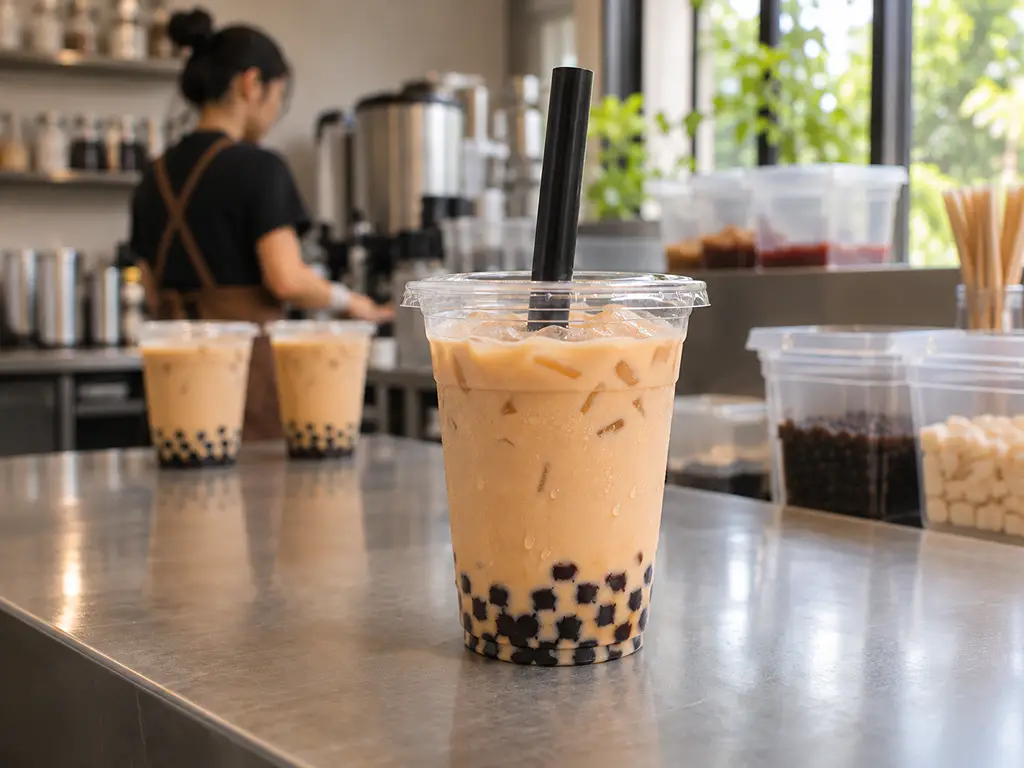
Before going further, one quick distinction: this guide is about drinking straws only. The word “straw” also names the stalks grain plants leave after harvest, and some tableware brands borrow it for wheat-straw plates and cups. Those live in a different aisle. Here, straw means the tube between the cup and the customer.
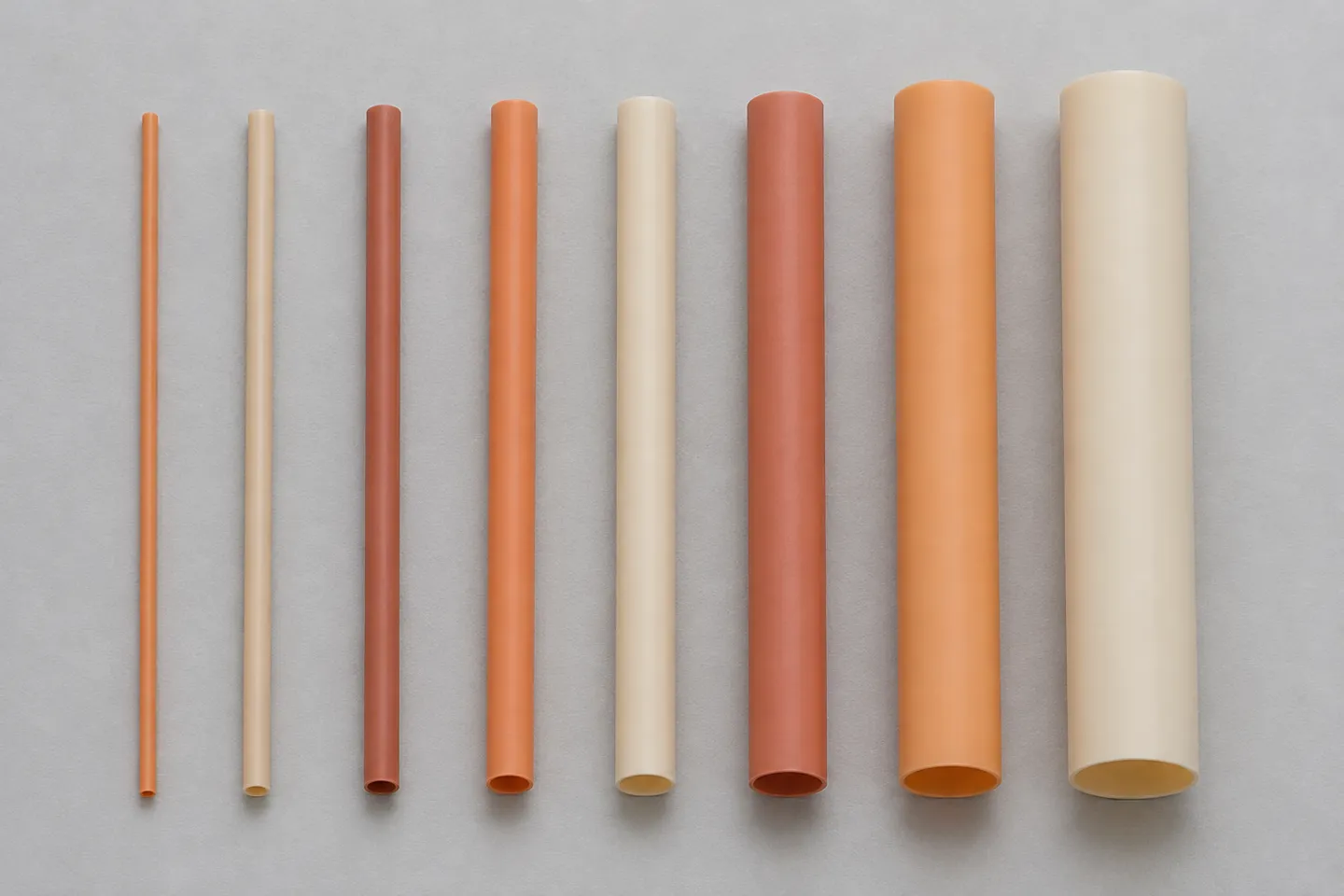
The names printed on supplier pages (cocktail, jumbo, giant, smoothie, boba, colossal) are foodservice habits, not values set by a standards body. Wholesalers label sizes based on what restaurants ask for at the counter, so the same word can drift a millimeter or two between catalogs. That drift is why the number on the box matters more than the name on the flyer, a point that returns in the buying section below.
Drinking Straw Sizes at a Glance
| Level | Typical diameter | Typical drinks |
|---|---|---|
| Cocktail | ~3 mm | mixed drinks, tasters, kids’ drinks |
| Standard | ~5-6 mm | water, soda, iced tea, juice |
| Jumbo | ~6-7 mm | soda, slush bases |
| Super jumbo | ~7-8 mm | thicker sodas, milk-based fountain drinks |
| Giant | ~9-10 mm | light milkshakes, smoothies |
| Smoothie | ~10 mm | smoothies, thick shakes |
| Boba | 10-13 mm | bubble tea with pearls or popping boba |
| Colossal | 14 mm+ | loaded shakes and novelty drinks |
Two numbers anchor the whole ladder. A standard straw measures about 6 mm across, roughly 0.24 inches, and runs about 7.5 to 8 inches (19-20 cm) long. Every wider bore exists because something solid rides inside the drink, and every longer straw exists because the cup it serves is taller.
Reading the ladder is the easy half. The decision that costs money happens next: which rung does your drink actually need?
Matching Straw Size to Drink, Cup and Seal
A straw order has three inputs: the topping, the cup, and the seal. Hand those three to a supplier and the straw size falls out of the conversation. Skip one, and you are guessing on a per-carton budget.
Straw Size Matching Matrix by Drink Type
| Drink type | Recommended bore | Length | Cut / tip | Where it fails |
|---|---|---|---|---|
| Soda, iced tea, juice | 5-6 mm | 7.5-8 in | flat | bore is too tight for any shake or topping |
| Milkshake, smoothie | 9-10 mm | 8-10 in | flat | thick mix stalls in a 6 mm bore |
| Classic pearl milk tea | 10-12 mm | 9-10.5 in (21 cm on Taiwan-spec cups) | angled for sealed film, flat for lid hole | pearls larger than the bore jam mid-sip |
| Popping boba and fruit drinks | 10 mm | 8.5-9 in | flat or angled | 9.5-10 mm pearls leave almost no margin in a 10 mm straw |
| Jelly and irregular toppings | 12 mm and up | 9-10.5 in | wide flat | irregular pieces snag on angled tips |
| Hot coffee or tea in lid cups | 5-6 mm PP | 7 in | flat | paper softens, PLA warps above 60°C |
Let the Topping Set the Diameter
Commercial tapioca pearls typically run 8-12 mm, which is why catalogs put the boba straw between 10 and 13 mm. Popping boba runs smaller, around 9.5-10 mm, and that creates the tightest margin on the menu. Poured against a 10 mm straw, a 10 mm pearl has nothing left to spare (Karat catalog data via boba.guide, 2026). Jelly pieces are worse than pearls in one way: their irregular shapes catch on angled tips, where a smooth sphere would slide through.
The working rule is simple. Give the bore roughly 2 mm more than your largest topping, then test with the actual topping, not the catalog promise. When the margin is too thin, suction has to push each pearl through a gap barely wider than the pearl itself, flow stalls, and the straw clogs in the middle of the drink. That is the exact failure home cooks describe when pearls “only go through certain straws.”
The two working rules
+2 mm
of bore margin over your largest topping
1-2 in
of straw standing above the lid line
Cup Height Sets Length; Seal Type Sets the Cut
Length has a physical test instead of a magic number: the straw must reach the bottom of the cup and still stand 1-2 inches above the lid. A 16 oz cup holds about 500 ml with a 90-95 mm opening, the standard format for milk tea, and it takes a 9-inch straw to do both jobs. Taiwan-spec cups are shorter and wider and take a 21 cm straw; US-spec cups run taller and thinner and take 9 inches. Measure your cup once, write the length down, and stop ordering by feel.
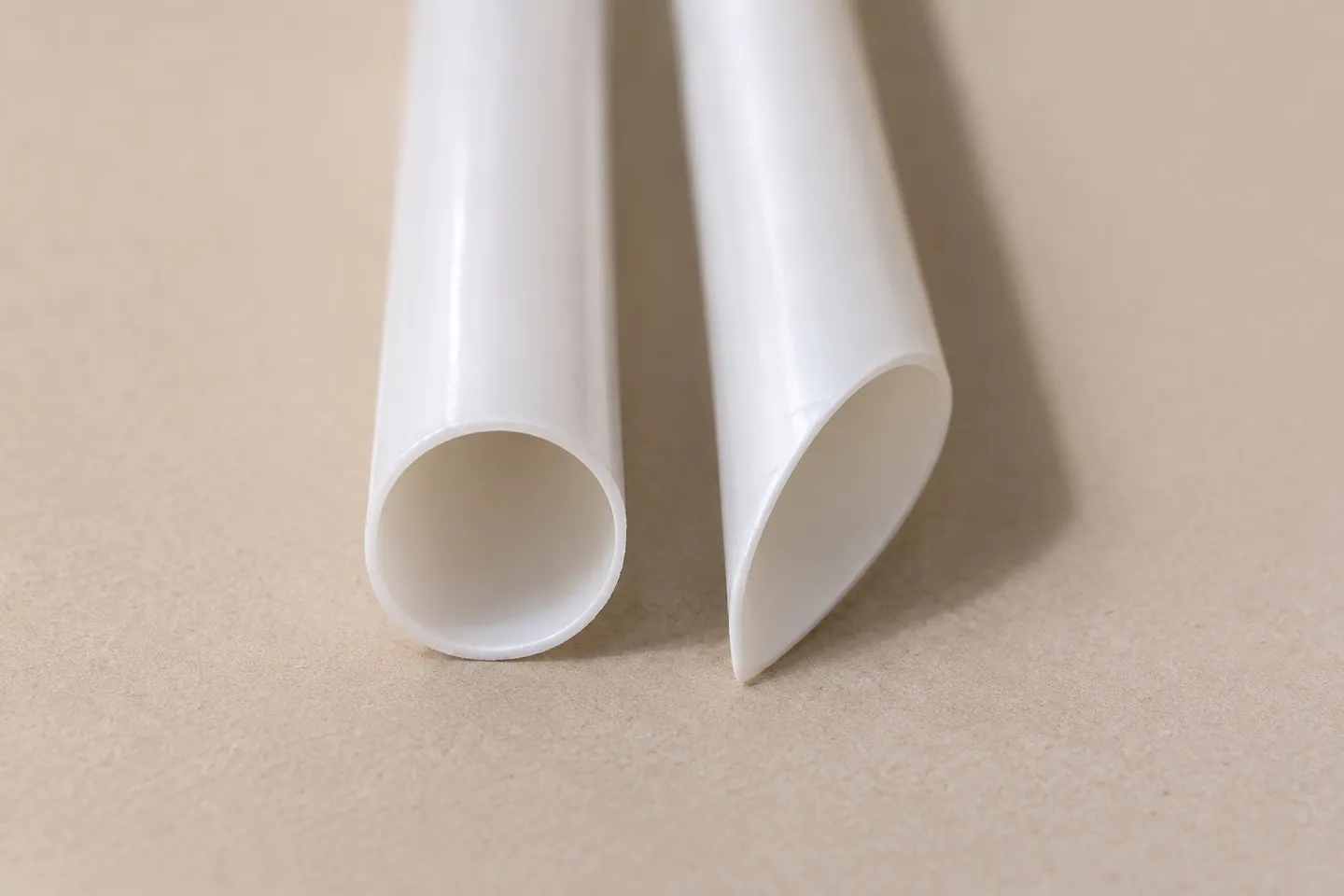
The cut is decided by the seal, not by the drink. Sealed film cups need an angled tip, because the point is what pierces the film. Cups with a straw-hole lid, like the screw-on lids used across takeaway milk tea, need a flat cut. An angled tip chews the hole edge, leaves plastic shavings in the first sip, and can scratch a lip on the way past. Change the seal and the same straw flips from an asset to a complaint generator.
One more number belongs in this decision: the carton. Karat’s 9-inch boba straw listed at $39.75 per 1,600 wrapped pieces, about 2.48 cents each, against $28.50 per 1,600 unwrapped, about 1.78 cents, in August 2026 pricing (Karat catalog pricing via boba.guide, 2026). A shop pouring 100 cups a day empties a 1,600-piece carton in about 16 days.
Carton math at a glance: 1,600 pieces per carton, 100 drinks a day = one carton every 16 days. Individually wrapped costs about 0.7 cents more per piece, roughly $11 more per carton, which is the price of hygiene for delivery and takeaway orders.
Paper vs PLA: Where Eco Straws Break
Single-use plastic rules keep spreading, so sooner or later the drink menu changes material. The trap is that the matching rules from the last section do not change with it. The bore still has to clear the pearls and the cut still has to match the seal, while the new material brings failure modes of its own.
Where Paper Straws Fail
Paper fails first at the seal. Without the wall stiffness of plastic, a paper tip often folds against a sealed film instead of piercing it. The failure is common enough that one video of it pulled more than 140 comments (r/mildlyinfuriating thread on paper straws failing to pierce, 2026). Paper fails second in the drink: steeped in milk tea for twenty minutes, it softens until the customer is chewing the straw instead of the pearls.
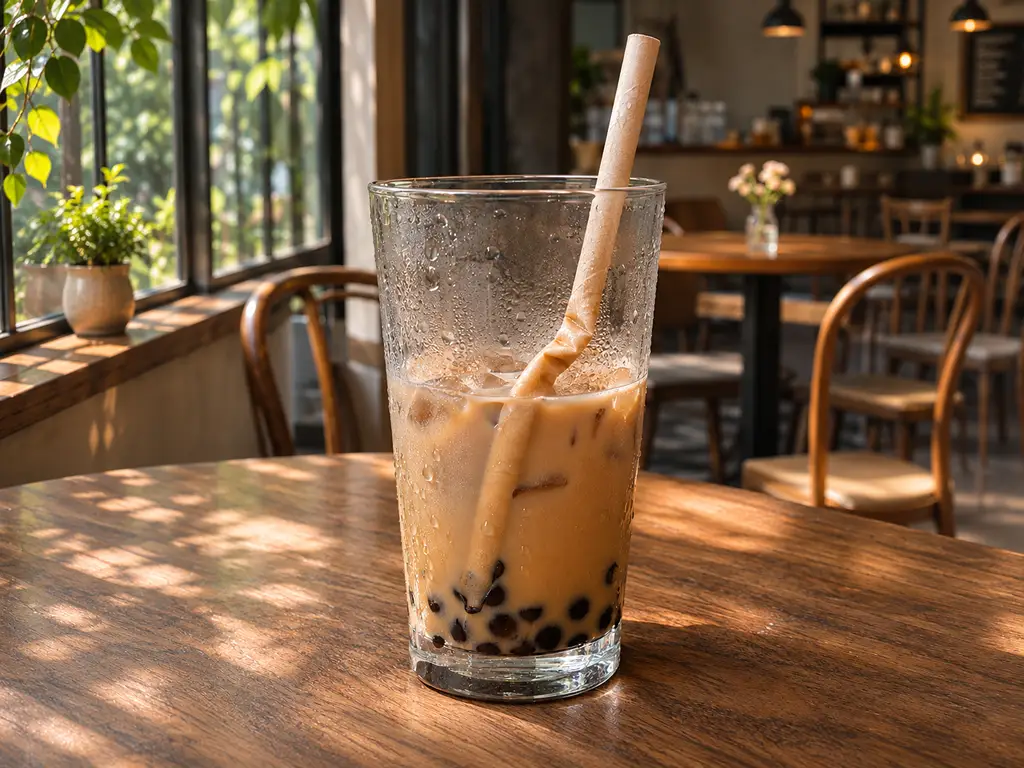
The third failure is quieter and costs the most. Some shop owners respond to narrower paper straws by switching to smaller pearls, rather than sourcing a wider straw (r/boba thread on shops downsizing pearls for paper straws, 2023). The material change silently rewrote the topping spec.
The topping sets the diameter. The straw must clear the pearls, not the other way around.
PLA Works Cold, Not Hot
PLA, the plant-based plastic most eco lines use, carries a heat ceiling around 60°C in typical commercial ratings (standard commercial PLA straw ratings run -30°C to 60°C). Cold drinks sit comfortably inside that range. Hot coffee does not: brewed coffee leaves the machine at roughly 85-90°C, well past the ceiling, and the straw warps in the cup. For hot menus, the answer is PP or paper for the hot line, not PLA.
Material swaps also deserve one chemical check. In 2023 a University of Antwerp team tested 39 straw brands across five materials and found PFAS in most of the paper and bamboo straws, while stainless steel showed none (Boisacq et al., Food Additives & Contaminants, 2023). The study itself notes straws are a minor exposure route, so the takeaway is not panic. It is verification: ask for the food-contact report, the same way you would ask for a temp rating.
Paper vs PLA on the Drink Menu
| Check | Paper | PLA |
|---|---|---|
| Cold drinks | works | works |
| Hot drinks above 60°C | softens quickly | warps |
| Piercing sealed film | often fails | rigid enough to pierce |
| Long soak in sweet tea | goes soft mid-drink | holds shape |
| Feel on the teeth | mushy when soaked | firm |
| What to ask for | food-contact report, PFAS statement | food-contact report, temp rating |
Before any eco switch, run three checks: drop your largest topping through a sample straw, confirm your hottest menu item against the material’s temp rating, and request the food-contact report before signing the order.
The shops that navigate this well treat the eco switch as a re-matching exercise, not a like-for-like swap. The shops that struggle picked a material from a label and let the pearls, the seal, and the temperature absorb the difference.
Locking the Spec: How to Buy Straws for a Drink Business
Most straw failures happen at restock, not at first order. The first batch arrives at 12 mm, the replacement lands at 10 mm, and suddenly every pearl drink clogs. Four steps close that gap for good.
Step 1: Write the four fields. Put internal diameter in mm, length in mm, material, and cut type on one line, and order against that line, not against a product name. The names are exactly why this step exists: the same “boba straw” is 10 mm × 9 inches in US catalogs and 12 mm × 21 cm in Taiwan catalogs. Numbers survive translation; names do not. Specify internal diameter, because wall thickness of about a millimeter means an outer-diameter spec overstates what pearls actually get.
Same straw, two catalogs. Numbers survive translation; names do not.
US catalog
10 mm × 9 in
Taiwan catalog
12 mm × 21 cm
Step 2: Run the carton math. At 100 drinks a day, a 1,600-piece carton lasts about 16 days, so per-carton differences are real money over a quarter. Wrapped pieces cost about 0.7 cents more each, about $11 more per carton; for a takeaway-heavy shop, wrapped wins on hygiene alone, and for a dine-in shop, bulk is fine.
Step 3: Accept on three parameters. Test topping pass-through with your largest pearl, match the hottest menu item against the material’s temp rating, and collect the food-contact certification (FDA and EU 10/2011 are the two most requested). Certification outranks the eco label on the box, because the label describes intent while the parameters describe behavior.
Step 4: Buy the set together. Straws, cups, lids, and the sealing method form one system with one failure surface. A supplier who can cover the whole set, from 350 ml-1 L cups to 90-95 mm straw-hole lids to sealing machines, removes the four-way finger-pointing that happens when each part comes from a different vendor.
Straw spec checklist
- Internal diameter in mm (not outer)
- Length in mm, tested against the cup
- Material with temp rating
- Cut type matched to seal (angled for film, flat for lid hole)
- Food-contact certification on file
- MOQ and carton count confirmed in writing
When you are ready to price a spec instead of a product name, Outstanding quotes against exactly these fields. We hold straw MOQs at 10,000 pieces per carton (10,000 pcs/CTN), take light customization like logo printing and color starting at 1,000 units, and return simple samples within 48 hours. Our straws ship with FDA and EU 10/2011 food-contact documentation, which you can check against our current food-contact certifications, and our custom straw options cover length, diameter and color within the standard 180-200 mm range. Send us your topping size, cup height and seal type, and the quote comes back against those three numbers, not against a name.
If you want to price your approved spec against a real catalog, Outstanding’s straw range covers PLA and paper straws with matching cups and lids.
Price your spec, not a product name
Topping size, cup height, seal type: three numbers in, one quote back, with the FDA and EU 10/2011 paperwork attached.
Get a straw quoteReferences
- boba.guide. “Best Boba Straws: Size, Material & Buying Guide.” 2026. https://boba.guide/best-boba-straws/
- Boisacq, P. et al. “Assessment of poly- and perfluoroalkyl substances (PFAS) in drinking straws.” Food Additives & Contaminants, 2023. https://pubmed.ncbi.nlm.nih.gov/37619405/
- Reddit r/boba. “Small Tapioca Pearls.” 2023. https://www.reddit.com/r/boba/comments/16a46fy/small_tapioca_pearls/
- Reddit r/mildlyinfuriating. “Paper straw that came with the drink won’t pierce.” 2026. https://www.reddit.com/r/mildlyinfuriating/comments/1uq39bk/paper_straw_that_came_with_the_drink_wont_pierce/