
What Is a PET Preform?
The 500 ml water bottle on your desk started life as a clear plastic tube shorter than your finger. That tube is the PET preform: a small, test-tube-shaped piece with a fully finished threaded neck, injection-molded from polyethylene terephthalate (PET) resin. Blow it and you have a bottle. Ship it and you are moving resin in its densest, cheapest form.
Three facts sit inside that definition, and each one matters commercially:
- It is an intermediate, not a finished product. The preform occupies the middle station of a two-stage process. Resin goes in at one end, bottles come out at the other, and the preform is what changes hands between the two stages.
- Its neck is already final. The threads, the sealing rim, and the support ring are molded to finished dimensions. A process that stretches plastic into a bottle wall cannot form a precision thread. The neck gets its accuracy at the injection stage. The cap you buy later locks onto a dimension that was settled before the preform ever left the mold.
- It exists to move resin cheaply. A truckload of preforms carries far more plastic and far less air than a truckload of empty bottles. That is why preforms travel between resin plants, preform molders, and bottle-fillers all over the world.
One clarification before going further. The word “preform” also names products in fiber optics and in composite manufacturing. This article is only about the plastic packaging preform, the kind that becomes beverage bottles, jars, and cans.

How a Preform Becomes a Bottle
The transformation runs on a reheated stretch-blow cycle, in four moves:
Four moves, one bottle
Reheat. The preform passes through infrared heaters and softens to a glass-clear, pliable state.
Stretch. A rod inside the preform extends it lengthwise, aligning PET molecules vertically.
Blow. High-pressure air expands the softened tube against the mold wall, stretching the molecules horizontally.
Cool and eject. The wall sets, the mold opens, and a finished bottle drops out.
The two-directional stretching is not a detail. Aligning the polymer chains vertically and horizontally turns a thin wall into a strong one. That is why a bottle blown from a preform weighing a few grams can hold a liter and survive a shelf. This biaxial orientation is the mechanical reason the two-stage process works at all.

So what separates the preform from the bottle? The preform is small, rigid, and dimensionally final at the neck but nowhere else. The bottle is the blown form that takes up volume and carries the product. Everything a buyer negotiates about a bottle, its capacity, its wall strength, its cap fit, is already written into the preform’s weight and neck.
What you can blow from a preform depends on what the contents demand. Water bottles optimize for minimal weight. Carbonated soft drinks need heavier preforms with base designs that resist internal pressure. Hot-fill juices and teas need materials and wall distribution that tolerate temperature. Wide-mouth jars for food run on large-diameter necks. Pharmaceutical bottles run on small volumes and tight tolerances. Across all of these, the selling points stay constant: the bottles are light, clear, shatter-resistant, and recyclable.
Reading Preform Specs: Weight, Neck Finish, and Material
A preform inquiry comes down to three specifications. Get these three into writing and most downstream disputes disappear.
Preform Weight: The Grams Decide the Bottle
Preform weight is quoted in grams, and it maps directly to the container it can blow. Heavier preform, larger or stronger bottle, higher unit price. Published supplier tables put typical pairings in these ranges (Siddhartha International, 2026):
Typical Preform Weight to Container Pairings
| Bottle capacity | Typical preform weight | Common application |
|---|---|---|
| 200-250 ml | 8-12 g | Pharmaceutical bottles |
| 500 ml | 12-18 g | Drinking water bottles |
| 1 liter | 20-28 g | Edible oil and beverages |
| 2 liters | 32-40 g | Carbonated soft drinks |
| 5 liters | 55-70 g | Bulk water containers |
The ranges are typical, and actual weights vary with bottle design, base thickness, and pressure resistance requirements, as the same table notes. What matters for procurement is not memorizing the ranges. It is demanding a written weight tolerance. A preform specified at 14 g with no stated tolerance can arrive at 13.2 or 14.8, and both will blow differently. Underweight preforms on a carbonated line risk thin walls and burst bottles; overweight preforms quietly raise the cost of every bottle you blow.
Neck Finishes: The Interface That Locks Your Cap
The neck finish is the standardized geometry at the top of the preform, and the industry runs on a short list of them. Distributor catalogs list the tamper-evident beverage family first: 28 mm PCO 1810, 28 mm PCO 1816, and their shorter, lighter successor, 28 mm PCO 1881. Alongside them sit water standards like 28 mm Alaska, dairy sizes around 30 mm, wide 38 mm juice necks, and jar necks of 48 mm and up. Continuous-thread finishes in the 28-400, 28-410, and 28-415 family serve non-beverage closures (K.G. International, 2025):
Common Neck Finishes and Where They Fit
| Neck finish | Family | Typical fit |
|---|---|---|
| 28 mm PCO 1881 | Tamper-evident, short neck | CSD and water bottles, lighter closures |
| 28 mm PCO 1810 / 1816 | Tamper-evident, long neck | Older CSD and water lines, taller closures |
| 28 mm Alaska | Water standard | Mineral water, short caps |
| 30 mm | Dairy | Milk bottles |
| 38 mm (3-start) | Wide neck | Juices and dairy drinks |
| 46-63 mm | Jar necks | Food jars, pickles, candy |
| 28-400 / 410 / 415 | Continuous thread | Non-beverage closures |
The PCO 1881 deserves a procurement note. It is the short-neck version of the 1810 and 1816 family, and the shorter neck trims resin from every bottle on the line. That lightweighting direction is now the default for new beverage projects (K.G. International, 2025).
Here is the boundary that bites: a neck finish that is one standard off from your cap is a sealing failure factory. The checkable action is simple. Before approving a preform, match its neck drawing against your cap supplier’s drawing, then trial-cap samples on receipt.
Material: Virgin, rPET, and Modified PET
Virgin PET is the baseline: maximum clarity, established food-contact compliance, predictable processing. Mechanically recycled rPET is the fast-growing option, and regulation is now writing the procurement spec for you. California’s AB 793 requires plastic beverage containers to contain at least 15% postconsumer recycled plastic from 2022, 25% from January 1, 2025, and 50% by 2030 (CalRecycle, 2025). If you sell into regulated markets, ask for the recycled-content percentage and its traceability documentation together; a percentage without documentation is a compliance risk, not a feature.
Between virgin and recycled sits a third family: modified PET with UV blockers, oxygen barriers, or color. It solves specific content problems, such as protecting light-sensitive vitamins. Give it a one-line mention in any inquiry so suppliers quote the right resin.
OutstandingPack quotes come with the resin declaration and drying records attached.
Request a Documented QuoteWhat Goes Wrong: Defects, Drying, and Incoming Checks
Almost every preform-related field failure traces back to one of three layers: the preform itself, the blow-molding step, or the logistics chain. The skill worth building is assigning the fault to the right layer before deciding what to fix.
The Drying Baseline
PET is hygroscopic. Mold it with moisture still in the resin and hydrolysis cuts the polymer chains, which shows up later as brittleness, haze, yellowing, and bottles that fail drop tests. This is why serious preform producers publish a drying window and hold to it. One major preform exporter publishes its drying window as follows: dry at 140-180°C, with 160-175°C recommended, for 4 to 6 hours. Hold the dew point at -40°C or lower and residual moisture at 0.005% (50 ppm) or less, with hot-air flow around 1.85 m³/kg·h (Outstanding preform specification page, 2025). Those five numbers are not trivia. They are the acceptance line you can demand in writing from any supplier.
Drying parameters are the first thing to request and the first thing missing from cheap quotes. No drying record means no process control, and no process control means defects that will be blamed on your blowing line.
Defects and Where the Fault Actually Sits
The most studied injection defect in preform molding is shrinkage around the gate, but the defects that reach your warehouse arrive with confusing symptoms. The matrix below assigns each common symptom to its usual layer and the check that settles it.
Defect and Risk Matrix: Attribution and Checks
| Symptom | Usual layer | Check that settles it |
|---|---|---|
| Haze or yellowing | Preform side: wet resin or poor drying | Request drying records and resin declaration for the batch |
| Uneven wall thickness after blowing | Often blamed on the blow molder, rooted in preform weight tolerance | Get the written weight tolerance and sample-weigh preforms on receipt |
| Neck sealing failures | Preform side: neck flatness or thread tolerance | Check mouth flatness and trial-cap samples before release |
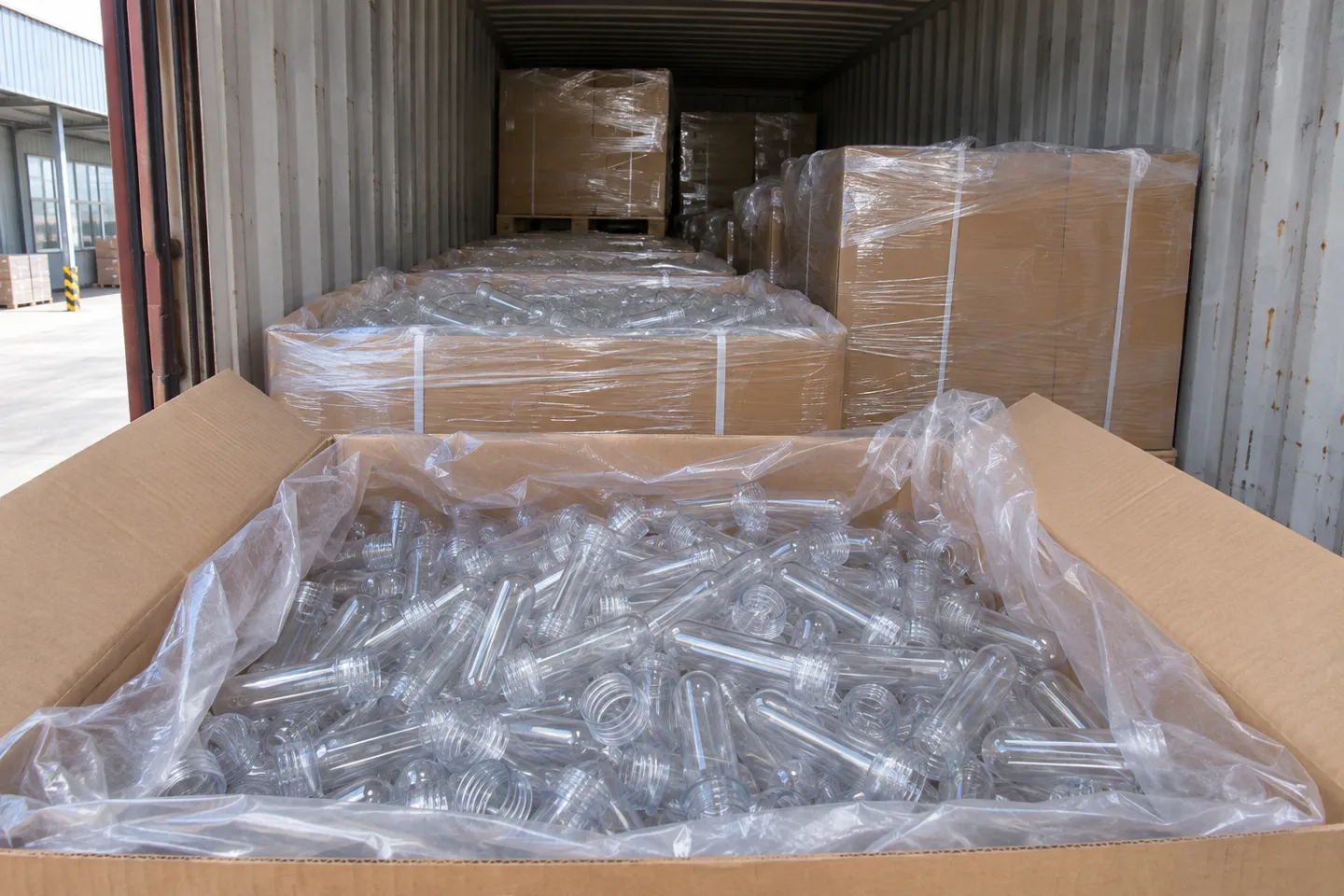
| Bottles deformed on arrival | Logistics: container heat in transit | Put insulation wrap and packing standards into the shipping clause |
That third row saves real money. Wall distribution problems get misdiagnosed as blowing problems so often that experienced molders warn each other about it in trade groups. The resolution is always the same: weigh the preforms before touching the blow-molder settings.
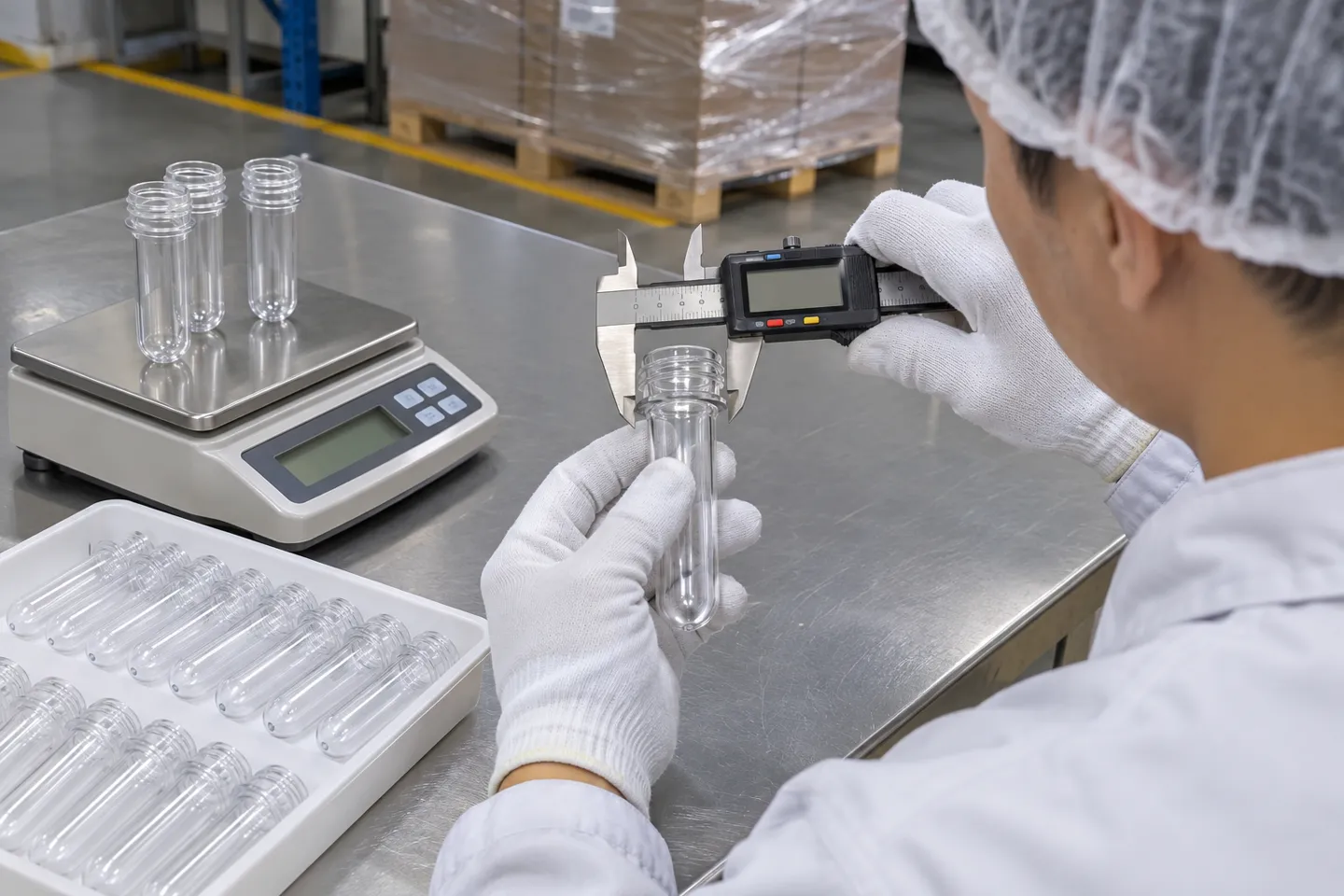
An Incoming Check Sequence You Can Run
A workable receiving check takes four moves.
Weigh. Sample preforms against the written gram weight.
Measure. Sample necks against the finish drawing.
Trial-seal. Cap samples with the intended closure and look for leakers.
Retain and test. Keep sealed batch samples and agree a testing cadence with the supplier, ideally third-party lab reports on appearance, dimensions, and seal integrity.
The Buying Economics: Pricing, MOQ, and Make or Buy
Preform pricing has one mechanic that surprises first-time buyers. Preforms are priced by the thousand, and the quote moves with the global PET resin price. Resin is the dominant cost input (K.G. International, 2025). Weight is the first variable of unit price: a 40 g preform carries roughly twice the resin of a 20 g one.
The same preform is quoted by the thousand, and the quote moves with the global PET resin price. A locked unit price without a resin clause is a bet on the resin market, not a deal.
Price mechanism
quote = weight in grams x resin price per kg + conversion margin
Quoted per thousand pieces, repriced as the resin index moves.
Sampling and volume terms follow the same logic of customization depth. Light customization, meaning printing or logo marking on existing molds, is commonly quoted with sampling in about 48 hours and minimum orders near 1,000 pieces by export preform suppliers. Heavy customization means a new mold or a non-standard neck. It moves sampling to around 15 days and minimum orders into the tens of thousands, and it adds a mold fee that suppliers and buyers typically share. These are published terms from export suppliers, and they are negotiable starting points, not laws. For import planning, add the customs line to your worksheet: US rulings classify plastic bottle preforms under HTS 3923.30, inside international heading 3923 for plastic packing goods (U.S. Customs and Border Protection, ruling NY 889149).
How you buy matters as much as what you pay. Three routes exist, and their costs sit in different places:
Three Routes to Bottles: Where the Cost and Risk Sit
| Route | You gain | You carry |
|---|---|---|
| Buy preforms, blow in-house | Cheapest freight per kg of plastic; control over blowing | Blow-line yield risk; preform QC duty |
| Buy finished bottles | Zero equipment; one supplier interface | High freight (shipping air); volume commitments |
| Build a preform line | Full upstream control at scale | Mold and machine investment; long payback; resin price exposure |
The make-or-buy route deserves a cold look before commitment. Plant engineers who discussed this exact move on public forums converge on the same warnings. Cycle time determines competitiveness. Molds for serious cavity counts cost more than the machine. PET drying infrastructure is the line item people forget. For small and mid volumes, buying preforms wins; the investment case only clears at stable, large volumes.
Two boundaries close this section. A long-term fixed unit price without a resin-adjustment clause fails in both directions: you overpay when resin falls and your supplier walks when resin spikes. And make-vs-buy arithmetic fails outright for small orders, because mold amortization eats every cent of the per-piece saving.
What This Means for Your Supply Chain
Price the Bottle, Not the Preform
Every fact above folds into one procurement stance. Compare quotes on the unit cost of the finished bottle, not on the per-piece preform price. The finished-bottle number includes the weight tolerance that governs your yield and the neck finish that governs your sealing rate. It includes the drying discipline that governs your defect rate and the packing terms that govern what survives the ocean. A cheaper quote with no weight tolerance, no drying record, and no packing standard is usually the most expensive quote on the table.
The Five-Line Inquiry Checklist
Put these five lines into every preform inquiry and score suppliers on how completely they answer:
Line 1: Preform weight and written tolerance.
Line 2: Neck finish standard with dimensioned drawing.
Line 3: Material declaration: virgin or rPET percentage, with food-contact documents for your market.
Line 4: Drying parameters and batch-test records, third-party where possible.
Line 5: Packing and shipping terms, including insulation and palletizing standards.
Suppliers who answer lines one and four in writing are demonstrating process control, not just quoting. Suppliers who dodge those two lines are telling you where their defects will come from.
Outstanding publishes its preform weight control at ±0.1 g, with wall-thickness error at 0.05 mm or less and mouth flatness at ±0.1 mm. Its PET preform specification page also lists a 99.8% pass rate. We hold those five lines as standard items in every quotation, and we send samples against your drawing before any deposit is due.
Run the checklist against your current quote. If a supplier cannot fill in lines one and four in writing, treat that silence as data.
Start Your PET Preform Inquiry
Send your target weight, neck finish, and resin requirement; we reply with a written tolerance, drying records, and samples before any deposit.
Request Your QuoteReferences
- CalRecycle. “Plastic Minimum Content Standards and Reporting (AB 793).” 2025. https://calrecycle.ca.gov/bevcontainer/bevdistman/plasticcontent/
- Siddhartha International. “PET Preform Sizes Explained: Neck Sizes, Weights & Bottle Uses.” 2026. https://www.thesiddhartainternational.com/blog/pet-preform-sizes-explained-choose-the-right-one-for-your-product.html
- K.G. International. “PET Preforms.” 2025. https://www.kgint.com/pages/pet-preforms
- U.S. Customs and Border Protection. “NY 889149: Tariff classification of plastic bottle preforms.” CROSS Rulings Database. https://rulings.cbp.gov/ruling/NY%20889149