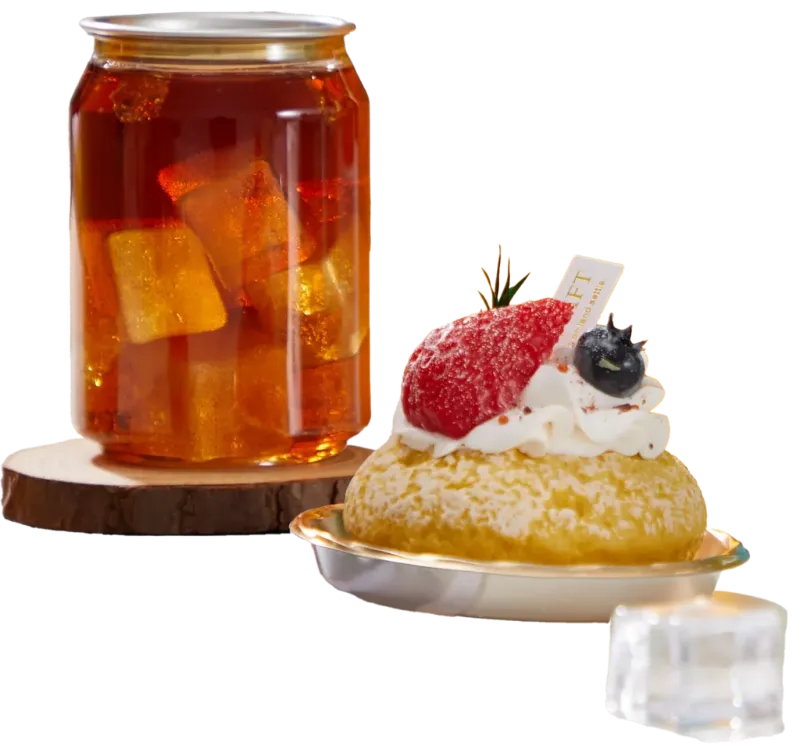
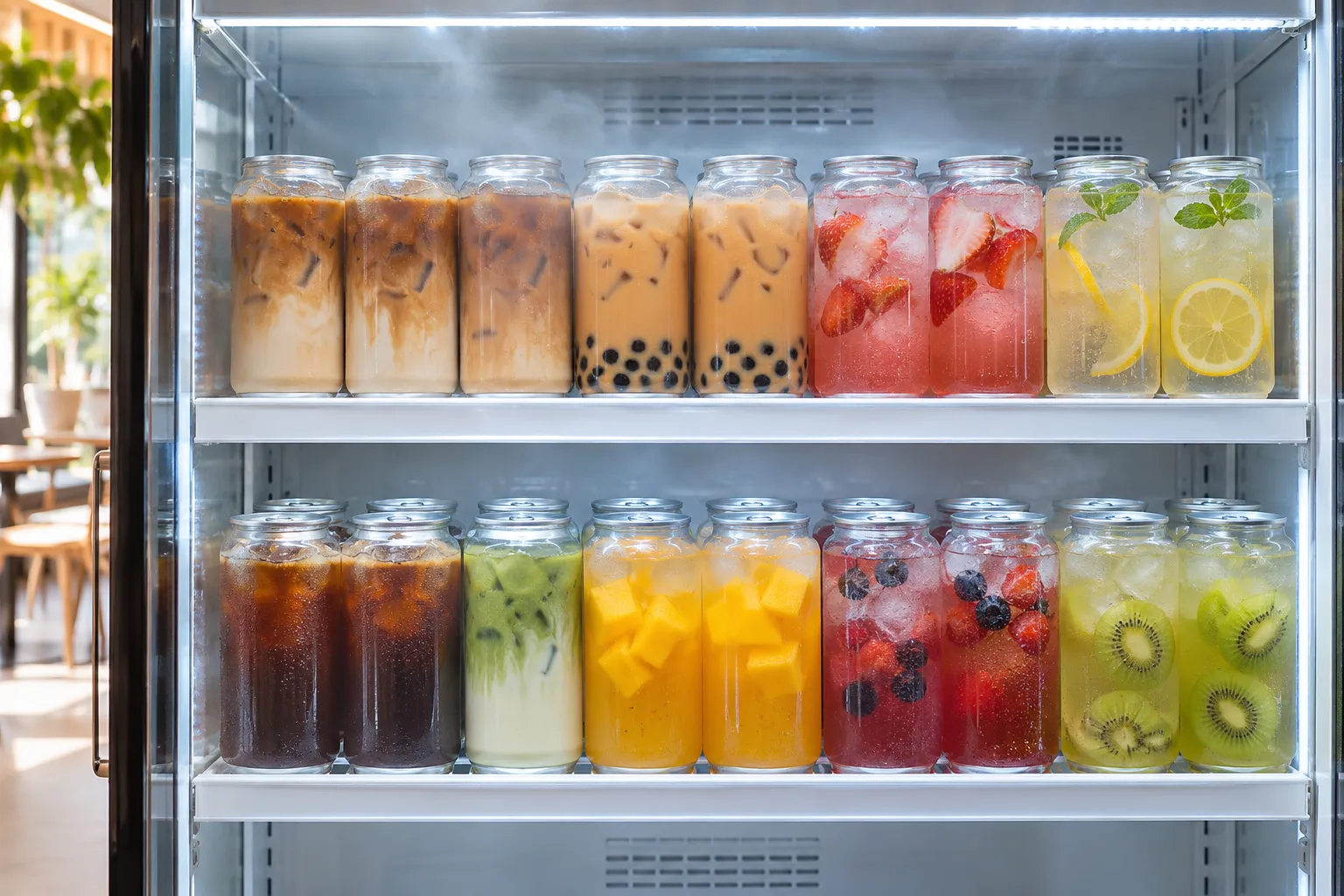
The iced coffee arrives in something that looks like a soda can and opens like one too. Pull the aluminum tab, and the whole drink is on display through the clear wall: espresso, milk, ice, every syrup streak in view. That single detail explains why this format keeps showing up on counters and in feeds.
The container is a clear plastic can: a can-shaped vessel molded from transparent PET, the same food-grade plastic used in water bottles, closed with either an aluminum easy-open end or a plastic lid. It is not a metal can, and it is not a storage canister. The drinks counter, the bakery fridge and the delivery bag are where it lives.
The visibility is the product feature. A soda drinker on Reddit explained the appeal in one line: “I can’t drink from cans since I never drink what I can’t see… so this solved it” (r/Soda, 2024). When the drink itself is the marketing, a package that hides it works against you. Clear PET solves that at a weight and price glass never could.
PET brings the practical side too: light enough to cut freight, shatter-resistant enough for delivery, BPA-free and accepted for food contact. That is why the format has spread across cold brew, iced coffee, bubble tea, fruit tea, juice, cocktails and desserts in a few years.
Sizes, Capacities and Lid Types: Match the Combo to Your Product
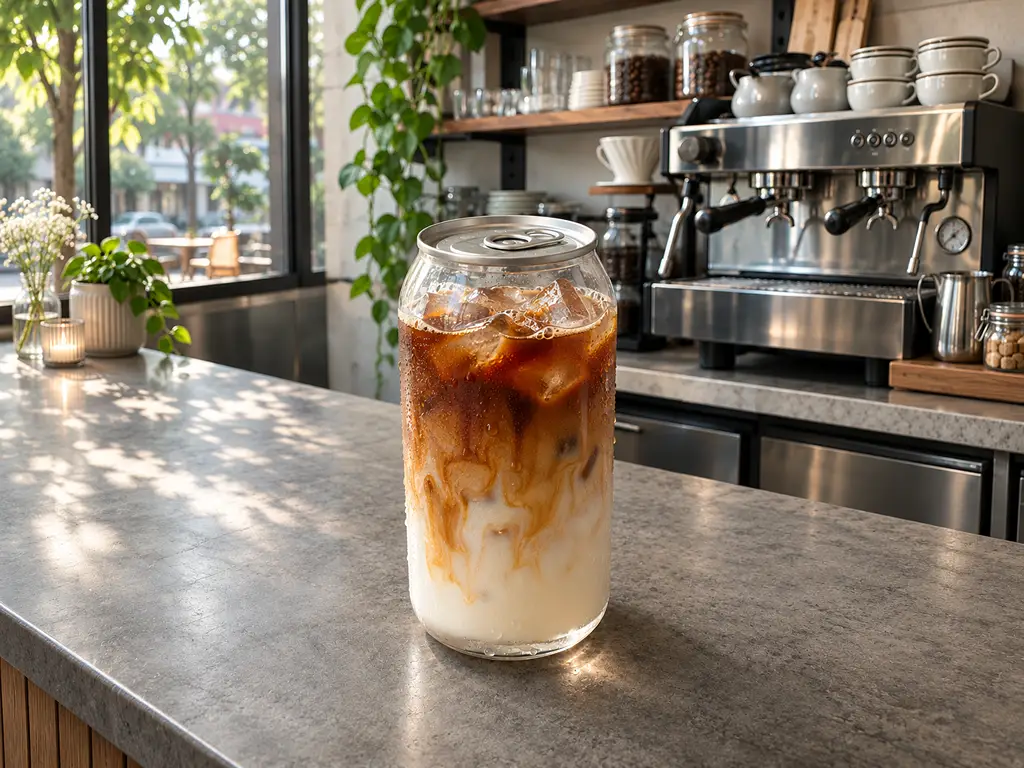
Before comparing suppliers, map your product to a lid style. The lid decides the opening experience, and the opening experience decides what the can can sell.
Lid types and what they fit
| Lid type | Opening experience | Best for | Typical capacity fit |
|---|---|---|---|
| Aluminum easy-open end (factory-applied) | Pull tab, single serve, no reseal | Iced coffee, cold brew, soda, cocktails | 250-500ml (8-16oz) |
| Screw cap | Opens and reseals repeatedly | Nuts, candy, protein powder, dry snacks | 380ml-1L and up |
| Peel-off foil seal | Full-open, tamper-evident | Desserts, dairy-style drinks, powders | 250-500ml |
| Snap-on plastic lid | Quick access, reseals loosely | Fruit teas, parfaits, cold drinks | 350-1000ml |
Three size facts sit under that table. Standard beverage can volumes run 250ml, 350ml and 500ml, which line up with the 8oz, 12oz and 16oz sizes customers already know. Custom tooling can take capacity from 150ml up to 5L. Can weight usually lands between 22g and 35g, and that number drives both unit price and perceived heft in hand.
One technical detail quietly controls everything: the neck finish. A 202 finish is the common standard for beverage cans, and it determines which lids fit, which seamer works, and which spare parts you will be buying later. Lock the neck size before you lock the design.
The mismatch warning is short but real: powders, nuts and anything the customer will reseal belong in screw caps or foil-sealed jars, not single-serve pull tabs. And carbonated drinks need ends and bodies rated for pressure, whatever the shape looks like.
Pre-Sealed Cans or a Can Seamer: The First Real Decision
A founder posted on r/coldbrew after watching a roastery seal iced coffee into clear cans on video. His question: where do I find “these tipe of machines or how are they called? I want to start selling cold brew on these tipe of package” (r/coldbrew, 2023). The machine has a name, a can seamer, and his search is the exact fork every shop owner hits: buy cans that close without equipment, or seal them yourself.
The Snap-Lid Route: No Equipment
Some cans come with snap-on plastic lids already fitted, or use flat lids that press on by hand. You fill, you cover, you serve. There is no machine to buy, nothing to service, and a staff member can be trained in a minute.
The trade-off is the “can” feel. A snap-on lid reads as a cup with a lid, not a can with a pull tab, and some lids reseal loosely. For delivery and shelf products this route also means the customer opens what you sealed loosely hours earlier, so the lid, not a seam, carries your spill risk.
The Seal-In-House Route: Two-Piece Cans and a Seamer
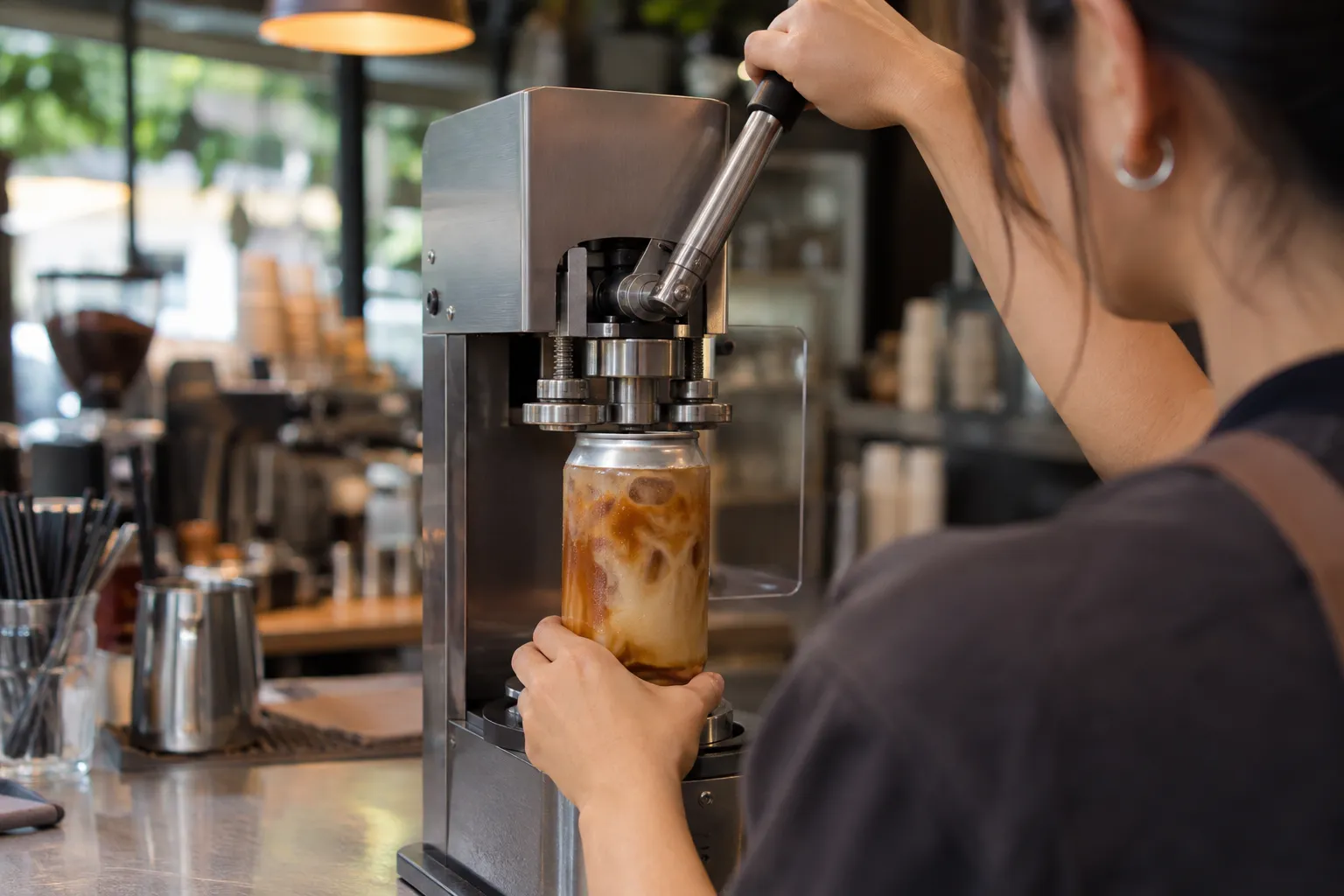
The other route is the one in that roastery video: fill the can, place a flat aluminum easy-open end on top, and press it down with a countertop seamer. Typical desktop units run a 55mm caliber and seal a can in roughly 3 seconds at bench-level power (OUTSTANDING, 2026). The customer gets a genuine pull-tab moment, and the sealing step itself becomes part of the show in an open kitchen.
This route buys freedom and costs attention. You can print the cans, pick your end style and change designs without waiting for a factory to pre-assemble anything. But a seam that was not made right leaks, and a leak in a delivery bag is a refund plus a review. Seal integrity deserves a spot check from day one, by vacuum or water immersion, on every new lid batch.
Two routes side by side
| Dimension | Snap-lid route | Seamer route |
|---|---|---|
| Upfront cost | None | One countertop machine plus flat ends |
| Workflow | Fill and cover | Fill, cap, press, about 3 seconds per can |
| Customer moment | Cup with a lid | Real pull tab, sealable in view |
| Customization | Limited to stock can-and-lid combos | Free to print cans and choose end styles |
| Best fit | Testing, delivery, low volume | Dine-in made-to-order, events, brand builds |
| Where it breaks | Reads as a cup, loose lids | Unverified seams leak, equipment to maintain |
The boundary between them follows the sales channel. Dine-in and made-to-order reward the seamer: the sealing moment is visible and the can is consumed on site. Delivery and e-commerce reward the route that seals hardest once verified: snap lids rated for transport, or seamed cans that passed a water immersion check before dispatch.
Buying at Scale: Channels, MOQ and Unit Economics
The Three Buying Channels
Retail small packs come from Amazon and packaging web stores, usually 50 to 200 units per order. They are perfect for a 30-can product test, and they are expensive per unit. One coffee shop owner put it bluntly in a sourcing thread: Amazon is “like the absolute last resort for us, they’re not wholesale prices” (r/coffeeshopowners, 2025).
Wholesale distributors sit in the middle. Restaurant supply houses and packaging distributors carry stock cans at real wholesale rates, ship fast, and customize nothing. When your shop needs 500 plain cans next week, this is the channel that answers.
Factory direct is the third channel: minimum order commitments in exchange for the lowest unit price, your printing, your choice of neck finish, your lid mix, and tooling if you want a shape nobody stocks. This is where a brand gets made, and where the contract terms matter.
Unit Economics: Why the Same Can Costs Different Money
The price spread across these channels is not a mystery; each price buys something different. Retail prices buy tiny quantities and immediacy. Distributor prices buy availability without commitment. Factory prices buy your volume promise, and factories price that promise aggressively.
The public anchors make the spread concrete. A packaging brand’s web store lists custom clear cans at $1.28 a can at its 1,000-unit minimum (noissue, 2026). Owners ordering factory-direct through sourcing platforms report custom cup pricing around 8 cents per unit including shipping (r/coffeeshopowners, 2025). Different products, different quantities, same pattern: the channel moves the unit price by multiples.
Unit economics: three data points
≈ 8¢
per unit, factory direct
owner reported, custom cups
$1.28
per can, custom minimum
published web-store price, 1,000 units
“absolute last resort”
Amazon retail packs
in an owner’s words, 2025
That last line is the whole calculation. Work out monthly volume per SKU. A SKU moving 300 units a month can live happily on distributor stock. A SKU moving 3,000 units a month on retail packs is donating money every cycle, because the per-unit premium compounds with every reorder.
The Sampling Workflow and Your Acceptance Checklist
Factory custom runs on a five-step workflow: specification and quote, sample, pilot order, mass production, shipment. Samples of simple customizations typically take 48-hour-class turnaround, while mold-based samples take around 15 days. Owner communities also document the trap: branded custom packaging with lead times of 8 to 12 weeks, which turns every reorder into a stockout gamble (r/coffeeshopowners, 2025). Get lead time commitments in writing before the deposit.
The acceptance checklist is what you demand from the supplier, in the sample stage, before the deposit. Sealing integrity tested by vacuum or water immersion. Neck and bore tolerances around ±0.1mm, preform weight within ±0.1g, and wall thickness uniformity held to hundredths of a millimeter. Drop testing with contents, at 1.8m class. Periodic third-party food-contact reports, quarterly rather than annual. One manufacturer publishes its full standard set publicly, and reading it costs nothing (OUTSTANDING Quality Control, 2026).
When a SKU’s volume clears the factory-direct line, this is what a workable light-custom offer looks like, and it is the offer we run at OUTSTANDING. Light customization means your logo and colors printed on existing can molds. It starts at 1,000 pcs, with samples out in 48 hours and production shipping in 3 to 5 days (OUTSTANDING, 2026). Mold-level custom runs from 30,000 pcs across capacities from 150ml to 5L, standard neck finishes including 202, and a lid mix from easy-open ends to screw caps. The point is that this tier of offer exists, so your checklist has a concrete answer to compare against.

How Clear Plastic Cans Fail: Shelf Life, Heat and Recycling
Failures here are not hypothetical. Monster launched its Hydro line in clear plastic cans in 2017; the rollout hit delays and distribution challenges and the format was eventually abandoned. A startup called Orka Beverage burned three production runs across three factories. Filling sensors misread the clear bodies, seams failed and leaked, and cans slipped off conveyor suction designed for metal (PackWorld, 2025). The format survived on craft counters and milk tea lines, not because it is risk-free, but because those operators learned where its edges are.
Where clear plastic cans break, and what to check
| Your scenario | Real failure mode | Checkable action before you commit |
|---|---|---|
| Cold brew / RTD coffee | Not shelf stable: safety risk without refrigeration or pasteurization | Confirm your process has a cold chain or a pasteurization step |
| Carbonated drinks | PET loses CO2 faster than aluminum | Use cold-fill rated cans only; test carbonation retention over your shelf life |
| Hot-fill products | Standard PET softens around 60-65°C | Verify the temp window, typically -30 to 60°C for PET cans, against your fill process |
| Sea-freight e-commerce | Container heat deforms cans in transit | Spec insulated packing and run a transit trial batch |
| Long storage | Too cold makes PET brittle, too hot warps it | Put storage temperature limits in the supplier contract |
| Recycling claims | Aluminum end plus PET body confuses material sorting at recycling plants | Market the format honestly and check local recycling guidance |
Every row in that table traces back to a real incident, a published material limit, or an owner’s post-mortem. None of them are exclusive to cheap suppliers or exotic products; they are properties of the material and the recycling system it enters.
Sealed does not mean shelf-stable. The seal keeps oxygen out; the process keeps bacteria down. As one cold brew discussion put it, keep the product refrigerated or pasteurize it, because the alternative risk is botulism (r/coldbrew, 2023).
Read the matrix as a filter, not a scare list. Cold brew passes if you already run refrigeration. Fruit teas, juices and desserts pass easily. Hot-fill soups and strongly carbonated sodas fail, and no supplier argument changes the material limits. The honest move is to match the format to products that fit it and leave the rest in packaging that does.
Three checks belong in your sample stage. Run your own seal spot checks on the first batches, because the seam is your risk, not the factory’s routine. Verify the temperature window in writing against your hottest process step. And if you sell online, ship one trial case through your real fulfillment route in summer before you commit the reorder.
The Buying Structure That Scales
Put the earlier sections side by side and a structure falls out. Unit prices for the same container spread by multiples across three channels. Sealing routes divide by sales channel: dine-in rewards the seamer, delivery rewards verified seals. And the failure matrix filters which products belong in clear plastic cans at all.
For a bubble tea franchise owner or a growing coffee brand, that reads as three layers. Layer procurement by monthly volume per SKU: retail packs for tests, distributor stock for movers under a thousand units a month, factory light custom for everything above that line. Layer equipment by channel: the seamer and pull-tab ends where drinks are made in front of customers, pre-applied screw caps or seamed-and-checked cans for delivery and e-commerce. Layer products by physics: cold, still or short-shelf-life drinks in clear cans, hot-fill and high-carbonation products in whatever they already ship in.
The stance behind this structure is simple: treat clear plastic cans as a procurement decision, not a decoration budget. The visibility premium is real, customers pay attention to what they can see, and the owner voices in this article prove the format sells. But the money is made or lost at the channel line, the seam, and the temperature window. Owners who sort their SKUs by monthly volume and pick the route per channel keep the premium and skip the refunds.
Start the structure this week: pull your sales data by SKU, mark the ones past a thousand units a month, and get one light-custom quote with a sample against your acceptance checklist. The cans that survive that filter are the ones worth scaling.
Every clear can OUTSTANDING ships is backed by ISO 9001, FDA and EU 10/2011 food-contact compliance, so what your customers see through the wall is matched by what is on the certificates.
References
- Packaging World. “The Clear Can Conundrum.” 2025. https://www.packworld.com/trends/package-design/article/22939548/the-clear-can-conundrum
- r/coldbrew. “Looking to package on a can.” 2023. https://www.reddit.com/r/coldbrew/comments/14epnfw/looking_to_package_on_a_can/
- r/coffeeshopowners. “Where are we getting our cups?” 2025. https://www.reddit.com/r/coffeeshopowners/comments/1lzrjmu/where_are_we_getting_our_cups/
- r/Soda. “more companies should make clear cans for the drinks.” 2024. https://www.reddit.com/r/Soda/comments/1cwl1wm/more_companies_should_make_clear_cans_for_the/
- noissue. “Custom Clear Cans.” 2026. https://noissue.co/shop/cups/cold-cups/custom-clear-cans/