Coffee Cup Sizes: The Full Ladder, 2 oz to 32 oz
A single espresso lives in about 2 oz. The “cup” marked on a drip machine holds 5 oz, a convention inherited from teacups and still confusing home brewers decades later (r/Coffee, 2021). Walk into an American cafe and the smallest hot drink on the menu is usually 8 oz. Three numbers, three different worlds, all called “a cup of coffee”. This guide uses cup size to mean the container, in fluid ounces and milliliters, so each number below maps to a real cup you can hold or order.
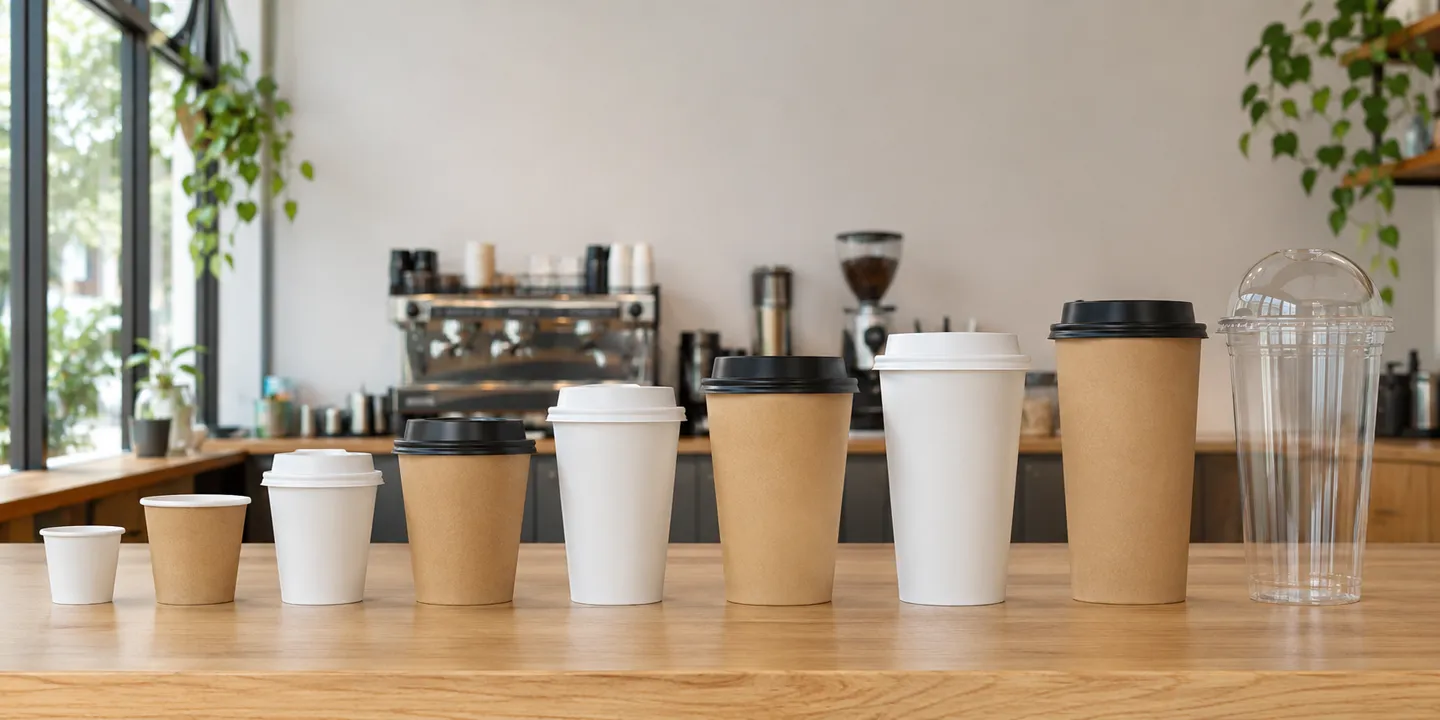
The full ladder runs from 2 oz to 32 oz, and every step has a drink that fits it. Espresso and its small relatives occupy the bottom. Milk drinks take the middle. Cold drinks dominate the top, because ice needs room that hot drinks never ask for.
| Size | Milliliters | Typical drink |
|---|---|---|
| 2-3 oz | 60-90 ml | Espresso, doppio, macchiato |
| 4-5 oz | 120-150 ml | Cortado, flat white (Australia standard), cappuccino (traditional) |
| 6-8 oz | 180-240 ml | Cappuccino (US shops), “small” hot coffee |
| 8 oz | 237 ml | Standard hot coffee, americano |
| 10-12 oz | 296-355 ml | Latte, regular drip, cappuccino (US shops) |
| 16 oz | 473 ml | Large hot, standard iced |
| 18-20 oz | 530-591 ml | Large iced, ventisized hot |
| 24 oz | 710 ml | Large cold drinks |
| 30-32 oz | 887-946 ml | Cold only: cold brew, iced tea |
Starbucks names deserve one footnote, because they come up in every size conversation. Its ladder runs demi 3 oz, short 8 oz, tall 12 oz, and grande 16 oz. Venti means 20 oz for hot drinks but 24 oz for cold, and trenta covers iced drinks only, at 30 oz (Reader’s Digest, 2025). The venti split matters more than the naming trivia. One chain, one word, two volumes, divided by whether the drink contains ice. That is the first sign that size is a decision, not a fact. The question behind it follows directly: the same number in a different cup is not the same product.
Cup Materials: Same Size, Different Cup
A 12 oz paper cup, a 12 oz clear plastic cup, and a 12 oz PP cup hold the same volume and fail at different jobs. Temperature separates them first. Clarity separates them second, because an iced latte sells partly through the look of its layers. Structure, single wall, double wall, ripple, decides how the cup feels in the hand and what it costs.
| Material | Heat reality | Best for | Weak spot |
|---|---|---|---|
| Single-wall paper | Handles hot drinks; heat passes through | Tea, americano, short holds | Needs a sleeve for anything above warm |
| Double-wall or ripple paper | Insulated, no sleeve needed | Hot lattes, sit-and-carry orders | Bulker per carton, higher unit cost |
| Clear PET | Softens approaching 60-65°C; cold only | Iced coffee, cold brew, layered drinks | Any hot fill warps it |
| PP | Tolerates near-boiling fills | Hot drinks when plastic is required | Cloudy, poor drink display |
| PLA or rPET | PLA softens near 55-65°C (Xometry, 2022); cold only | Eco-positioned cold drinks | PLA needs industrial composting |
| Ceramic or glass | Dine-in only | Cafe tableware | No takeaway role |
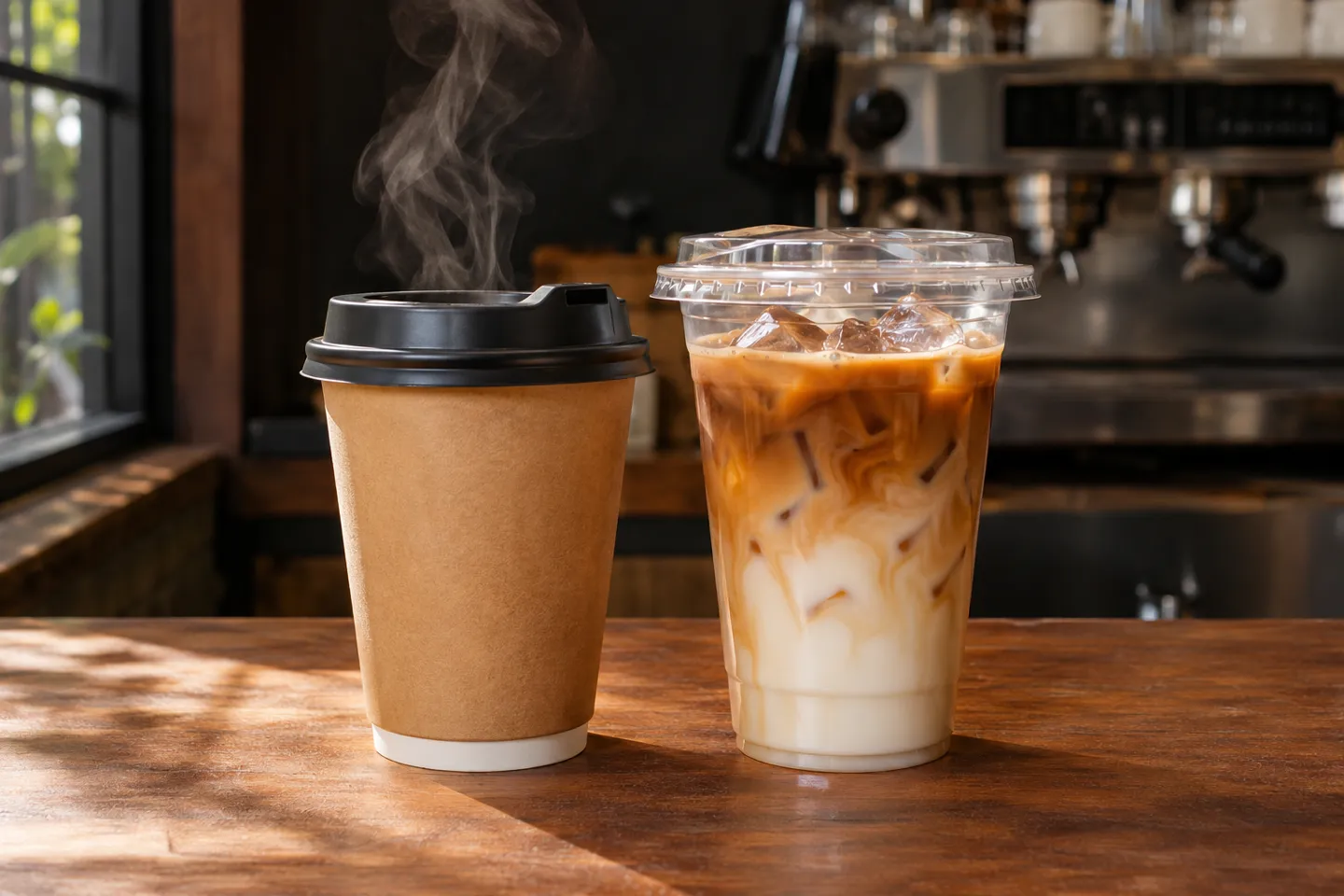
The number to remember sits in the PET row. Standard clear PET cups top out around 60-65°C, while a proper hot drink runs 80-90°C at the counter. PET’s glass transition sits at 67-80°C depending on crystallinity, which is why the gap matters to anyone buying packaging (Dhaka et al., 2022). A transparent cup built for ice will soften, lean, and occasionally leak under a fresh flat white. Check the output temperature of every drink on your menu before you choose a material, then let the material rule out the wrong cups for you.
Standard clear PET tops out at 60-65°C
Hot fills leave the counter well above that line, so hot runs in double-wall or ripple paper, or PP, and clear PET stays with the cold ladder.
Choosing Your Size Ladder: Hot, Iced, and Where You Operate
Menus decide cups, not the other way around. The practical question is never “what sizes exist” but “which three or four of them earn a place in my cabinet”. Answering it takes three checks: separate your hot and cold ranges, adjust for your market’s habits, then cap the count before inventory caps you.
The Hot Ladder and the Iced Ladder
Treat hot and iced as two ladders, not one. American shops commonly run 8, 12, and 16 oz for hot drinks, then 12, 16, and 20 oz for cold, a full step larger at each position. Starbucks publishes the split in its own menu. Venti means 20 oz for hot drinks and 24 oz for cold, and trenta exists only for iced coffee and tea, at 30 oz (Reader’s Digest, 2025). Ice occupies volume, cold drinks lean on big transparent displays, and a 20 oz hot paper cup gets heavy and awkward in one hand.
Shops that collapse the two ladders feel it at the counter. Baristas describe customers asking for a “large latte” at shops whose largest hot cup is 12 oz, and the answer keeps disappointing people (r/barista, 2022). The reverse gap costs less: almost nobody walks out over a missing 24 oz hot drink.
Regional Conventions
“Standard” changes at the border. Australian specialty shops build their menu around 6 oz for flat whites and 12 oz for larger milk drinks, with 8 oz reserved for mochas and hot chocolates. European cafe culture drinks smaller still. A counter espresso or morning coffee commonly lands at 120-150 ml, and several operators in that thread note that anything above 8 oz reads as American-sized. In the US, 8 oz reads as small and 16 oz reads as normal.
| Market | Hot norm | Cold norm | Watch-out |
|---|---|---|---|
| US | 8 / 12 / 16 oz | 12 / 16 / 20 oz | Customers equate size with value |
| Australia | 6 / 8 / 12 oz | 12-16 oz | A 16 oz latte reads oversized |
| Europe (dine-in) | 120-150 ml equivalent (4-5 oz) | Rare, growing | US-style ladders overwhelm local menus |
| Bubble tea chains (Asia-origin) | Fewer hot tiers | 500-700 ml and up | Wide openings and sealed tops beat sipping lids |
A chain expanding across borders inherits this problem silently. Copy the home ladder into a European city and the “medium” becomes the largest drink most locals have ever been served. Undersized local conventions cut the other way, leaving your US menu looking starved (r/barista, 2022).
How Many Sizes?
Start at five: three hot, two iced. Fewer than three hot tiers and the menu answers every custom order with “we only have this one”, which some shops survive on and many do not. One-size models work under real conditions: a short menu, mostly dine-in traffic, a premium price that justifies “we make it one way”. They fail the moment a delivery platform filters your SKUs against a competitor’s medium-and-large menu.
Every extra size costs more than its carton space. One cafe operator ran a year-long analysis of milk waste and found larger hot cups increased steaming waste. The 16 oz cup they wanted to drop was also expensive and hard to source in their area (r/barista, 2022). Another shop made the opposite bet: its Americano gets one shot at 12 oz, two at 16 oz, three at 20 oz. That is a recipe ladder to maintain across every size you add.
Weight your cold tiers generously. Ready-to-drink coffee alone was valued at $31.4 billion in 2025 and is projected to reach $49.0 billion by 2033 (Grand View Research, 2026). The iced habit that drives cafe counters comes from the same shift. The cold ladder is where growth concentrates, so a 3-2 split that underweights it ages quickly.
Before locking your ladder, work down this list:
The ladder check
List every drink on the menu with its output temperature.
Split the list into hot and iced, no exceptions at 60°C.
Note your market’s hot norm (US 8/12/16, AU 6/12, EU 4-5 oz dine-in).
Assign the smallest cup that serves each drink with headroom.
Cap the total at five SKUs until monthly sales prove a sixth.
Check every cup size has a matched lid in the same order.
From Sizes to Specs: What Goes on the Buying Sheet
A ladder becomes an order only after it survives translation into specs. Suppliers cannot quote “medium”, but they can quote a diameter, a material with a certificate, and a quantity. Three checks take a menu from sizes to a sheet a factory can price without calling you back.
Fit
Rim diameter and matched lid
Certification
FDA 21 CFR 177 or EU No 10/2011
Quantity
MOQ and lead time per tier
Fit First: Rim Diameter and Lids
The rim diameter is the spec that quietly breaks orders. Most standard hot ranges use an 80 mm rim at 8 oz and a shared 90 mm rim across 10, 12, and 16 oz. The 12 oz cup varies by supplier, so a lid bought for one 12 oz cup may not seat on another (NP Packaging, 2026). Lid families follow the drinks: flat sip lids for coffee, domes for cream-topped cold drinks, straw-slot lids where the drink gets an oversized straw. Change a cup size, change the lid check with it, and confirm the lid’s inner diameter against the rim in writing before the order leaves.
Certification and Material Specs
Write the compliance into the sheet, not into the hope that it arrives. The United States regulates plastic food-contact polymers under 21 CFR Part 177 (eCFR, 2026), and the European Union’s plastic materials regime is Regulation (EU) No 10/2011 (EUR-Lex, 2011). Ask the supplier for the declaration of compliance and migration test reports in the same email as the quote. Recycled-content and compostable claims need the same discipline. rPET and PLA each come with conditions, and a claim you cannot document is a claim a customs officer or a customer can take apart.
Skip the quote ping-pong: send your rim diameters, materials, and target markets in one email, and we come back with prices per tier and the certificates attached.
Get a line-item quoteMOQ, Printing, and Lead Times
Minimum order quantities for custom-printed cups commonly run from around 1,000 pieces to tens of thousands. Light customization on existing stock sits at the low end and fully custom work at the top; sampling is measured in days, and new tooling in weeks. Printing on a supplier’s existing molds keeps the MOQ low and keeps your ladder intact. Commissioning a new mold for one drink size is how a five-cup menu becomes a warehouse problem. Consolidate the order by ladder tier so every tier moves in the same production window, then hold the matrix below against every line item before signing.
| Scenario | Size that fits | Material | Lid | Failure boundary |
|---|---|---|---|---|
| Espresso to go | 4 oz | Single-wall paper | Flat sip lid | Clear PET banned: espresso exits at 85-90°C |
| Hot latte | 12 oz | Double-wall paper or PP | 90 mm sip lid | Single wall needs sleeves; PET warps above 60-65°C |
| Iced latte | 16 oz | Clear PET | Straw-slot or dome lid | Fill-line must leave ice headroom or lids pop |
| Cold brew retail | 16-24 oz or 250-500 ml PET can | Clear PET with easy-open lid | Sealed easy-open | Thin walls deform in hot containers or sea freight heat |
| Bubble tea | 500-700 ml | Clear PET or PP, wide mouth | Sealed film or wide-straw dome | Narrow sip lids clog; pearls need the wide opening |
Run one last pass before signing: rim diameters matched to lids in writing, certificates named per market, MOQs sized to real sell-through. A sheet with those three boxes ticked is a sheet a factory can quote straight, and a sheet you can hold them to.
Making the Ladder Work for Your Business
Two ladders mean two inquiry sheets. Your hot range and your iced range share a menu board and almost nothing else: different materials, different temperature limits, different lids, different price logic. Quoting them as one line item gives a supplier one number to protect. Splitting them gives you two prices to compare and two MOQs to plan around: a paper line for hot, a clear PET line for cold.
The temperature red line is your complaint firewall. A contract that names the right material for each tier never has to survive a warped-cup photo on a review page. A spec sheet that spells out rim diameter and certification per tier removes the “this is not what I ordered” conversation before it starts. The 60-65°C ceiling on standard clear PET is doing that work for free every time a hot drink stays in a paper cup.
Negotiate in specs, not in adjectives. A buyer who asks for a price on 90 mm double-wall 12 oz with FDA compliance and a printed logo gets a real number. Nothing in that request needs interpretation. Keep the ladder at five tiers until sell-through data argues for a sixth, and put custom printing only on the tiers the till already proves. The cold side keeps earning its keep: ready-to-drink coffee’s climb toward $49 billion by 2033 (Grand View Research, 2026) is the same iced-ladder demand showing up at your counter.
When the ladder is set and the sheet is written, the supplier side becomes simple. Our disposable cup line runs the full ladder in clear PET for cold, PP for hot, and paper for the in-between, with matched lids for each rim (OUTSTANDING). We keep the buying side as light as the sheet. Simple samples ship in 48 hours, light-custom orders start at 1,000 pieces, and bulk production leaves the factory in 3-5 days (sample and MOQ details).
If the ladder logic here matched how you already buy, the next step is small. Run the checklist against your current menu, price one tier from two suppliers on the same sheet, and let the matrix above catch what the quotes miss.
Price your ladder with OUTSTANDING
Clear PET for the cold ladder, PP and double-wall paper for hot, and a matched lid for every rim. Tell us the drinks, we will match the cups.
Start your cup inquiryReferences
- Reader’s Digest. “Starbucks Sizes, Explained: Grande, Venti, Trenta and the Rest.” 2025. https://www.rd.com/article/starbucks-coffee-sizes-explained/
- Dhaka, V. et al. “Occurrence, toxicity and remediation of polyethylene terephthalate…” 2022. https://pmc.ncbi.nlm.nih.gov/articles/PMC8755403/
- Xometry. “PLA (Polylactic Acid): Definition, Applications, and Types.” 2022. https://www.xometry.com/resources/materials/what-is-pla/
- Grand View Research. “Ready To Drink Coffee Market Size And Share Report.” 2026. https://www.grandviewresearch.com/industry-analysis/ready-drink-coffee-market-report
- NP Packaging. “Paper Cup Sizes Explained: UK Guide for Cafés.” 2026. https://nppackaging.co.uk/paper-cup-sizes-explained-uk-guide-for-cafes/
- WebstaurantStore. “Coffee Cup Sizing Guide.” https://www.webstaurantstore.com/guide/1307/coffee-cup-sizes.html
- r/barista. “What cup sizes does your shop offer?” 2022. https://www.reddit.com/r/barista/comments/wnvlgl/what_cup_sizes_does_your_shop_offer/
- r/Coffee. “The ‘cup’ size on a typical drip machine (5 fl oz)…” 2021. https://www.reddit.com/r/Coffee/comments/piztao/the_cup_size_on_a_typical_drip_machine_5_fl_oz_is/
- EUR-Lex. “Commission Regulation (EU) No 10/2011 on plastic materials intended to come into contact with food.” 2011. https://eur-lex.europa.eu/legal-content/EN/TXT/?uri=CELEX:32011R0010
- eCFR. “21 CFR Part 177, Indirect Food Additives: Polymers.” 2026. https://www.ecfr.gov/current/title-21/chapter-I/subchapter-B/part-177