What Straws Are Actually Made Of
The straw next to your iced americano has changed material twice in a decade, and the second change is still being argued about. A paper straw softens against your lips after twenty minutes in the drink. The polypropylene tube it replaced will outlast the cafe that served it. Between those two sits a third option that most casual debates skip. Polylactic acid, known as PLA, is a plant-based plastic that now holds a real share of the commercial straw market.
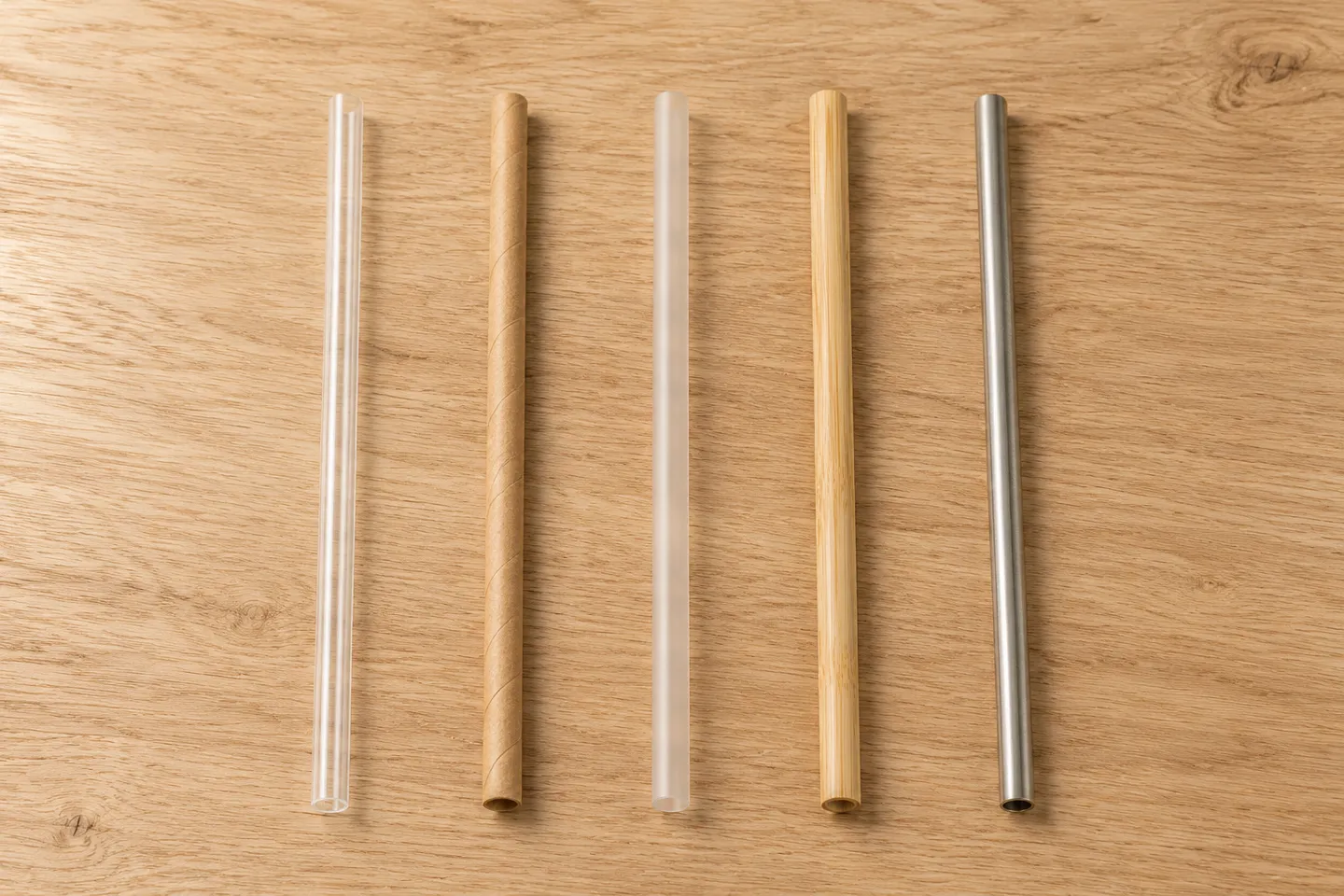
Every straw on the market comes from one of five material families. Conventional plastic, usually polypropylene (PP), is the cheapest and the most durable in the cup. Paper straws, rolled from three or four plies with a food-safe coating, became the default substitute once plastic bans spread. PLA is fermented from plant starch or sugar and engineered to feel like plastic while composting under industrial conditions. Plant-fiber straws made from bamboo or coffee grounds occupy a small premium niche. Reusable straws in stainless steel, glass, or silicone cover the at-home and dine-in segment.
Material choice decides four things at once. It fixes how the straw breaks down and how it behaves in the drink. It also sets the temperature ceiling and decides whether the straw is legal in your market. Every argument in the paper straws versus plastic straws debate is an argument about one of those four properties.
The quick version: plastic is durable and cheap but persists in the environment for centuries. Paper is familiar and ban-compliant but loses strength in liquid. PLA behaves like plastic in cold drinks yet needs an industrial composting facility to deliver its environmental promise. (One clarification: this article covers drinking straws, not straw, the agricultural material.)
The sections below walk those properties in order. First the evidence that challenged the default story, then drink-by-drink selection logic, the real cost math, and the compliance map. The last one is the acceptance checklist you can send to a supplier.
Where the Default Story Breaks
For years the assumption held that paper straws are better for the planet and safer for people. Three pieces of research published within the last three years have poked holes in that story. Each one changes what a buyer should check.
The sharpest reversal came in October 2026. South Korea’s Ministry of Climate, Energy and Environment commissioned a life-cycle assessment that counted pollution from production through disposal. It reported that paper straws generated about 6.33 times the carcinogenic impact of conventional plastic straws (South China Morning Post, 2026). The metric is a statement about manufacturing and waste streams. It is not a claim that sipping through paper exposes anyone to toxins. The same study flagged bio-based plastic straws for elevated life-cycle emissions too.
LIFE-CYCLE ASSESSMENT, SOUTH KOREA, OCT 2026
6.33x
the carcinogenic impact ratio of paper straws against conventional plastic straws, counted from production through disposal, not exposure during drinking.
A separate Belgian study tested 39 straw brands across five materials for PFAS, the so-called forever chemicals. PFAS turned up in most material types. They appeared most frequently in paper and bamboo straws, and not at all in stainless steel (Boisacq et al., Food Additives & Contaminants, 2023). Coatings and processing, rather than the paper fiber itself, appear to drive the difference. That is why the finding belongs on the spec sheet rather than on the material label. A written PFAS-free statement from a supplier is worth more than the word “eco” on a box.
Durability evidence points the same direction. An independent evaluation of business-grade paper straws found that not one of the tested products stayed functional after 30 minutes in liquid (nothing.eco, 2026). Dry laboratory testing runs the other way. Before any liquid touches them, paper straws showed higher strength and stiffness than plastic ones (BioResources, NC State University). The distance between dry strength and wet collapse is the single most operationally important fact about paper straws.
None of this makes plastic harmless. Plastics of all types, including ones labeled biodegradable, can persist in the ocean for an indefinite time (NOAA Marine Debris Program, 2024). Plastic straws are commonly estimated to take up to 200 years to decompose (WWF Australia, 2025). The honest reading is narrower than either camp prefers: a material label does not settle the question. Staff get a usable line out of this as well. When a guest asks whether paper is actually greener, the truthful answer is that the trade-offs sit in production and disposal numbers. They do not sit in the last inch of the straw.
Matching Straw Material to Your Drinks
Menus are not uniform, so straw selection cannot be uniform either. The working variables are serving temperature, drink duration, and thickness, and each material has a boundary where it stops working.
Cold drinks: the takeaway line
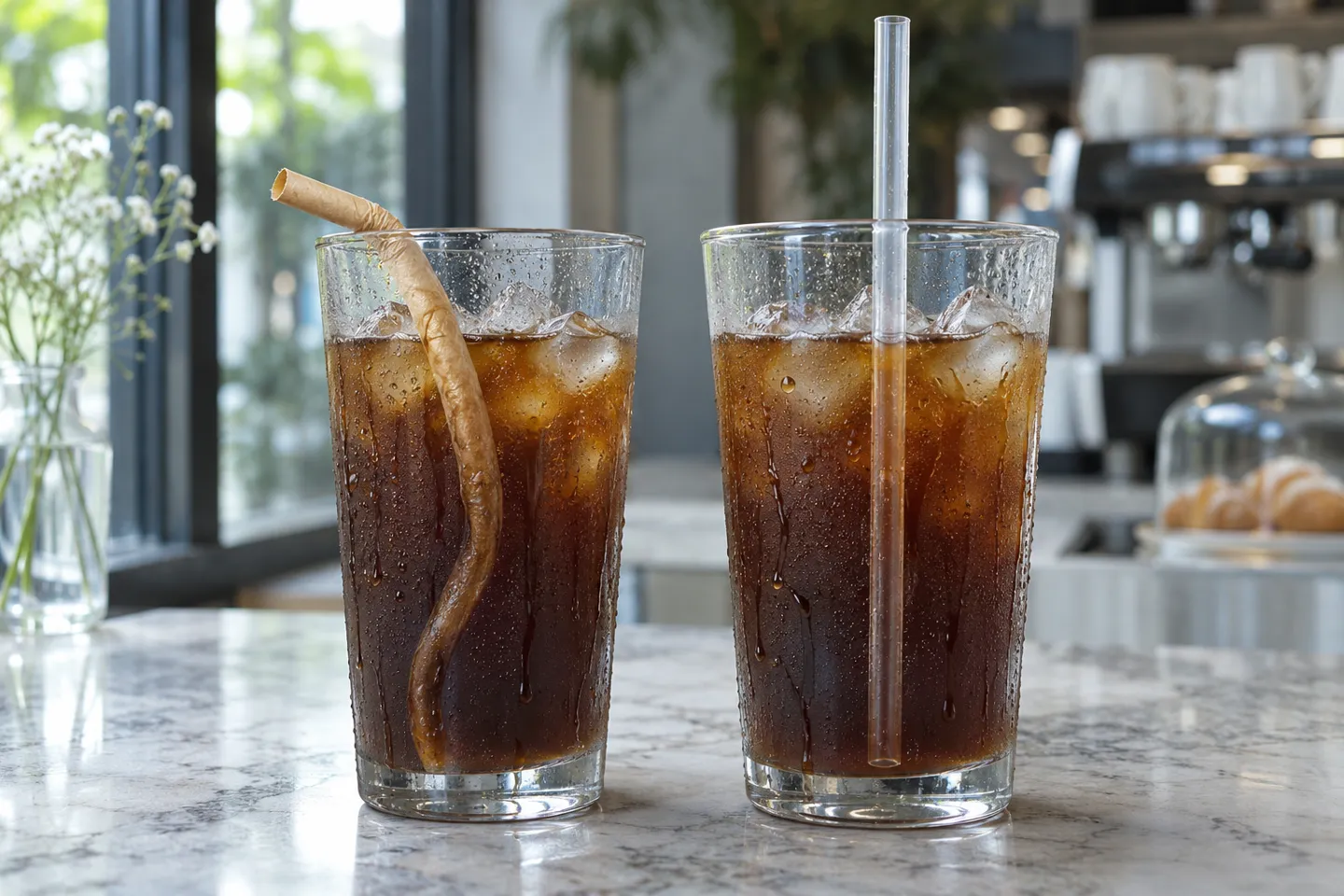
Put the 30-minute finding in service terms first. A 20 to 30 minute window covers fast takeaway and delivery orders, and it misses long sessions entirely. PLA behaves closest to conventional plastic in cold service: one-piece stiffness, no coating to dissolve, and a plant-based story that supports sustainability marketing. Conventional plastic remains the cheapest cold-line option in markets that still allow it.
THE 30-MINUTE TEST
0
tested business-grade paper straws stayed functional after 30 minutes in liquid, per the 2026 independent evaluation of cafe-supply products.
Hot drinks: temperature is the boundary
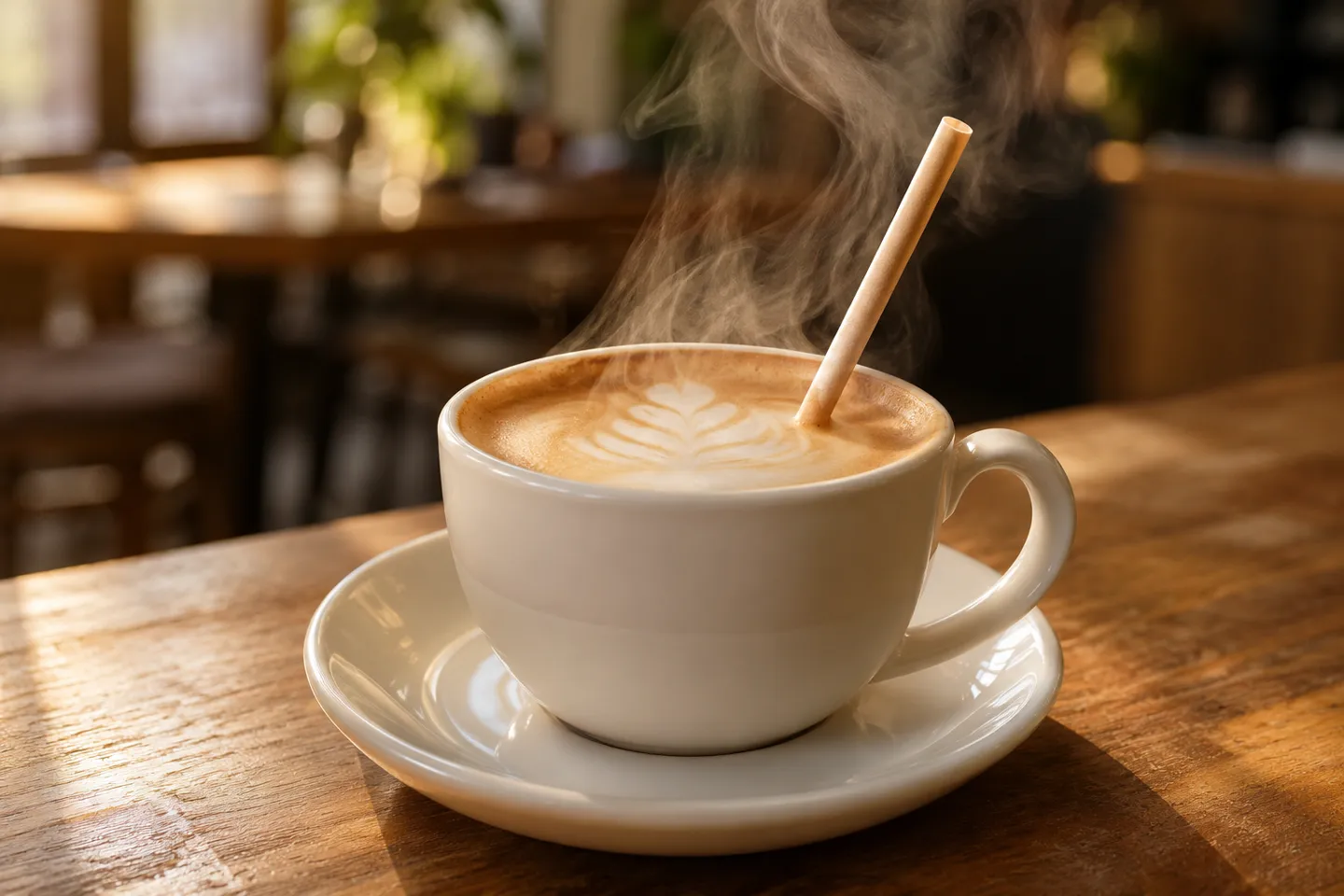
Temperature is where material choice stops being a preference. PLA has a working ceiling around 60°C. Manufacturer spec sheets for PLA straws typically list a range of -30°C to 60°C, which is cold service only. A flat white or a hot milk tea runs hotter than that at the cup wall. The hot line therefore needs coated paper or polypropylene where PP remains legal. Paper in hot drinks carries its own trade-off. Heat-tolerant coatings add cost, and lightly coated paper can shed fibers into a hot, acidic drink.
Thick drinks and long sessions
Bubble tea needs a wide bore, typically 10 to 12 mm, or the pearls will not pass. Frozen drinks need a spoon-straw instead of a straight tube. Long sessions are the quiet failure mode. A straw that survives minute 30 can still collapse at minute 60, and the guest asks for a replacement. That replacement doubles the straw count on the order. The cost effect is the subject of the next section.
Straw material selection matrix by drink scenario
| Drink scenario | Recommended material | Failure boundary | Confirm before ordering |
|---|---|---|---|
| Iced takeaway, fast turnover | Paper or PLA | Paper softens after 20-30 minutes | Average consumption time per cup |
| Hot coffee or hot milk tea | Coated paper or PP where legal | PLA softens near 60°C | Peak serving temperature and coating specification |
| Bubble tea and smoothies | Wide-bore paper or PLA at 10-12 mm | Narrow bores clog with pearls | Bore diameter against pearl size |
| Frozen drinks and slush | Spoon-straw in paper or PLA | Straight tubes clog with ice | Spoon-head availability in your chosen material |
| Long sessions and events | PLA or reusable straws | Paper collapses past 30-60 minutes | Event duration and per-guest straw count |
Read the matrix as boundaries rather than endorsements. The last column lists what to verify before ordering. Every failure in column three is a complaint your staff would otherwise hear in person.
The Real Cost Math
The price gap between paper and plastic straws is real, persistent, and regularly misread. Unit price is the wrong denominator for a consumable that guests sometimes consume two at a time.
Unit price facts
Current trade pricing puts paper straws at roughly $0.02 to $0.05 each. Conventional plastic runs $0.005 to $0.02, a gap of about two to ten times depending on volume (GotCups, 2026). The gap is not new. In 2018, distributors quoted around 2.5 cents for paper against half a cent for plastic. One packaging supplier described that as maybe ten times more expensive (CNBC, 2018). PLA typically lands between the two and closer to paper at small volumes.
The usage truth
Unit price assumes one straw per drink. The 30-minute collapse breaks that assumption. When a guest asks for a second straw, the per-cup consumption on that order doubles. Hospitality operators have documented this replacement pattern as paper straws became standard (The Happy Turtle Straw, 2025). Add damp-storage spoilage, since paper absorbs humidity in the stockroom and in an open counter bin. Add the staff time spent handing out replacements as well.
The total-cost formula
A usable formula for a beverage business: total straw cost = unit price × straws per cup × (1 + spoilage rate), plus the ordering overhead carried per SKU. The worked example below uses deliberately simple assumptions. Take a shop serving 500 cups a day. Suppose 30% of orders need a second paper straw and 5% of stock spoils. The shop then consumes 500 × 1.3 × 1.05, about 682 paper-straw equivalents per day. At $0.03 each that is roughly $20.5 a day and $615 a month. One plastic straw covering every cup at $0.007 to $0.014 would cost $105 to $210 a month instead. Treat the numbers as an illustrative model, not a quote. Real prices move with volume, printing, and coating.
Illustrative monthly straw cost for a 500-cups-per-day shop
| Cost factor | Paper straws | Conventional plastic straws |
|---|---|---|
| Unit price | 2026 trade range, $0.02-0.05 | $0.005-0.02 |
| Assumed straws per cup | 1.3 (second-straw effect) | 1.0 |
| Assumed storage spoilage | 5% | Minimal |
| Illustrative monthly total | $410-$1,030 | $75-$300 |
The formula is a decision tool, not a price list. The structural point is that usage and spoilage narrow the effective gap between materials. A straw that survives the whole drink is worth more than its unit price suggests.
Compliance: What Is Legal Where
The European Union banned single-use plastic straws from 3 July 2021 under Directive (EU) 2019/904 (EUR-Lex, 2019). The directive covers conventional plastic and oxo-degradable products. The United Kingdom adopted its own ban in the same year. In the United States the rules form a patchwork of state and city ordinances. Canada’s federal single-use plastics prohibition took effect across 2022 and 2023. Local lists keep growing, so treat this section as a map rather than a ruling. Check the current list for your market before committing to a material.
What the bans target is material class. Conventional petroleum-based plastic straws and oxo-degradable straws are restricted. Paper straws and certified compostable straws are the standard compliant substitutes. PLA sits in a gray zone by jurisdiction. It is plant-based and industrially compostable, yet some frameworks treat it as conventional plastic unless it carries a compostability certificate. That is why larger markets usually require certification paperwork for PLA products.
The vocabulary matters at ordering time. Biodegradable is a material-behavior claim with no single test behind it. Compostable, when certified, means the product passed a defined standard. The standard is EN 13432 in Europe, or ASTM D6400 with BPI certification in North America. Both standards assume industrial composting facilities, not a backyard pile. PLA is exactly this case. It composts in an industrial facility. A straw that ends up in the ocean behaves no better there than the plastic it replaced. Separately, FDA food-contact compliance and EU Regulation 10/2011 certify contact safety, not environmental performance. A straw can legally touch a drink and still fail a compostability audit.
Compliance self-check before ordering
- Pull the current single-use plastic list for your market and confirm which straw materials it restricts.
- For PLA orders, require a compostability certificate (EN 13432, ASTM D6400, or BPI) and check the certificate number on the issuer’s website.
- For food contact, require FDA or EU 10/2011 documentation matched to your serving temperature.
- Request a written PFAS-free statement.
- Re-check the local list at least once a year, because restricted lists grow.
What to Demand from a Straw Supplier
Procurement loses money on straws in predictable ways. A bore clogs with pearls. A coating fails in hot drinks. A carton arrives damp. All of it is preventable with a written acceptance spec. The table below is the checklist to attach to an inquiry.
Straw acceptance specification checklist
| Parameter | What to specify | Why it fails in service |
|---|---|---|
| Material and grade | Paper, PLA, or PP with food-contact documentation | Coating or resin grade varies by brand and batch |
| Diameter | 5-6 mm standard, 8 mm soda, 10-12 mm bubble tea | Narrow bores clog with pearls and pulp |
| Length | 180-200 mm standard service length | Short straws sit too low in tall cups |
| Working temperature | Cold line: low-temperature toughness. Hot line: softening ceiling | PLA deforms near 60°C and paper coatings fail in heat |
| Packaging | Individually wrapped or bulk with pieces per carton stated | Damp cartons spoil paper stock |
| MOQ and sampling | MOQ, sample lead time, and bulk lead time in writing | Unconfirmed lead times break peak-season stock |
Verify certificates the way an auditor would. Collect certificate numbers, look each one up on the issuing body’s website, and match the certificate to the batch on your purchase order rather than to the sales deck. For food contact, request FDA declarations or EU 10/2011 test reports specific to the material and the temperature you serve. For compostability, the certificate number is what a regulator will ask for. The word “compostable” printed on a box is not.
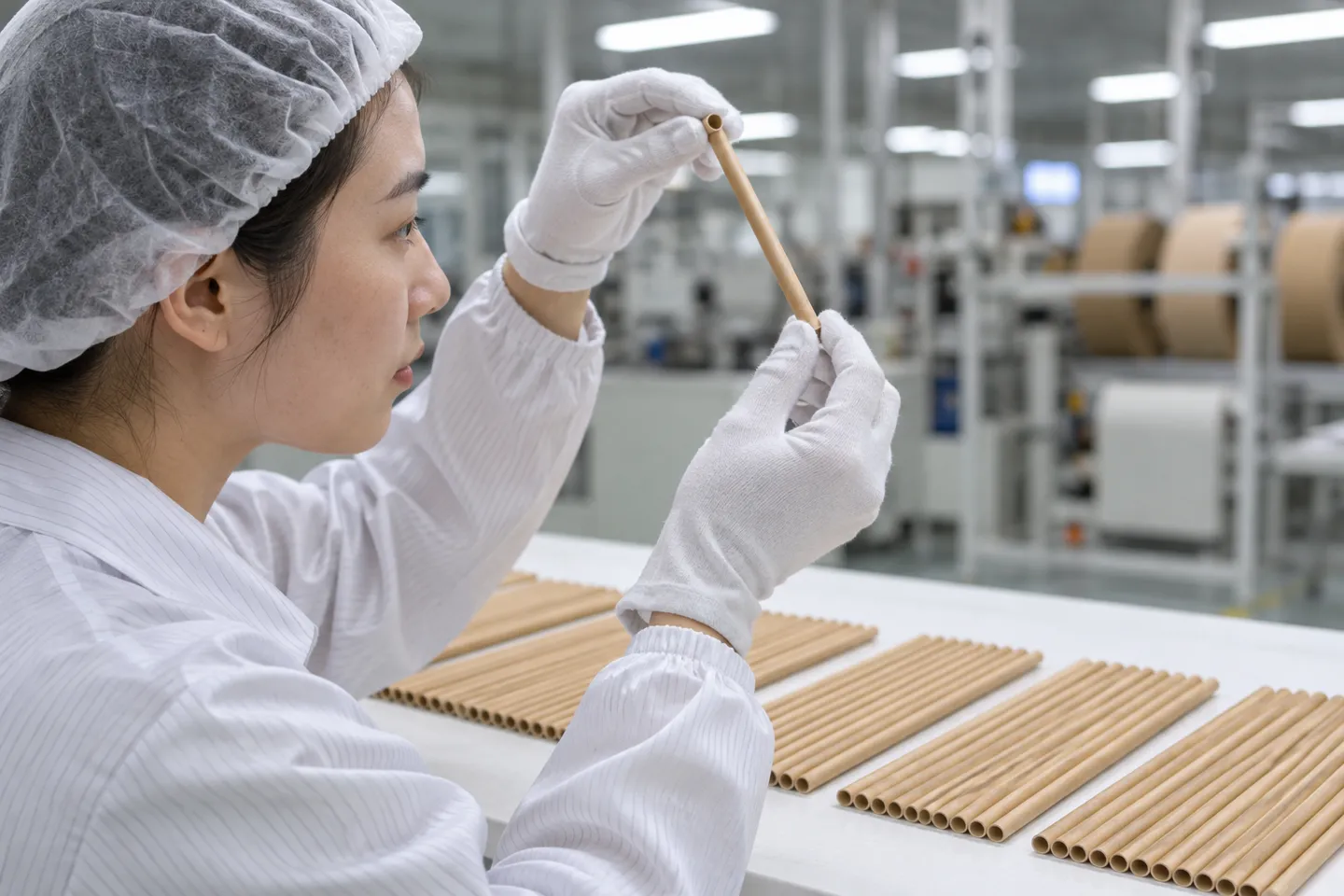
Four supplier risks deserve a line in your vendor file. Stockouts: when a new market bans a material, capacity tightens quickly, so confirm production lead time before peak season. Batch drift: coating weight and paper grammage can shift between production runs, so tie acceptance to your approved sample rather than to the catalog page. Sample-to-bulk consistency: approve the pilot, then require the bulk order to match it in writing. Storage: paper stock needs dry, sealed space away from steam lines and dish pits, with a rotation rule so older cartons ship first.
What This Means for Your Product Line
Put the three preceding sections together and one configuration principle falls out: the straw lineup follows the menu, not the label. The selection matrix says temperature splits the line in two. PLA carries cold service, and coated paper or polypropylene carries the hot line where it is legal. The cost math says usage and spoilage, not unit price, decide which material is actually cheaper per served cup. The compliance map says a multi-market operation cuts its SKU list by regulation, not by preference.
For a bubble tea or coffee chain buyer, that converts into three concrete moves. Spec the cold line in PLA and the hot line in coated paper or PP. Write the acceptance parameters from the previous section into supplier agreements. Consolidate straws with matching straw-hole lids and cups in the same order. The lid bore and the straw diameter are one decision, and separate sourcing turns a single decision into two coordination problems.
At OUTSTANDING, we build both straw lines for beverage brands under one roof. Our PLA and paper straw specifications run from 6 mm in diameter, in 180-200 mm service lengths, rated from -30°C to 60°C. They come with FDA food-contact documentation and a 10,000-piece minimum packed 10,000 pieces per carton. Our current range is listed on our PLA and paper straw specifications page. We can also pair straws with matching straw-hole lids and cups as one consolidated shipment.
Whatever combination you land on, keep the acceptance checklist and the certificate numbers in the same file as your menu plans. Menus and regulations both change. A paper trail is what lets you switch materials without restarting the research.
Spec Both Straw Lines With One Supplier
PLA and paper straws from 6 mm diameter and 180-200 mm length, rated from -30°C to 60°C, with FDA food-contact documents and a 10,000-piece minimum, plus matching straw-hole lids and cups in the same shipment.
Start Your Straw InquiryReferences
- South China Morning Post. “Paper Straws Worse for the Environment Than Plastic, South Korea Study Finds.” 2026.https://www.scmp.com/week-asia/health-environment/article/3371936/paper-straws-worse-environment-plastic-south-korea-study-finds
- Boisacq, P., et al. “Assessment of Poly- and Perfluoroalkyl Substances (PFAS) in Commercially Available Drinking Straws Using Targeted and Suspect Screening Approaches.” Food Additives & Contaminants: Part A, 2023.https://pubmed.ncbi.nlm.nih.gov/37619405/
- NOAA Marine Debris Program. “The Mystery of How Long Until It’s Gone.” 2024.https://marinedebris.noaa.gov/discover-marine-debris/mystery-how-long-until-it-s-gone
- WWF Australia. “The Lifecycle of Plastics: How They Impact Our Planet.” 2025.https://wwf.org.au/blogs/the-lifecycle-of-plastics
- European Union. “Directive (EU) 2019/904 on the Reduction of the Impact of Certain Plastic Products on the Environment.” 2019.https://eur-lex.europa.eu/eli/dir/2019/904/oj/eng
- GotCups. “Paper vs. Plastic Straws: Which Is Better for Business in 2026?” 2026.https://gotcups.com/blogs/news/paper-straws-vs-plastic-straws
- CNBC. “Paper Straws Cost Maybe 10 Times More Than Plastic Ones.” 2018.https://www.cnbc.com/2018/07/09/paper-straws-are-better-for-the-environment-but-they-will-cost-you.html
- nothing.eco. “7 Best Paper Straws for Every Drink.” 2026.https://www.nothing.eco/blogs/news/best-paper-straws
- BioResources, NC State University. “Evaluation of Paper Straws versus Plastic Straws: Development of a Methodology for Testing.”https://bioresources.cnr.ncsu.edu/resources/evaluation-of-paper-straws-versus-plastic-straws-development-of-a-methodology-for-testing-and-understanding-challenges-for-paper-straws/
- The Happy Turtle Straw. “Why Your Customers Are Hating Paper Straws More Than Ever (and What You Can Do About It).” 2025.https://www.thehappyturtlestraw.com/why-your-customers-are-hating-paper-straws-more-than-ever-and-what-you-can-do-about-it/