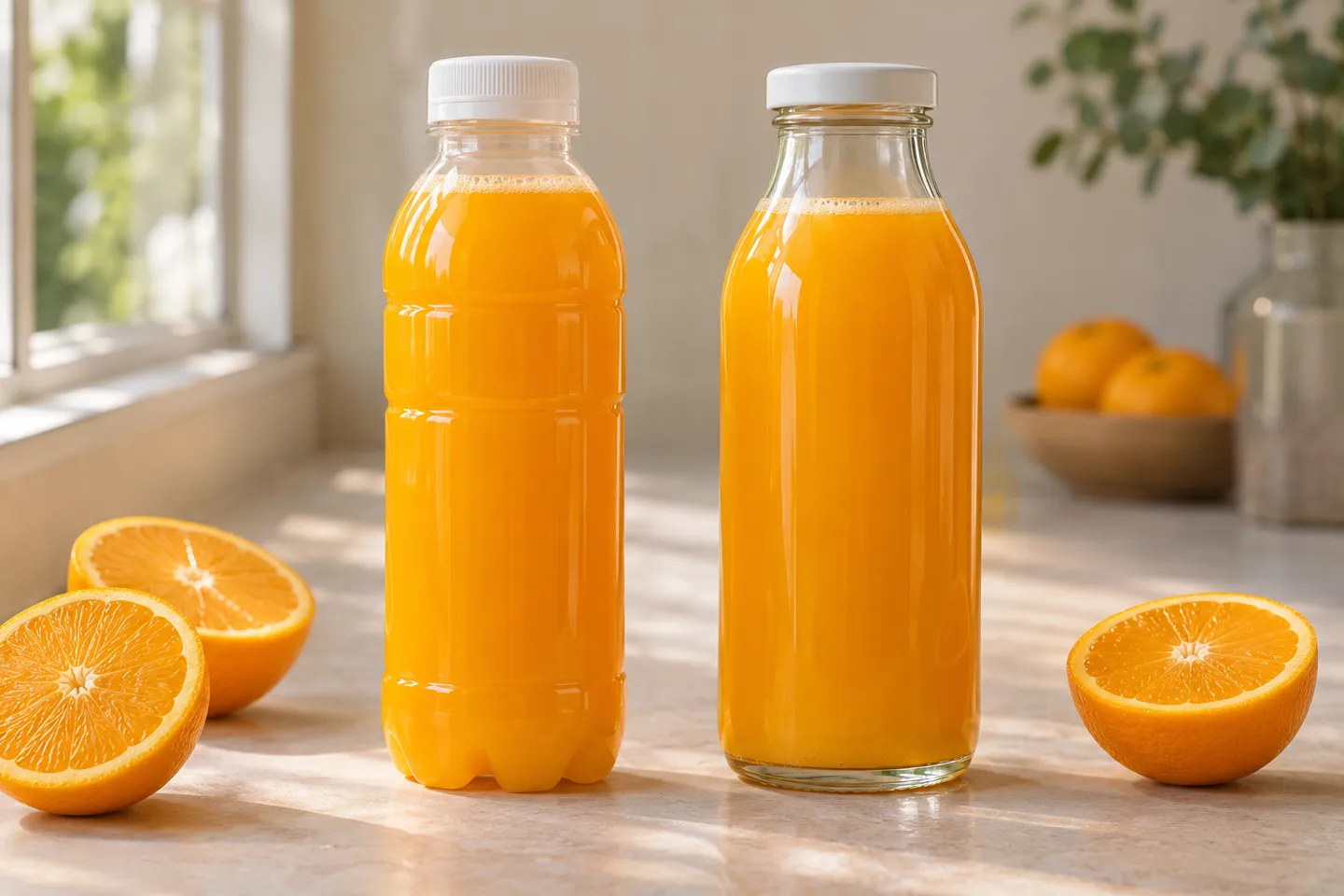
A 500 ml PET bottle of cold-pressed orange juice and a 500 ml glass bottle of the same juice are not the same product. The liquid inside can be identical, yet the two bottles will ship at different costs, survive different handling, sit on different shelves, and command different prices. When people ask about juice bottle types, the useful answer is never one flat list. It is three decisions stacked on top of each other: what the bottle is made of, how big it is, and how it closes.
Material is the decision that drives the other two. The same 500 ml volume behaves completely differently in glass, PET, or paperboard. The oxygen that spoils the juice, the heat that a filling line applies, the cost per unit at order quantities, even the story the bottle tells on a shelf. All of it follows from the material. Size and closure matter, but they get chosen after and around the material.
One quick boundary note, because search results mix two different questions: this guide is about the containers that hold juice, not about the types of juice itself. If you came to sort out glass from PET from aluminum, you are in the right place, and the order below runs from the shelf all the way to the purchase order.
The Five Materials, Side by Side
Five materials do almost all of the work in juice packaging: glass, PET plastic, polypropylene and HDPE, aluminum, and paperboard cartons. Each one has a behavior that decides where it fits.
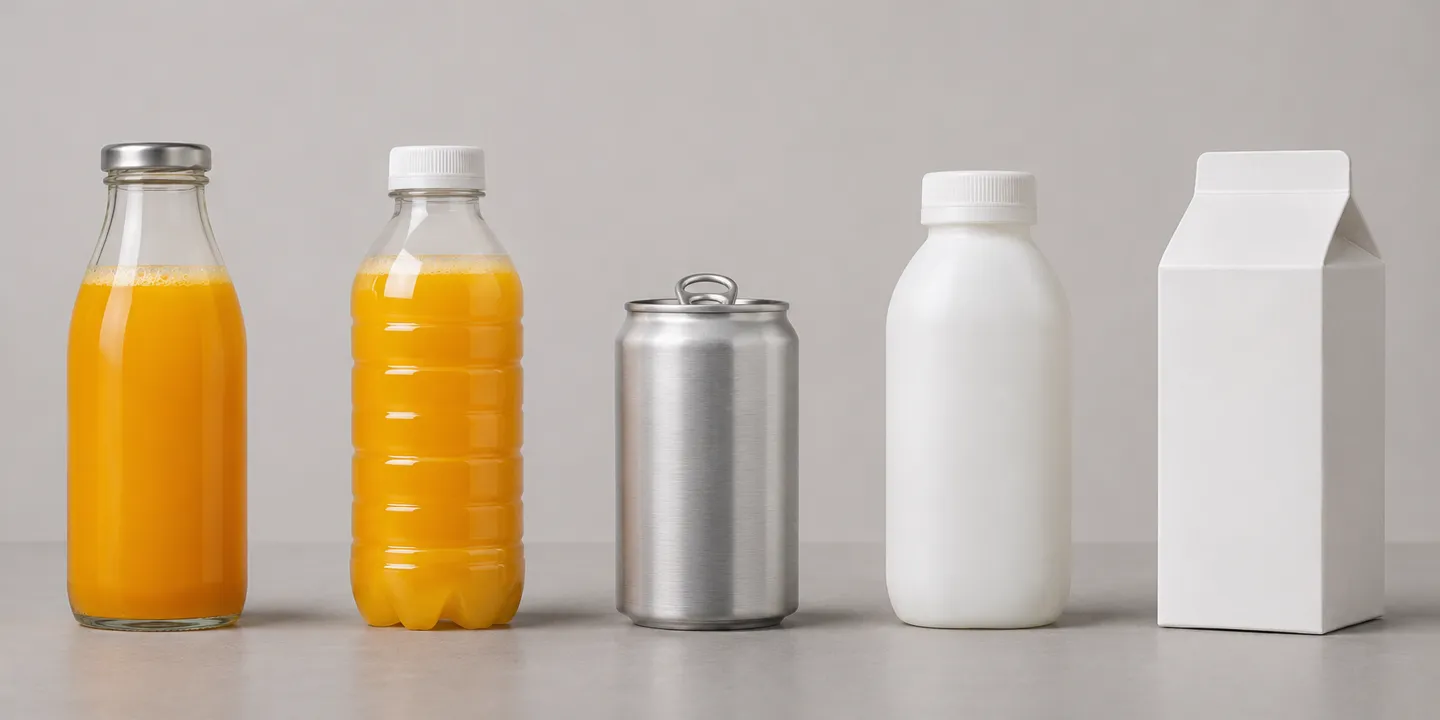
Glass is inert and premium. Nothing in the juice reacts with it, it tolerates hot filling without complaint, and the weight in the hand reads as quality. The costs are weight, breakage, and freight, which is why glass has quietly retreated to premium lines and short supply chains.
PET is the workhorse of the juice aisle. It is crystal clear and shatterproof, it recycles in most curbside programs, and it blocks oxygen decently for its price. Its ceiling is heat: standard PET is not built for hot filling, and that limit starts to matter the moment you pick a filling process.
PP and HDPE are the practical cousins. Polypropylene tolerates heat that PET cannot, which makes it the material for hot-fill lines that can accept a less glassy look. HDPE shows up in dairy-adjacent drinks where opacity is fine.
Aluminum bottles and cans block light completely and carry the easy-open experience people already know from the beverage aisle. Paperboard cartons in the Tetra Pak style also block light and ship flat, which is why long-life juices in ambient retail keep using them. The trade-off is that the shopper never sees the juice, and hot filling them is a specialist process.
Juice bottle materials at a glance
| Material | Oxygen barrier | Heat ceiling | Weight and breakage | Cost tier | Recycling story | Best for |
|---|---|---|---|---|---|---|
| Glass | excellent | very high (handles hot fill) | heavy, breaks | $$$ | returnable and refill narratives | premium lines, short channels |
| PET | good | low standard, medium in hot-fill grades | light, unbreakable | $ | widely accepted curbside | mainstream cold juice |
| PP and HDPE | moderate | high for PP | light, unbreakable | $ | accepted where programs exist | hot fill where clarity can drop |
| Aluminum | excellent plus full light block | high, but not for direct hot fill | very light | $$ | infinitely recyclable narrative | chilled juice cans, energy and coffee drinks |
| Paperboard | excellent plus full light block | low | light | $$ | renewable fiber narrative | ambient long-life juices |
Size deserves one compact map, because it is the other axis buyers actually shop by.
Common juice bottle sizes and where they fit
| Size | Metric | Typical use |
|---|---|---|
| 4 oz | about 120 ml | cleanse programs, samples, kids portions |
| 8 oz | about 240 ml | single-serve cold press, cafe grab and go |
| 12 oz | about 355 ml | meal replacement sizes, coffee plus juice menus |
| 16 oz | about 500 ml | the retail standard for cold juice |
| 32 to 64 oz | about 1 to 1.9 L | family formats and the best cost per ml |
Shape is the last variable, and the lightest one. Round, square, bullet, and flask silhouettes mostly affect shelf adjacency and how the bottle photographs; they rarely change the physics. Treat shape as a branding variable, and spend your decision energy on material and process.
Glass or Plastic: The Decision That Follows Your Channel
The glass-versus-plastic question usually gets argued as a matter of taste or brand image. In practice it is a channel question. Where and how the juice is sold decides which material pays for itself.
Start with the number that decides most small-brand budgets. At bulk order quantities, a 16 oz (500 ml) PET bottle typically lands below $0.60 per unit, while an equivalent glass bottle easily runs above $3.00 and only drops toward $1.50 at large volumes once shipping is included ([Goodnature]). The glass figure is also not the full bill. Breakage in transit stacks on top, and a return program adds de-labeling, washing, and sanitizing labor that PET never asks for.
Glass runs about five times what PET costs per bottle: roughly $3.00 against $0.60.
16 oz (500 ml) scale, bulk order quantities, landed-cost basis.
The market has already voted with its volumes. Plastic holds about 39.8% of global beverage packaging materials, anchored by PET and HDPE (Persistence Market Research, 2026). The whole beverage packaging market, valued at USD 173.6 billion in 2025, is still growing at about 5% a year (Grand View Research, 2026). The mainstream rail of this industry is built around plastic bottles. That is exactly why they are cheap, available, and easy to re-source when a supplier disappoints you.
Glass still earns its keep in specific slots. A high-margin pressed line for cafes, a gift or hotel SKU where weight signals quality, a local delivery route where a returnable bottle becomes part of the brand. These are the slots that pay for glass. What glass does not survive is commodity e-commerce parcel shipping, where breakage refunds quietly eat the margin that the premium look created.
Cost is the first gate, but it is not the last one. The next gate is your filling process, and it is less forgiving than your accountant.
Matching the Bottle to Your Filling Process
Pick the process first, then the bottle, then the size. Working in that order prevents the most expensive mistake in juice packaging: falling in love with a bottle your line cannot fill.
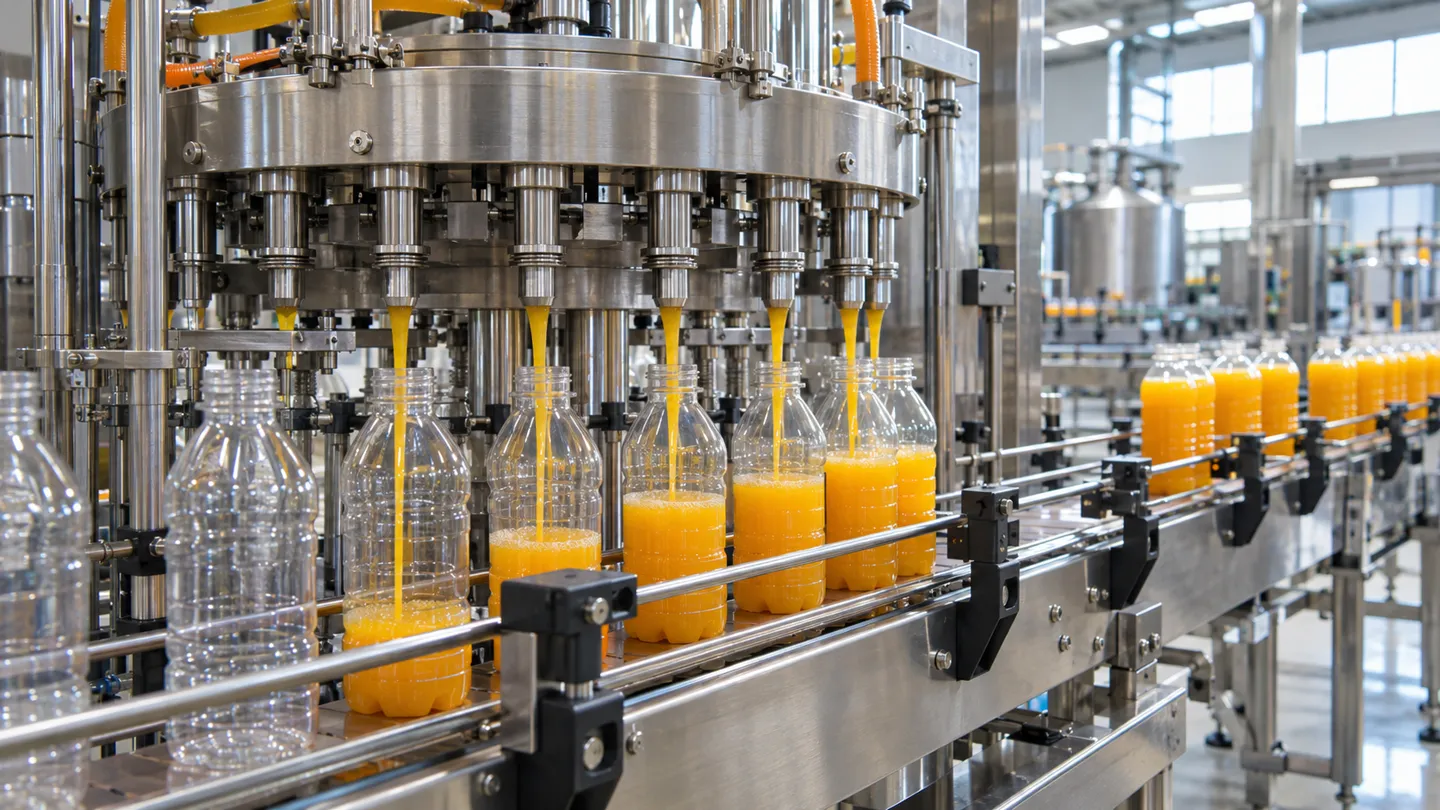
Cold-Fill, Hot-Fill, and HPP: What Each Process Demands
Cold filling is the default and the least demanding option, because it puts no thermal spec on the bottle at all. What it demands instead is honesty about shelf life. Without a kill step, fresh juice lasts about 2 to 3 days refrigerated ([Hiperbaric]), and no bottle changes that biology. Refrigeration and speed to market do.
Hot filling pasteurizes with heat. The juice is heated to roughly 190 to 203°F (90 to 95°C) before it enters the bottle (Oberk, 2015). Standard PET cannot take that treatment. As the hot liquid cools inside a sealed bottle, the pressure differential caves the walls inward, the failure known as paneling. Hot-fill PET exists for exactly this job: the bottles are heat-set during manufacturing, with panel ribs and a crystallized neck that hold their shape near 85°C. Glass and polypropylene also survive the heat, at the price of weight or clarity.
High pressure processing (HPP) pasteurizes with pressure instead of heat. Sealed bottles go into cold water at 400 to 600 MPa (58,000 to 87,000 psi) (Petainer, 2024). The bottle compresses by roughly 10 to 15% at peak pressure and has to spring back, so elastic PET is the natural fit. The failures concentrate at the neck: closures need high thread engagement, with 28 mm or 38 mm caps being typical, and headspace should stay under about 5% (Petainer, 2024). The reward justifies the discipline, because the same fresh juice that lasts 2 to 3 days can stretch its shelf life up to 30 times ([Hiperbaric]).
One practical rule covers all three processes: get the compatibility in writing before the order, not after the first deformed pallet.
Qualify the bottle in this order
Choose the process
Your shelf-life target decides it: cold chain speed for fresh juice, hot fill for ambient teas and juices, HPP for clean-label juice with weeks of refrigerated life.
Qualify the bottle
Against that process: maximum fill temperature, paneling design for heat, elastic recovery and closure spec for pressure.
Fix the size last
Serving occasion sets the volume, and the volume sets the oxidation math.
Sizing: Single-Serve to Family
Three size tiers cover almost every juice business. Single-serve, roughly 8 to 12 oz (240 to 355 ml), fits cleanse programs, cafe counters, and delivery menus. The bottle is emptied the day it is opened, so oxidation barely gets a chance. The 16 oz (500 ml) bottle is the retail standard: big enough to feel like a purchase, small enough to finish in one sitting. Family sizes of 1 L and up deliver the best cost per milliliter, but they sit open in the fridge longer and carry more headspace air.
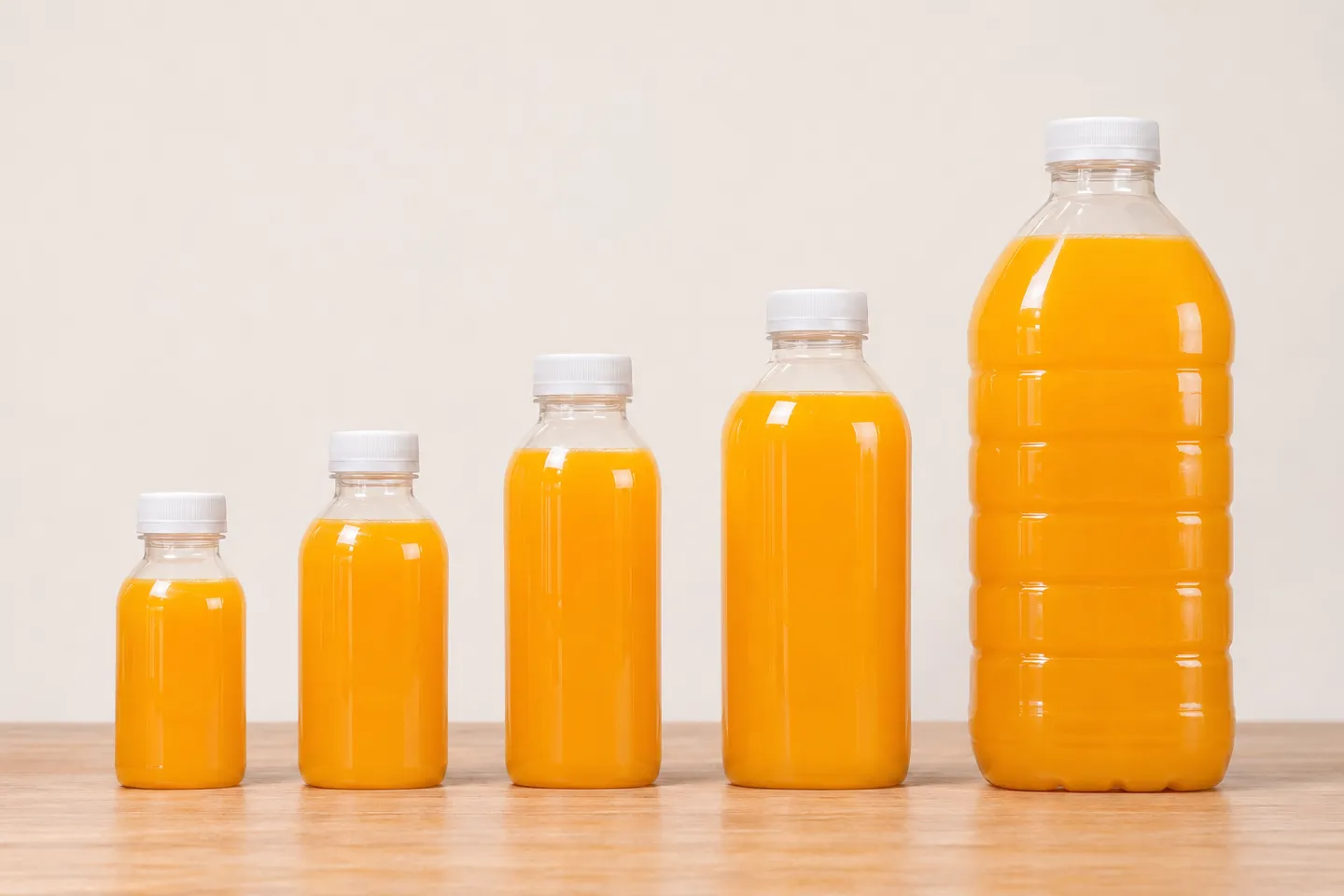
That headspace is not cosmetic. Oxygen sits in the empty volume above the juice and keeps working after the cap closes, which is why the homespun advice to fill a bottle to the neck actually works. It is also why an oversized bottle is a real cost. Home juicers report buying 18 oz bottles, finding that a single serving leaves too much air, and topping the rest up with water to kill the headspace. That is a strange way to lose money twice. Choose the size your serving actually needs, and let the filling line fill it full.
Bigger bottles also want wider necks and heavier caps to feel balanced in the hand. Keep that pairing in mind when you match a closure to a new format, because the closure is where the next section’s problems like to hide.
Send OutstandingPack your fill process and target sizes, and its team will confirm in writing which standard-finish bottles and cans qualify.
Check My Bottle FitFailure Modes and Where Each Choice Breaks
Every packaging failure in juice has a mechanism, and most of them were visible before the first pallet shipped. Five of them cover nearly everything.
How Juice Bottles Actually Fail
Paneling comes first because it looks the most dramatic. The symptom is PET walls caving inward days after filling. The cause is a pressure differential, usually hot liquid cooling inside a sealed bottle. The check before ordering: confirm the bottle’s maximum fill temperature in writing and ask whether the design includes vacuum panels if your process runs hot.
Seal and vacuum loss shows up as flavor that fades early, caps that loosen, or juice that leaks in transit. The cause is usually a closure mismatched to the neck finish, or a neck out of tolerance. The check: ask for seal-integrity test data, since vacuum and water-bath leak tests are standard practice, and get a written neck tolerance, for example neck flatness held within about ±0.1 mm.
Oxidation and flavor drift announce themselves when the juice tastes flat before its date code. The usual causes are a large headspace, too many transfers between vessels, or a barrier weaker than the shelf life printed on the label. The check: fill to the neck and match the material’s barrier to the promise the label makes.
Glass breakage in parcels is the e-commerce failure. The cause is simple: parcel networks drop boxes, and glass transmits every one of them. The check: ask for packed drop-test evidence, with a 1.8 m packed-drop simulation as a reasonable bar, and specify dividers and double-wall cartons in the order.
Heat deformation in sea freight arrives as bottles warped after weeks on the water. Container interiors routinely exceed 60°C on summer lanes, which pushes standard PET to its limit. The check: put heat-insulating wrap, palletizing, and stacking limits into the purchase order itself, not into an email thread your freight forwarder never reads.
The Boundary Matrix: Scenario by Bottle by Limit
Single-point warnings do not help you place an order. The table below is the decision version: find your scenario, take the first pick, and run the confirmation before you sign.
| Scenario | First pick | Why it wins | Where it breaks | Confirm before signing |
|---|---|---|---|---|
| Cold-pressed juice on a 3 to 5 day delivery window | PET bottle with screw cap | cheap, light, leak resistant | fails when you promise shelf life the process cannot deliver | cold-chain plan and fill-to-neck spec |
| HPP processing | elastic PET, high-thread cap, under 5% headspace | survives compression and springs back | fails with sharp corners or low-thread closures | written HPP compatibility and a post-pressure seal test |
| Hot-fill tea or juice | hot-fill PET, glass, or PP | heat-set walls resist paneling | fails instantly with standard PET | maximum fill temperature in writing |
| E-commerce parcel shipping | PET | shatterproof and light | glass refunds eat the margin | packed drop-test data and carton spec |
| Refrigerated retail shelf | clear PET, glass for the premium bay | clarity sells juice | caps loosen in the cold chain | torque spec and neck tolerance |
| Premium gift or hotel line | glass with an aluminum cap | weight reads as quality | cost and breakage must be budgeted | unit cost including a breakage allowance |
Before any deposit leaves your account, five questions close the loop: What is my filling process and its exact temperature or pressure demand? What channel will abuse this package, and how? What shelf life does my label promise? What breakage and refund budget am I accepting? Which documents will I require before the goods ship?
Order gate
Choosing a Supplier: What to Ask Before You Wire the Deposit
By the time you are comparing suppliers, the material decision is made. What separates a good order from a bad one now is paperwork and sequence. Ask in this order.
First, compliance files. Food-contact compliance is not a claim, it is a document. For the EU market that means Regulation (EU) No 10/2011 on plastics intended to come into contact with food (EUR-Lex, 2011). The US market looks to the FDA food-contact rules, plus third-party batch test reports from an accredited lab. Ask how often batches are tested. Quarterly is a serious answer; annual is a formality.
Second, neck finishes and closures. Juice cans and bottles use numbered finish sizes: 202, 211, 300, 305, 307, 401, and 502 are common. The code encodes the end diameter in inches and sixteenths (Worunda, 2026). Locking your product to a standard finish keeps your lids and ends swappable between suppliers, and that swap-ability is your bargaining power on the day a price negotiation turns sour.
Third, sampling and MOQ tiers. Ask how many MOQ tiers exist and what separates them. Printing a logo on an existing stock shape is a different order of magnitude from opening a mold for a custom silhouette, and a quote that blurs the two is hiding something.
Fourth, lead time and transit packaging. Get stock and custom lead times as separate numbers, and make the transit plan explicit: heat-insulating wrap on sea lanes, palletizing, stacking limits. Transit packaging failures are contract failures.
Fifth, after-sales. Ask what happens when a batch leaks. Root-cause analysis, replacement terms, and response time tell you whether you are dealing with a bottle seller or a partner.
One honest boundary closes the list. Custom molds are a real cost, and non-standard neck finishes are usually charged to the buyer. Small batches should stay on standard finishes and stock shapes, and the mold budget should wait for the shape that will actually differentiate the brand on a shelf.
Questions to send before the deposit
The Business Math Behind Your Bottle Choice
Put the cost gap back into your own volumes and it stops being a trivia fact. At roughly five to one between glass and PET at bulk scale, the material choice on a single SKU can move several thousand dollars per production run. That money lands on gross margin, not in a rounding error. Premium materials are a pricing decision you make once per product line. Commodity materials are a margin decision you live with every batch.
Shelf life and process fit decide which doors open. A 3-day fresh product negotiates with cafes and delivery apps. A 30-day HPP product negotiates with convenience stores. An ambient product negotiates with supermarkets. The bottle, matched to the right process, is the ticket those negotiations are priced from.
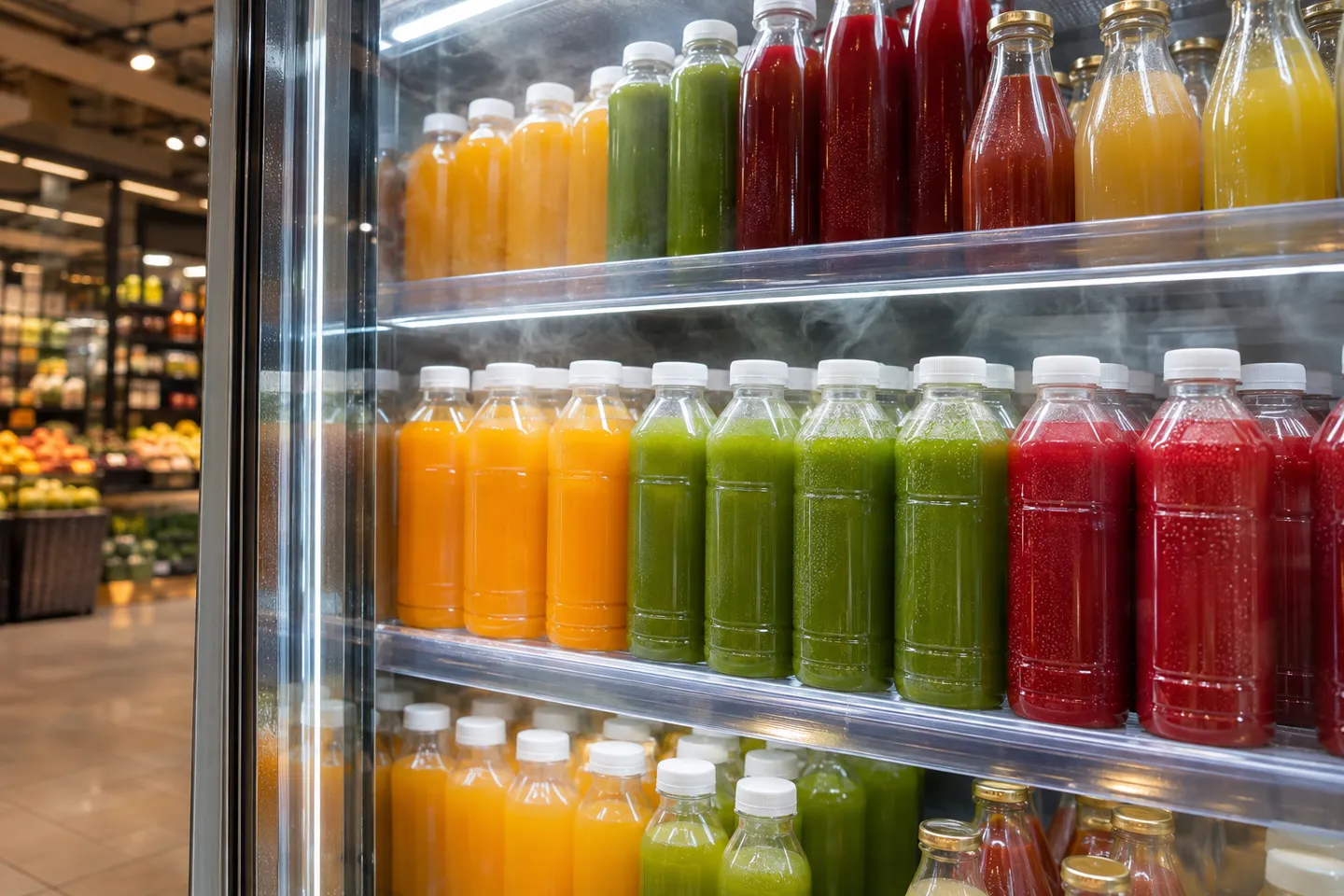
The finish number on your bottle drawing is a supply-chain decision disguised as a dimension. Standard finishes keep a second supplier one email away. Custom molds hand that bargaining power back and charge you for the privilege. Spend mold money on silhouette, not on specifications that already exist.
The industry’s direction makes the default comfortable. Plastic carries roughly 40% of beverage packaging materials (Persistence Market Research, 2026) inside a market still growing about 5% a year (Grand View Research, 2026). A PET-first portfolio is not a compromise; it is the mainstream rail. Glass stays for the line whose price pays for its weight, and cartons stay for the ambient shelf that never sees light.
So sort materials by channel instead of by instinct. PET where volume and shipping dominate, glass where margin and story can carry the cost, cartons where ambient retail rules. Lock standard finishes, put the test documents into the contract, and spend the mold budget only on the shape worth owning.
That playbook is how we work at Outstanding: our PET juice bottles and cans are built on standard finishes, and our light customization (logo printing on stock shapes) starts from 1,000 pieces with 48-hour samples. That means you can test a SKU before committing to a mold. The specifics are on our low-minimum customization options page.
Get Juice Bottles With Specs in Writing
PET juice bottles and cans on standard neck finishes, with fill-temperature, seal-test, and compliance documents on request. Light customization starts at 1,000 pieces with 48-hour samples.
Request a QuoteReferences
- Grand View Research. “Beverage Packaging Market Size, Share and Trends Analysis.” 2026.https://www.grandviewresearch.com/industry-analysis/beverage-packaging-market
- Persistence Market Research. “Beverage Packaging Market Share and Trends Analysis, 2026 to 2033.” 2026.https://www.persistencemarketresearch.com/market-research/beverage-packaging-market.asp
- Goodnature. “Plastic vs Glass Bottles for Cold-Pressed Juice.”https://www.goodnature.com/blog/plastic-vs-glass-bottles-cold-pressed-juice
- Petainer. “High Pressure Pasteurization and Packaging Compatibility.” 2024.https://www.petainer.com/insights/packaging-technology/high-pressure-pasteurisation-packaging
- Hiperbaric. “More Information about HPP.”https://www.hiperbaric.com/en/hpp-technology/what-is-hpp/more-information-about-hpp/
- Oberk. “Hot Filling Beverages and Juices in PET?” 2015.https://www.oberk.com/packaging-crash-course/quick-question-monday-hot-filling-beverages-and-juices-what-is-the-process
- EUR-Lex. “Commission Regulation (EU) No 10/2011 on Plastic Materials Intended to Come into Contact with Food.” 2011.https://eur-lex.europa.eu/legal-content/EN/TXT/?uri=CELEX:32011R0010