Two cafés can order what looks like the same 500 ml clear cup and get completely different results. At one shop, lids snap on tight and the sealing machine runs all day without a wrinkle. At the other, seals crease, lids pop off in the delivery bag, and half a case of cups quietly becomes stockroom waste. The cups themselves are rarely defective. The failure is a mismatch between cup diameter, lid type and sealing equipment, and it happens because most buyers are never told that these three things are one system. This guide walks through the decisions that separate those two shops: materials, drink boundaries, sourcing channels, and the checks that protect an order before money moves.
What Disposable Cups Are Actually Made Of
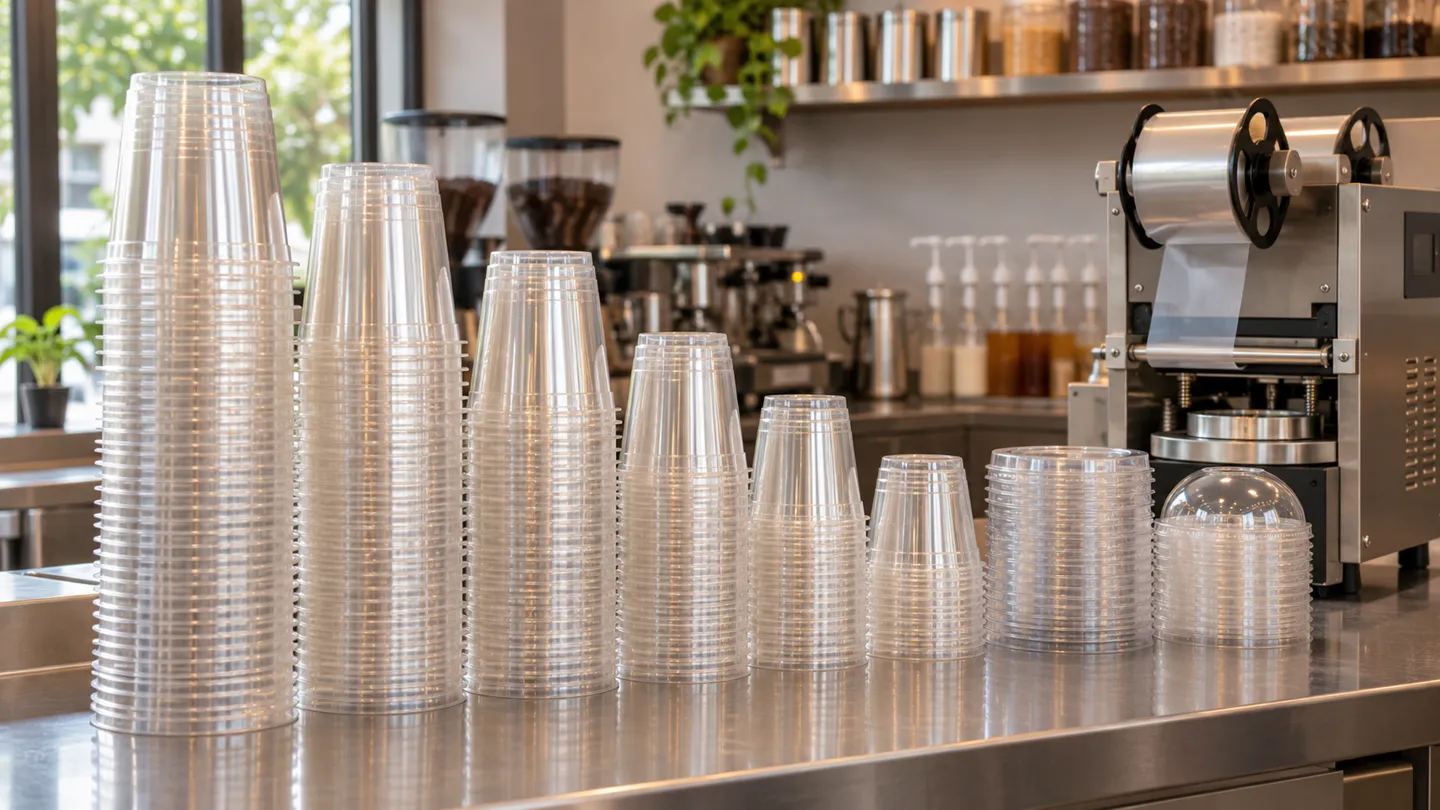
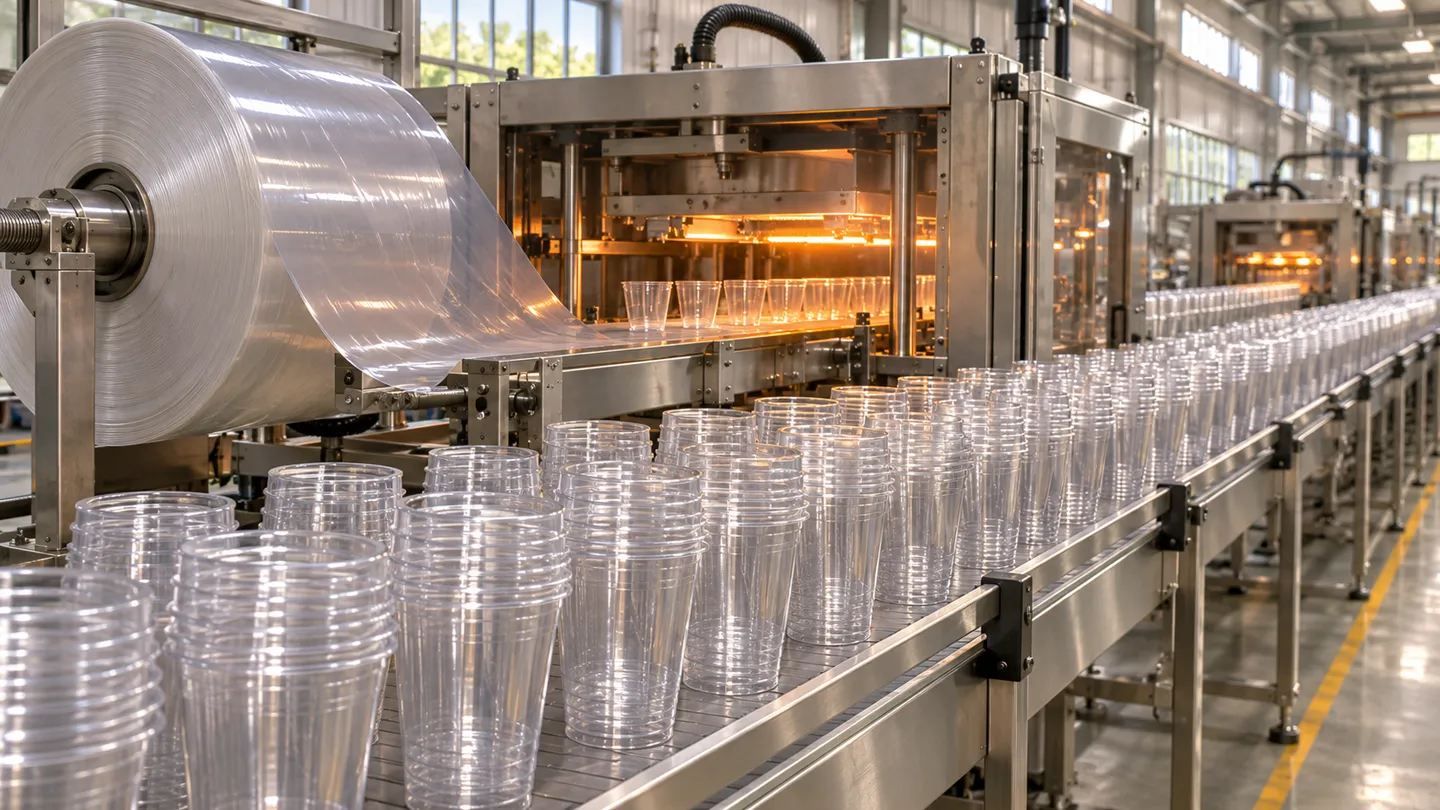
Four materials dominate commercial disposable cups, and each starts life on a different production line. PET (polyethylene terephthalate) is the clear, glass-like plastic behind most iced coffee and bubble tea cups. It starts as a small test-tube-shaped preform, which is heated and stretch-blown into the final cup shape. That process is why wall thickness and clarity track the quality of the preform. PP (polypropylene) is the slightly milky, softer plastic that bends without cracking, which makes it the default for hot drinks. PLA is a plant-based plastic pitched at compostable packaging programs. Paper cups start as flat stock with a polyethylene lining, single or double coated, then get rim-rolled into shape.
The cost and feel differences you notice across suppliers mostly trace back to resin quality and process control, not to secret designs. Virgin PET resin gives clear walls with no odor; recycled or blended stock saves cost but costs you transparency and batch consistency. One clarification before going further: premium “reusable-feel” party cups (the thick-walled Tossware style) are a different category with a different price structure. Everything in this guide is about commercial single-use cups: the cups a café, tea shop, juice brand or food packer buys by the pallet.
Matching Cup Material to Drink, Temperature and Delivery
The fastest way to waste a pallet of cups is to assign materials by price per unit instead of by drink. Three boundaries decide almost every real-world failure.
The first boundary is temperature. Standard PET cups hold cold drinks superbly but tolerate roughly 60-65°C at most, which is why manufacturers explicitly warn against hot filling in PET (Outstanding FAQs). The SKU-level data confirms the working range: clear PET cups across 250-1,000 ml are rated -30°C to 60°C. PP is the correct material above that line; it stays stable up to around 130°C and is the only widely used plastic rated safe for microwave reheating (Palmetto Industries, 2025). The common shop-floor myth that “plastic cannot take hot drinks” is really a PET statement, not a plastics statement.
The second boundary is the eco claim. PLA is marketed as compostable, but it only fully breaks down inside industrial composting facilities, typically running at around 55-60°C (Greenprint Products, 2026). Peer-reviewed research confirms those are the conditions full biodegradation requires (Fogašová et al., 2022). If your city has no industrial composting stream, a PLA cup behaves closer to ordinary plastic in the landfill. Verify the local waste infrastructure before printing “compostable” on your cup or your marketing. rPET (recycled PET) sits differently: it keeps the recycling stream and usually keeps food-grade certification, but expect slightly less optical clarity than virgin resin.
The third boundary is delivery. A sealed film lid survives a delivery bag better than a snap-on dome lid. A screw-on lid survives it better still, which is why ready-to-drink brands moving into e-commerce keep shifting toward screw-top formats. Condensation on cold cups also matters more than most buyers expect: it softens adhesive labels long before the print itself fails.
Match the Cup to the Drink
| Your scenario | Material that holds | Boundary action |
|---|---|---|
| Cold drinks, iced coffee, bubble tea | PET | Confirm -30°C to 60°C rating and condensation-resistant printing |
| Hot drinks, soups | PP or double-wall structure | Confirm heat rating in writing, never assume from transparency |
| Delivery and takeaway | PET or PP with sealed film or screw lid | Test one sealed case in a real delivery bag before scaling |
| “Eco” positioning | PLA or rPET | Verify local industrial composting or recycling stream first |
| Dry goods and food jars | PET food-grade | Check food-contact certification matches the batch |
Where to Source: Three Channels, MOQ and the Real Cost Structure
Every disposable cup on the market reaches you through one of three channels, and each channel answers a different volume problem. Local distributors sell stock cups by the case with minimal commitment; you pay a markup per unit but you can start this week. Domestic custom shops print your logo on blanks with moderate minimums and fast turnaround, at a noticeably higher unit price. Overseas factories sell at the lowest unit cost in exchange for larger quantities and longer, less forgiving logistics.
The confusion around minimum order quantities mostly comes from people quoting two different products. Light customization (printing your logo and color on existing stock molds) typically starts around 1,000 units at manufacturers that run it as a standard program. Full customization with a new mold typically starts at 30,000-100,000 units, because the tooling has to amortize (Outstanding FAQs). Those are exactly the two floors one manufacturer publishes: 1,000 for light work, 30,000-100,000 for mold-based. Industry guides for China sourcing put the common custom floor at 20,000-50,000 pieces per size and design (CupsPak, 2026). Quote your quantities with the right label attached, or you will compare a stock-print program against a mold program and wonder why the prices differ tenfold.
Three channels at a glance
| Channel | Typical minimums | Unit-price ballpark | Fits when |
|---|---|---|---|
| Local distributor | By the case, no program floor | Stock price plus distributor markup | You need cups this week |
| Domestic custom shop | Moderate; light custom from about 1,000 units | $0.08-0.15 per cup (US custom work) | Fast turnaround on logo blanks |
| Overseas factory direct | 1,000 light custom; 30,000-100,000 for a new mold | $0.03-0.08 factory-direct | Lowest unit cost at scale |
Unit prices need the same discipline. A café forum figure of about $0.05 per cup refers to 2019 stock cups bought by the thousand-case (r/smallbusiness, 2019). Café owners who source custom double-wall cups directly report roughly $0.11-0.15 per cup landed from Alibaba suppliers (r/barista, 2026). China sourcing guides bracket the factory-direct range at $0.03-0.08 against $0.08-0.15 for domestic US custom work (CupsPak, 2026). Material, wall layers, size and print method move every one of those numbers, so a quote without those four qualifiers is not a price, it is a placeholder.
The market itself makes this a long game rather than a one-off purchase. The global disposable cups market was valued at USD 18.5 billion in 2025 (Grand View Research, 2026). It is projected to reach USD 25.0 billion by 2033, a 3.7% CAGR from 2026. A cup program that gets re-ordered every quarter rewards whoever gets the channel decision right once, not whoever wins a single quote cycle.
The channel decision scales with your annual volume: under roughly 10,000 cups a year, stock plus local printing wins on total cost; 10,000-50,000, light customization at a factory-direct price starts to beat domestic custom shops; beyond 50,000 or when you want a proprietary cup shape, mold-based customization becomes the conversation, and the mold fee is negotiated separately.
The Diameter System: Cups, Lids and Sealing Film as One Set
The most expensive mistake in cup sourcing is not quality, it is incompatibility. Cup mouth diameters are standardized, with 90 mm, 95 mm and 98 mm dominating cold-drink formats. The same logic runs through food-can neck sizes: 202, 211, 300, 307, 305, 401 and 502. One buyer on a bubble-tea forum went looking for his shop’s cups, and he did not ask for “a good 500 ml cup”. He asked specifically for 95 mm diameter cups in 500 and 700 ml with a rounded bottom, because his sealing machine only accepts that format (r/boba, 2024). That is the level at which this purchase actually gets decided.
The 95 mm trap
A cup that is 1 mm off your sealing machine’s ring, or paired with a lid from a different diameter series, does not fail visibly at the factory. It fails at your counter, one seal at a time, and the whole case reads as “defective stock“. Always verify cup mouth diameter, lid series and sealing film or machine ring as one set, and re-verify whenever any one of the three changes.
The printing decision is the second half of this system, and it behaves differently across the customization stages. Silk-screen printing on stock PET cups is the economy route inside light-customization programs. Condensation on cold cups, however, is hard on any surface print. That is why adhesive labels remain the workhorse for iced formats and heat-shrink sleeves dominate premium looks. Mold-based customization opens the structural options: proprietary cup silhouettes (square, tapered, double-wall anti-scald walls), integrated straw-hole lids, and wall thickness tuned to the drink. This is also where a factory’s tolerance data stops being trivia. A lid that seats properly on every cup in a 30,000-unit run is the direct product of mouth-flatness tolerances. The suppliers who publish their numbers are showing you the mechanism behind the seat test you would otherwise learn about in your own shop (Outstanding quality control). Look for mouth flatness within ±0.1 mm, wall thickness deviation at or under 0.05 mm, and vacuum plus water-immersion leak testing behind it.
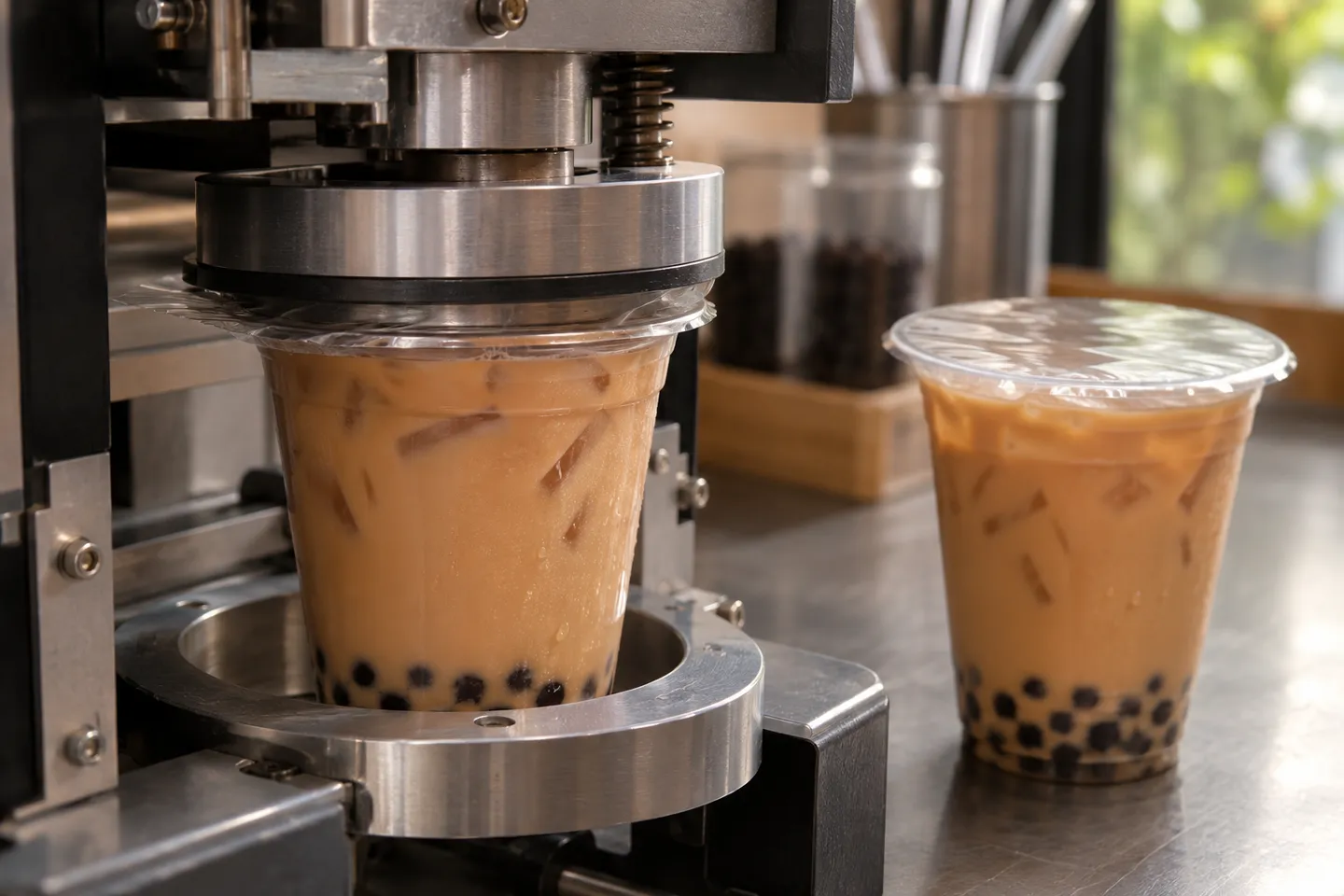
We run our custom cup programs at Outstanding on exactly this logic. Light customization on existing stock starts at 1,000 units for logo, color and printing; full mold-based customization starts at 30,000 units across 12-plus customization categories. Every quote is priced as a set (cup, lid, sealing film), so the diameter system is settled before production, not after (custom cup programs). Our PET cup range spans 250-1,000 ml in the 90-98 mm series with flat, dome, straw-hole and screw-on lids (PET cup range).
One-Set Sourcing: Options and Their Boundaries
| Sourcing option | Fits when | Boundary action |
|---|---|---|
| Stock PET cup + stock lid | Volume is modest, launch is urgent | Confirm lid and cup come from the same diameter series in writing |
| Light customization (print on stock mold) | You want your brand on a proven cup | Confirm print method survives condensation; ask for a cold-chain sample |
| Mold-based custom cup | Volume is stable and a proprietary shape has value | Get mold fee, sample date (about 15 days) and 30,000-100,000 MOQ in one quote |
| Double-wall structure | Hot or hand-comfort matters | Confirm wall spec and drop-test results, not just the photo |
| PLA line | Your market has industrial composting | Get the compostability certificate and verify local processing exists |
How to Verify a Cup Manufacturer Before the Deposit
Quotations tell you what a manufacturer wants to sell you. Verification tells you what they can ship, and it runs in five steps.
Specs and Tolerances to Demand in Writing
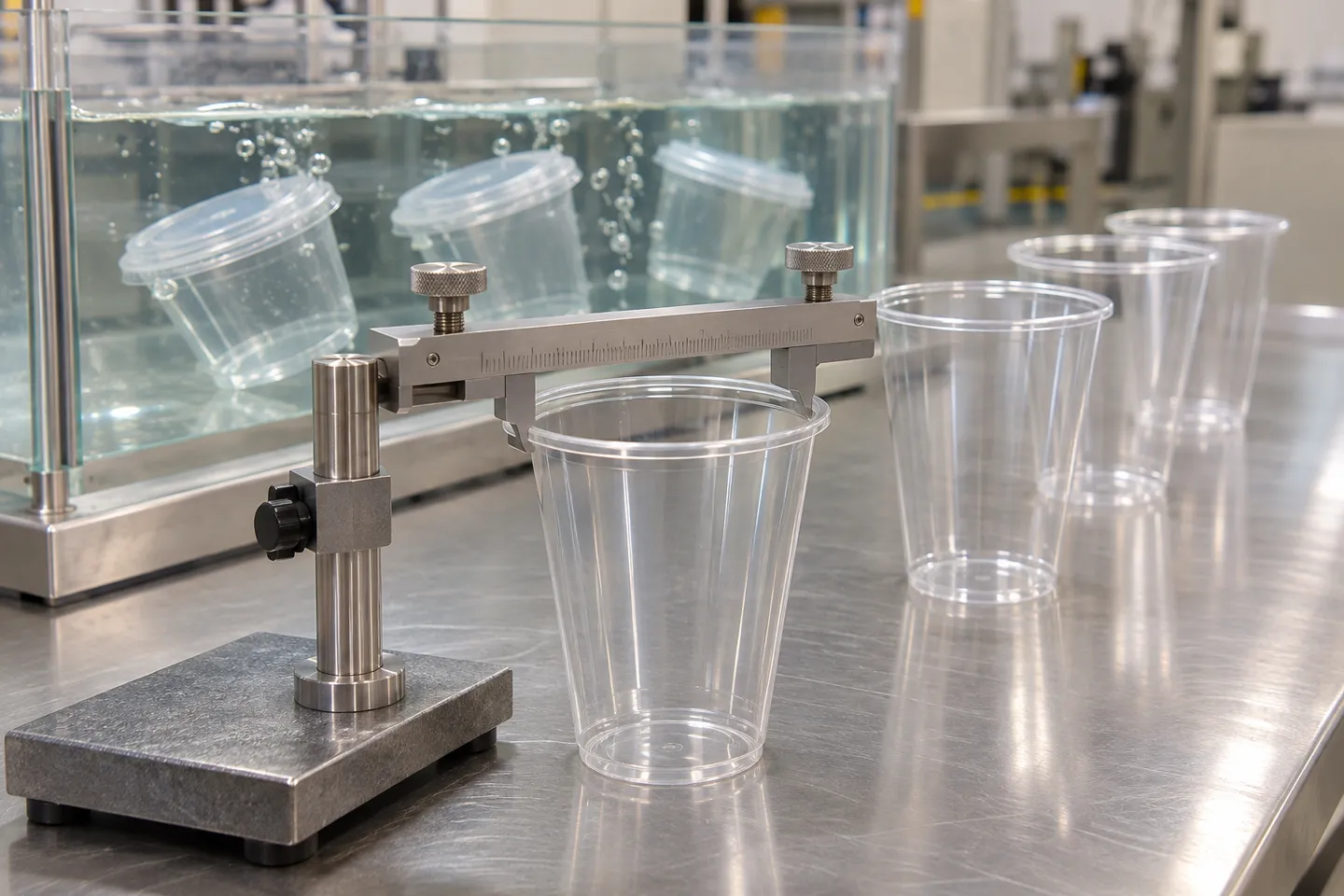
Ask each shortlisted factory to state, on the quotation, the numbers they control. Preform or cup weight tolerance: a serious line holds about ±0.1 g. Mouth flatness: ±0.1 mm. Wall thickness deviation: 0.05 mm or better. Leak testing method: vacuum or water immersion, not “visual check”. Drop testing with contents: 1.8 m is the standard anyone with a lab can run. Pass-rate claims need a denominator: a 99.8% pass rate quoted across IQC, IPQC, FQC and OQC stages means something different from a 99.8% quoted off one final visual table. One factory that publishes this chain is describing a system you can audit: 30,000 m² of automated lines, 36 machines, a 100,000-class cleanroom and quarterly third-party testing (Outstanding quality control). A supplier who cannot name their tolerances is describing a trading company.
OutstandingPack puts these tolerances on a quotation, priced as one cup, lid and sealing film set.
Request a quoted setCertificates, Batch Testing and the Sample Chain
Food-contact certification is where sourcing fraud actually lives, because certificates are files, and files get reused. The specific regulation for plastic food-contact materials in the EU is Commission Regulation (EU) No 10/2011 (EUR-Lex, 2011); FDA compliance has its own food-contact substance framework in the US. What protects you is not the logo on the PDF but the linkage between that PDF and your shipment. Ask for test reports that name the batch. Prefer suppliers who send products for third-party testing quarterly rather than annually. Before any deposit, run the sample chain. Most manufacturers send free samples, commonly five to six pieces and up to 20 at no charge. 3D samples from your drawings are also standard. A factory that turns simple samples in 48 hours is telling you its production discipline, not just its courier account.
Pilot Orders, Freight Checks and Peak-Season Promises
The first order should be a pilot. Size it to run the cups through your real sealing machine, your real fridge, and one week of real service. Only then should the second order multiply everything. Sea freight is the step most first-time importers underestimate. Containers in summer regularly deform thin-wall PET, which is why experienced suppliers pack heat-insulating film by default and reinforce cartons for e-commerce parcel abuse. Get the peak-season promise in writing. Realistic lead times are 3-5 days for stock or light-customized orders and 15-20 days for mold-based production. The difference between a factory and a middleman shows in who owns that schedule when August compresses it. After-sales matters more than the sales pitch. A 12-person support team that sends sealing-operation videos when your staff struggle is worth more than any brochure. So is defect handling that covers replacement, compensation and root-cause analysis. That is the difference between a solved problem and a lost quarter.
The five-step pre-deposit check
- 1Tolerances named in writing (weight ±0.1 g, mouth ±0.1 mm, wall ≤0.05 mm)
- 2Certificates linked to batch numbers, quarterly third-party testing
- 3Free samples tested in your real machine and fridge
- 4Pilot order through actual service before scaling
- 5Peak-season lead time and after-sales terms in the contract
What This Means for Your Cup Program
A cup program is a repeating decision, not a one-time purchase, and the sequence you follow saves more money than any single quote. Start from your menu, not the catalog. Assign the material by drink. PET for cold, PP above the PET temperature ceiling, PLA or rPET only where your local waste stream can honor the claim. Lock the set second: cup diameter, lid series and sealing method chosen together, because the 95 mm trap does not care how good your unit price was. Choose customization depth third. Light customization at the 1,000-unit level carries most brands through their first year without touching a mold fee. The step to mold-based work at 30,000-100,000 units should follow demand you have already measured. Vet the factory last but hardest, with tolerances, batch-linked certificates, samples and a pilot order doing the work that a sales deck cannot.
For franchisees and independent shop owners, that sequence protects cash. You get a branded cup in weeks at a four-figure commitment, instead of tying up a mold payment on demand you have not proven. For distributors and resellers, the same logic scales up. The depth of your diameter and lid coverage drives reorder rates, because a buyer whose full set works never shops for a replacement cup supplier.
That is the standard we hold our own program to. Batch-linked certification (FDA, EU 10/2011, SGS, RoHS, REACH, CE) gets refreshed by quarterly third-party testing. Samples turn around in 48 hours, and the 3-5 day schedule for stock and light-custom orders goes in writing (certification documentation, delivery schedules). A supplier who will not put those numbers in a quotation is not asking for your trust; they are avoiding your test.
Source cups, lids and sealing film as one set
Send your drink menu, cup diameter and monthly volume, and the quote comes back priced as a complete set.
Start your cup programReferences
- Grand View Research. “Disposable Cups Market Size and Share Report, 2026–2033.” 2026.https://www.grandviewresearch.com/industry-analysis/disposable-cups-market
- EUR-Lex. “Commission Regulation (EU) No 10/2011 on Plastic Materials and Articles Intended to Come into Contact with Food.” 2011.https://eur-lex.europa.eu/legal-content/EN/TXT/?uri=CELEX%3A32011R0010
- Fogašová, M. et al. “PLA/PHB-Based Materials Fully Biodegradable under Industrial Composting Conditions.” International Journal of Molecular Sciences, 2022.https://pmc.ncbi.nlm.nih.gov/articles/PMC9572414/
- Palmetto Industries. “Is Polypropylene Heat Resistant? Max Temp Rating & More.” 2025.https://www.palmetto-industries.com/is-polypropylene-heat-resistant/
- Greenprint Products. “Why PLA Requires Industrial Composting to Break Down.” 2026.https://greenprintproducts.com/why-pla-requires-industrial-composting/
- r/boba. “New Shop Owner Here — Who Is Your Cup Supplier?” 2024.https://www.reddit.com/r/boba/comments/1d23mof/new_shop_owner_here_who_is_your_cup_supplier/
- r/barista. “How Much Do You Pay for Your Paper Cups?” 2026.https://www.reddit.com/r/barista/comments/1u9gkd4/how_much_do_you_pay_for_your_paper_cups/
- r/smallbusiness. “Coffee Shop Owners.” 2019.https://www.reddit.com/r/smallbusiness/comments/b2cdh4/coffee_shop_owners/