A plastic cup of iced tea sits ten steps from the office microwave. Someone wants it hot in ninety seconds. The cup carries no symbol and no warning, so the decision rides on the plastic it is made of. That material sets a temperature range, and the range decides whether the cup survives its trip. Standard PET tops out near 60°C. Microwave-grade PP takes roughly 120°C. Everything else about cup safety follows from that gap, from one cup on a counter to a pallet on a purchase order.
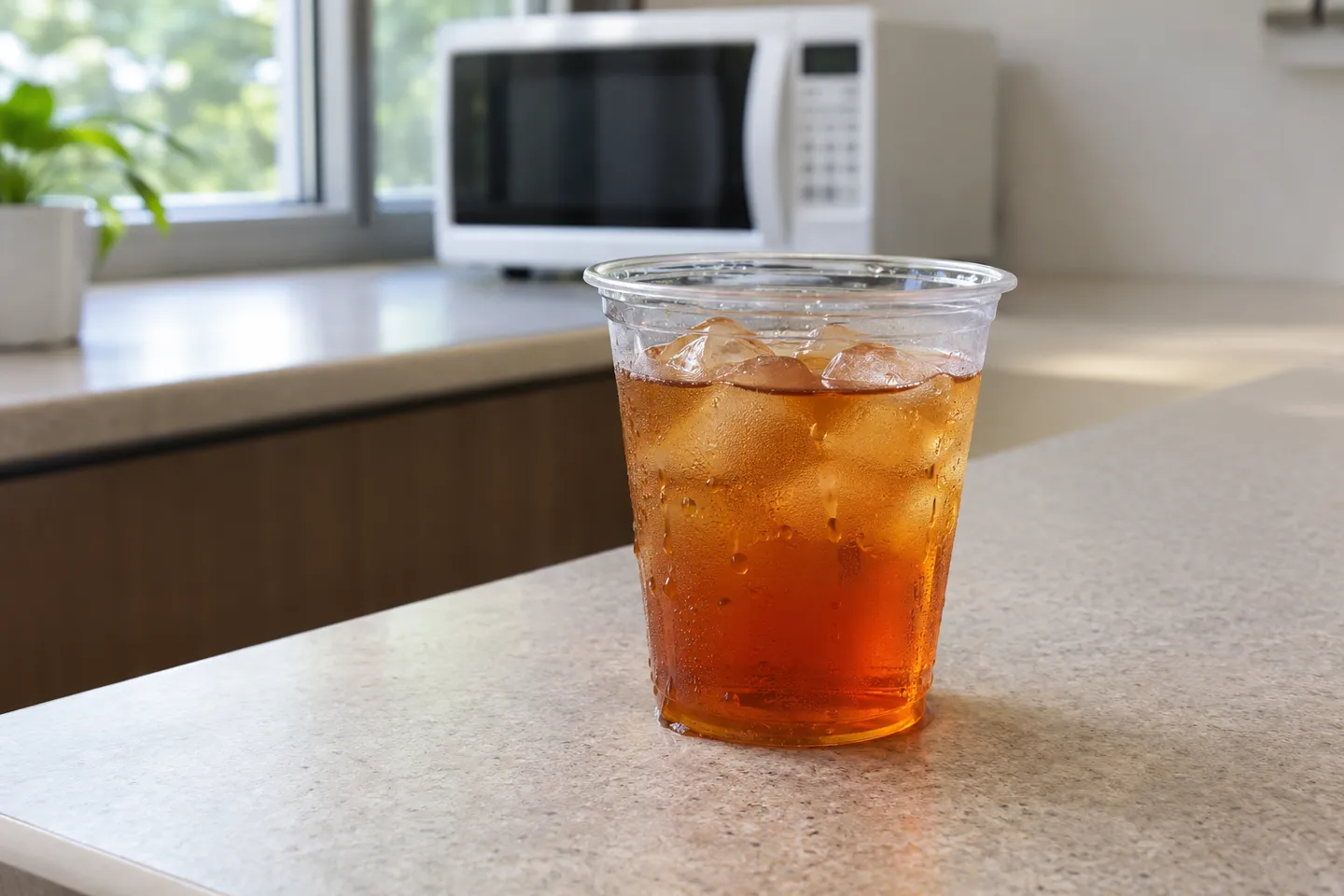
How to Tell if a Plastic Cup Is Microwave-Safe
Two different products get called “plastic cups.” A thin-wall cup sealed under film and sold in sleeves of a thousand is designed for one drink and one cold or iced serving. A thick-wall reusable tumbler is designed to survive dishwashers and years of handling. The judging steps below work for both, but the safety margins do not, so a single-use cup deserves the stricter reading.
Start with the markings. A microwave icon with wavy lines, or the words “microwave safe,” means the maker ran the container through exposure testing before printing that claim. Only containers that pass this kind of test can display the icon or wording (Harvard Health Publishing, 2017). An unmarked container is simply one the FDA has not reviewed. It is not one proven safe. On a thin single-use cup, an absent icon should settle the question.
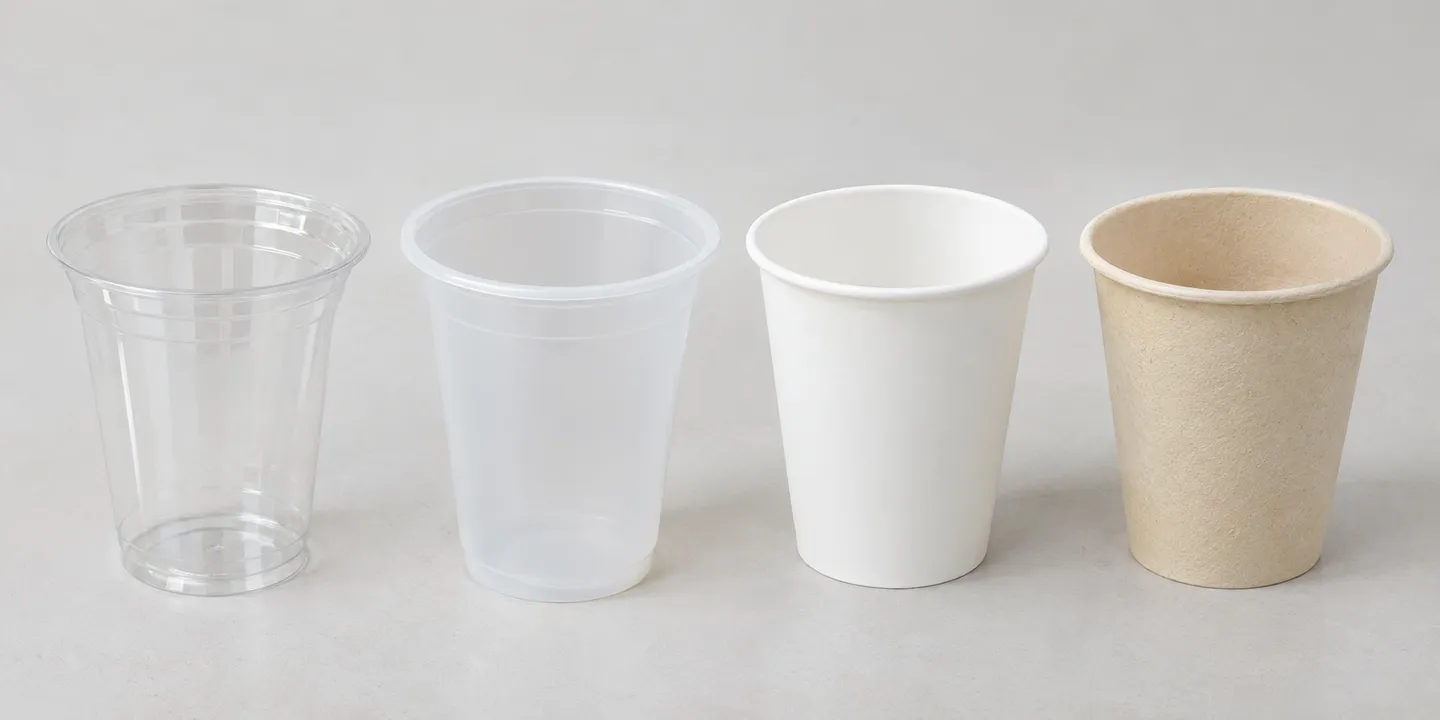
Next, read the number. The code inside the chasing-arrows symbol is a Resin Identification Code, numbered 1 through 7, and it identifies the resin the article is molded from rather than its recyclability (ASTM, 2021). Three codes cover almost every cup you will meet. Code 5, polypropylene, tolerates microwave-level heat better than any other common cup plastic. Code 1, PET, is the classic clear cold-cup plastic, and it has no business near a microwave. Code 6, polystyrene, joins melamine tableware in the hard-no group. FDA guidance states plainly that foods and drinks should not be heated on melamine dinnerware in microwave ovens (FDA, 2017).
No icon and no code leaves step three: treat the cup as not microwave-safe and go find the spec. The manufacturer’s data sheet or the seller’s listing should state a working temperature range in writing. If neither exists, the cup stays out of the microwave, full stop.
The 30-second cup check
One boundary matters here. The icon certifies that a container will hold its shape, not that zero substances migrate into the food; migration limits exist and are tested separately within regulatory margins. That is why the steps above are about finding tested limits, not about a search for a magic plastic that heat cannot touch.
What Each Cup Material Can Take: Temperature Limits and Where They Fail
The physics explains why material matters more than cup shape. Microwave ovens pass through glass, paper, ceramic and plastic and heat the food directly; the container warms afterward, from the heat of the food inside it (FDA, 2023).
The cup never meets the heating element. The oven heats the drink, and the drink carries the heat into the walls around it. So read every verdict below as a pairing: how hot the drink can get, and what temperature this plastic tolerates.
⭐ PET: The Cold-Cup Standard With a Hard Ceiling
PET dominates clear cold cups because it shows the drink, survives freezer shelves, and ships cheap. Its thermal file tells a narrower story. The glass transition temperature, the point where PET shifts from rigid toward soft, typically falls between 70°C and 80°C (Linseis, 2025). Working ranges printed on PET cold-cup data sheets sit below that, usually around -30°C to 60°C. That leaves roughly zero headroom between a chilled soda and a reheating error.
Failure arrives in stages rather than a single melt. First the rim softens where hot liquid concentrates. Then a thin wall loses its shape or a heat-seal film lets go along the rim. A cup that looks intact can still have crossed its limit invisibly, which is why PET failure is a range of symptoms, not one dramatic event. The same ceiling applies across the PET family: juice bottles, food jars and recycled-content rPET cups all inherit it, so the code-1 rule travels with the whole shelf.
⭐ PP: The Microwave-Grade Workhorse
Polypropylene earns code 5 its reputation on temperature. PP holds service temperatures up to roughly 130°C, which places a normal microwave reheat comfortably inside its range (Palmetto Industries, 2025). That is why hot-fill and microwavable cup lines are specified in PP, and why a shop that pours anything steaming should be stocking code 5 rather than hoping.
Tolerance at the resin level still does not guarantee it for a specific cup. Wall design, additives and lids all matter, and a PP body paired with a non-PP lid is only as microwave-ready as its weakest part. The printed claim remains the deciding fact. Container testing reviews note that only tested containers earn the label, and migration continues to be managed within regulatory margins even for approved ones (Harvard Health Publishing, 2017).
PS and Melamine: The Hard No
Polystyrene, code 6, combines a low softening point with styrene migration concerns when food contacts it hot. The honest default is simple: no microwave unless that exact container is labeled for it. Melamine is stricter still. FDA guidance states that foods and drinks should not be heated on melamine-based dinnerware in microwave ovens (FDA, 2017). Melamine also turns up in cheap reusable tableware and kids’ sets, which is exactly where the habit of reheating forms.
PLA and Paper: The Edge Cases
PLA, the compostable plant-based plastic, is chosen for its end-of-life story, not its heat file. It begins to soften and deform above about 50°C (Bioleader Pack, 2025), which puts it below PET on temperature despite its green appeal. A PLA cup is a cold-drink cup with a disposal advantage, and treating it as heat-resistant because it is “plant-based” is the fastest way to warp a shelf of stock.
Paper is not automatically microwave-friendly either. The fiber passes microwaves fine; the polyethylene lining, the seams and the inks are the variables. Corrugated-wall paper cups are built for holding a hot drink comfortably in hand, which is a different job from surviving a microwave cycle. Unless the maker claims microwave safety for that exact cup, paper follows the same rule as everything else: no label, no microwave.
| Material | Code | Working range | Microwave verdict | What crossing the line looks like |
|---|---|---|---|---|
| Standard PET (cold cups, bottles, jars) | #1 | About -30°C to 60°C | No | Rim softening, wall warp, seal film release, then visible collapse |
| Microwave-grade PP | #5 | Up to about 120-130°C | Yes, if labeled | Generally unmarked; check lid material |
| Polystyrene / foam | #6 | Softens near serving temps | No | Wall softening, styrene migration risk |
| PLA bioplastic | #7/PLA | Softens above about 50°C | No | Deformation starts below PET’s limit |
| Paper cup with lining | varies | Holding hot ok | Only if maker claims it | Lining, seam and ink behavior vary |
| rPET | #1 | Same ceiling as PET | No | Identical failure pattern to PET |
One cup, two worlds
The material sets the ceiling, not the cup.
What Actually Happens When You Heat the Wrong Cup
Duration feels like a safety unit, but temperature is. Thirty seconds in a microwave is not a fixed dose; the outcome depends on what is inside the cup. Water-based drinks climb slowly. Thick, sugary or fatty drinks reach higher peaks faster, and migration of substances from plastic rises with fatty foods in particular (Harvard Health Publishing, 2017). A short burst of reheated milk tea stresses a PET cup more than a long warming of plain water. The drink itself carries the heat into the walls.
Once a cup has visibly softened or warped, the decision is already made. The wall crossed its structural limit, so the cup is retired, whatever it contained. A single accidental exposure rarely creates an emergency. The repeated habit of microwaving a marginal cup is the mistake that compounds, because aged and stressed plastic sheds more (Harvard Health Publishing, 2017).
If your shop stocks cups in volume, every line should publish its temperature range in writing: the OUTSTANDING team sends data sheets plus real samples for your own hot-fill test.
Request the Data SheetsSealed cups fail differently from open ones. A film-sealed or lidded cup traps steam, so heating builds pressure that finds the weakest joint. The seal peels at the rim, a dome lid pops, or the film lets go into the drink. Shops running sealing machines already know the matching problem from production. The film, the rim temperature and the cup material have to be specified together, and heat is the variable that breaks the trio.
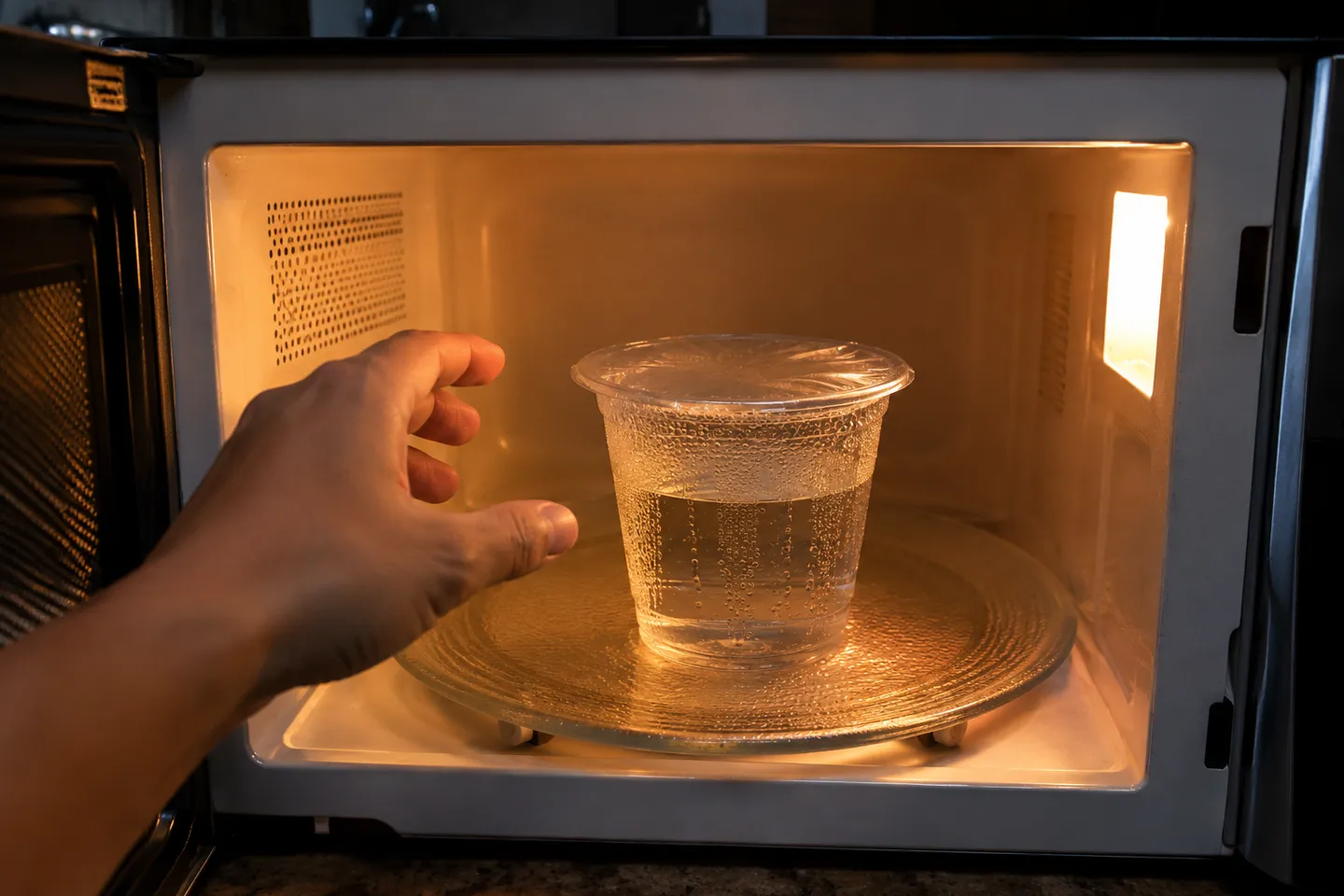
A clean-looking cup is the trap at the end of this section. No warp and no smell does not prove nothing migrated; it proves the container held its shape. The judgment rests on material and markings, not on whether the cup looks fine afterward.
Heating the wrong cup, graded:
Short burst, cold plain liquid: low stress, still not a habit to build.
Visible warp or softening: retire the cup, whatever it held.
Sealed cup heated: expect the seal or lid to fail, open it carefully.
Any repeat heating of a single-use cup: stop; the design assumption is one serving.
Matching the Cup to the Drink: A Menu-Based Material Decision
Shops do not pick one best plastic; they match a material to each band of the menu. The temperature file from the previous section becomes a stocking decision here, and the cup choices quietly shape complaint rates months later.
Iced and Cold Drinks: PET’s Home Ground
Cold menus are PET territory. Clarity shows off layered drinks, tolerance down to about -30°C handles freezer cases, and the unit cost undercuts alternatives at volume. The practical detail is rim quality: a flat, even rim decides whether a sealing film pulls tight, so cold-cup buyers should check rim consistency as seriously as clarity.
Hot Drinks: PP and Paper Take Over
Anything steaming belongs in microwave-grade PP or paper. PP handles serving temperatures near 120°C, and double-wall versions cut hand heat. Paper cups with a corrugated sleeve carry the hottest pours comfortably, with the caveat that the lining defines their limits. PLA and standard PET drop out of this band entirely, since both sit below the temperatures a hot drink reaches on the counter.
Delivery and Takeout: The Transit Window
Delivery adds time, condensation and handling to the cup’s job. Dome lids protect toppings, straw-hole lids serve iced formats, and double-wall structures keep the hand comfortable through a 30-minute ride. The responsibility line matters here: a customer who takes a sealed cup home will, sooner or later, microwave it. A printed “not microwave-safe” note on PET cups turns that moment from a liability dispute into a stated limit, which is why labeling is a purchasing decision rather than a courtesy.
Reheating and Kids’ Cups: The Default Rule
The default for reheating any drink bought in a single-use cup is to move it to glass or ceramic first. That one habit removes the entire material question from the daily routine. For children, the stakes double. Kids’ cups should be checked for material code and printed claims the same way as adult tableware. Reheating in melamine or unlabeled plastic lands hardest on the smallest users.
| Scenario | First choice | Backup | Confirm before ordering |
|---|---|---|---|
| Iced and cold drinks | PET | rPET | Rim flatness for sealing, clarity grade |
| Hot drinks | Microwave-grade PP | Paper with corrugated sleeve | Printed temp rating, lid material match |
| Delivery and takeout | PP double-wall | Dome-lid PET for cold only | Transit time, condensation, labeling |
| Reheating at home | Move to glass or ceramic | Not applicable | “Not microwave-safe” note on PET |
| Frozen desserts | PET (to about -30°C) | Paper | Freezer-rated print, lid crack resistance at low temp |
What to Require from a Cup Supplier Before You Sign
A supplier’s verbal “no problem” carries no weight in a dispute; paper does. The inquiry stage therefore asks for four items in writing. First, the material code. Second, the working temperature range from the data sheet. Third, the food-contact documentation, such as compliance with 21 CFR 177.1630 for PET or 21 CFR 177.1520 for PP (eCFR, 2026). Fourth, the sealing compatibility for the film and rim combination actually in use.
Sampling turns those papers into evidence. Fill real cups with hot water and watch for warp and odor. Run the sealing machine with the intended film. Match certificates to the actual shipment lots rather than to a PDF from last year. European destinations add EU 10/2011 to the checklist, and buyers should confirm which documents refresh with each production batch.
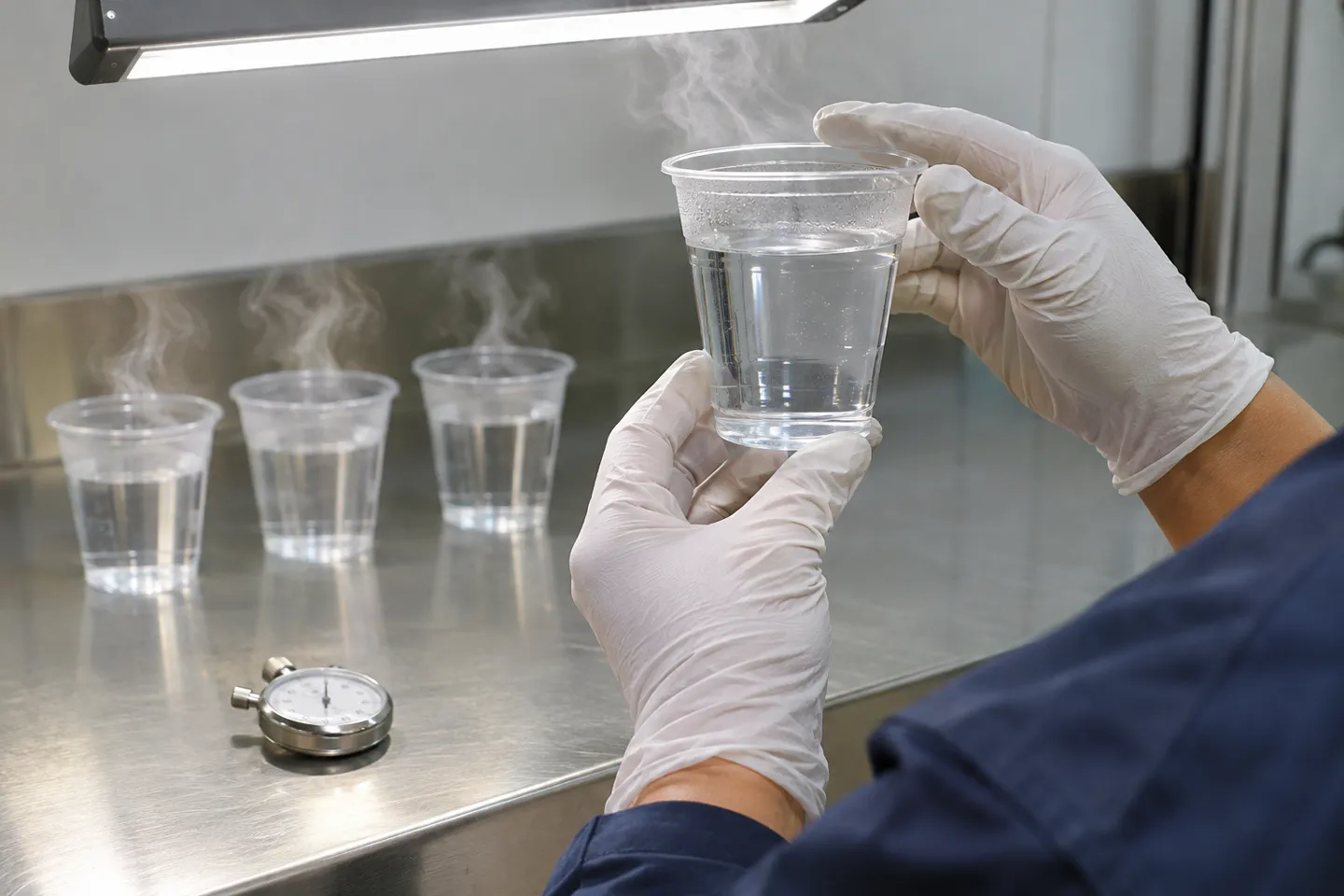
Batch consistency is the quiet failure mode. A resin source change between orders can shift a cup’s temperature behavior without any visible signal. So the purchase order should name the material code and temperature range as contractual values, with a retained golden sample as the reference. A supplier’s testing cadence tells you whether those values are monitored or merely printed; quarterly third-party checks are a defensible standard.
Supplier verification list
- Inquiry: written material code, temperature range, food-contact docs, sealing compatibility.
- Sampling: hot-water warp and odor test, seal machine run, certs matched to shipment lots.
- Consistency: batch-to-batch resin traceability, testing cadence.
- Contract: temperature range and cert numbers inside the PO, golden samples retained.
The Business Logic Behind Cup Materials
The temperature bands double as a product structure. A cold band built on PET buys clarity and unit cost at volume; a hot band built on PP and paper buys safety and grip. Shops that map their menu into these bands before ordering end up with a cup fleet that matches demand instead of a warehouse of compromise.
Crossing the line has a price list. Sealed runs that fail in production become scrap. Cups that warp in transit become refunds. A customer’s reheat incident becomes a review, and the trace on all three runs back to the same skipped spec line. Safety margins in cup materials are cheap at order time and expensive after the fact.
Supplier structure follows the same logic. A full-line supplier carrying PET, PP, PLA and paper lets the menu decide the material each season. A single-material specialist can win on depth when the shop sells one hero product. The criterion is menu structure, not habit, and it is the same temperature-band map doing the deciding.
Spec discipline closes the loop. Writing temperature ranges, material codes and labeling duties into purchase orders costs an afternoon and protects the brand every time a customer carries a sealed cup home to a microwave.
To benchmark these temperature bands against a supplier’s own published specs, OUTSTANDING lists full data for its disposable plastic cups in PET, PP, PLA and paper, rated -30°C to 60°C.
Put the Temperature Range in Writing Before You Sign
Tell OUTSTANDING your menu and cup sizes, and get material codes, working ranges and samples across PET, PP, PLA and paper lines in one reply.
Start the Specification ReviewReferences
- FDA. “Microwave Ovens.” 2023.https://www.fda.gov/radiation-emitting-products/resources-you-radiation-emitting-products/microwave-ovens
- FDA. “Melamine in Tableware Questions and Answers.” 2017.https://www.fda.gov/food/economically-motivated-adulteration-food-fraud/melamine-tableware-questions-and-answers
- Harvard Health Publishing. “Microwaving food in plastic: Dangerous or not?” 2017.https://www.health.harvard.edu/healthy-aging-and-longevity/microwaving-food-in-plastic-dangerous-or-not
- Linseis. “Polyethyleneterephthalate PET: an in-depth investigation.” 2025.https://www.linseis.com/en/wiki/polyethyleneterephthalate-pet-an-in-depth-investigation/
- Palmetto Industries. “Is Polypropylene Heat Resistant? Max Temp Rating & More.” 2025.https://www.palmetto-industries.com/is-polypropylene-heat-resistant/
- ASTM International. “Standard Practice for Coding Plastic Manufactured Articles for Resin Identification Codes (D7611).” 2021.https://www.astm.org/Standards/D7611.htm
- eCFR. “21 CFR 177.1630, Polyethylene phthalate polymers.” 2026.https://www.ecfr.gov/current/title-21/chapter-I/subchapter-B/part-177/subpart-B/section-177.1630
- eCFR. “21 CFR 177.1520, Olefin polymers.” 2026.https://www.ecfr.gov/current/title-21/section-177.1520
- University of New South Wales. “Superheating and microwave ovens.” n.d.https://www.animations.physics.unsw.edu.au/jw/superheating.htm