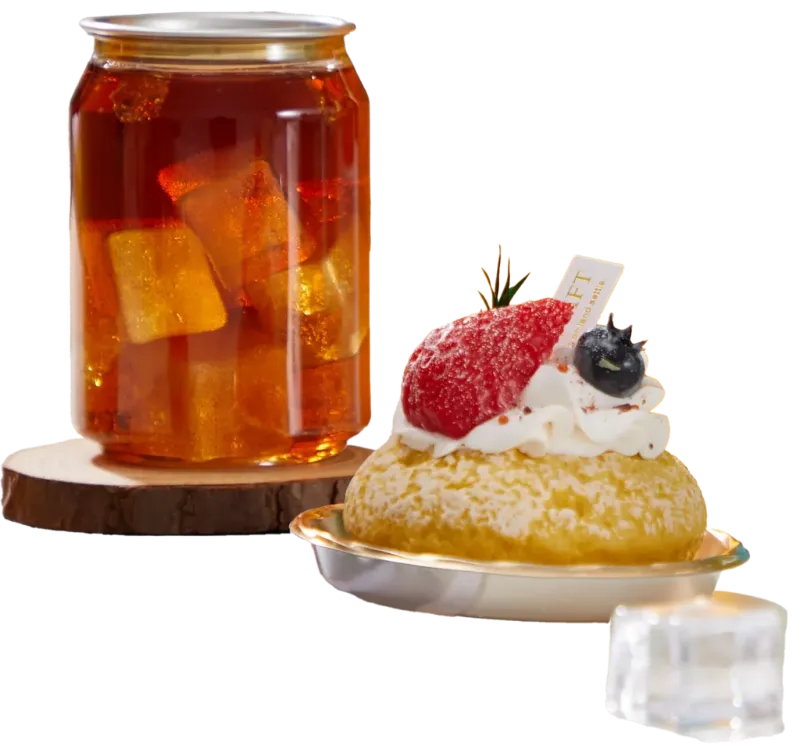
Before a new drink or cosmetic line ships its first pallet, someone has to pick the bottle. That decision usually starts with a shape sketch. Too often it ends with a returned container: panels caved in after a summer sea crossing, or caps weeping oil into cartons. Customs adds its own surprise: a food-contact document nobody requested at order time. Almost all of these outcomes trace back to one upstream choice: which plastic the bottle is made of.
A plastic bottle is three decisions stacked together. The body is the resin, and it decides how the bottle looks on a shelf and how it survives filling and chemicals. The neck finish is the threaded opening sized to a closure. The sealing system, whether screw cap, foil seal, or easy-open lid, decides how the product gets out. Two bottles can look identical on a shelf yet behave completely differently on a filling line. The difference is usually the body resin. Most selection mistakes happen when buyers compare shapes and prices and treat the resin as a footnote.
One clarification before the catalog. The phrase “plastic bottles” covers two different purchases: the reusable water bottle you buy as a consumer, and the packaging container you buy by the thousand to fill with a product. This article is about the second one. The material chapters still help if you are shopping for drinkware. The compliance and acceptance sections assume you are filling these containers on a line, shipping them in cartons, and selling them in a regulated market.
“Types of plastic bottles” can also be sliced three ways: by material, by shape, and by use. Shape means round, square, tapered, or custom. Use means beverage, food, pharma, or personal care. This article follows the material axis from start to finish, because material determines what a bottle can survive. Shape and use will appear along the way, but as consequences, not as the organizing principle.
The 7 Resin Types: A Field Guide
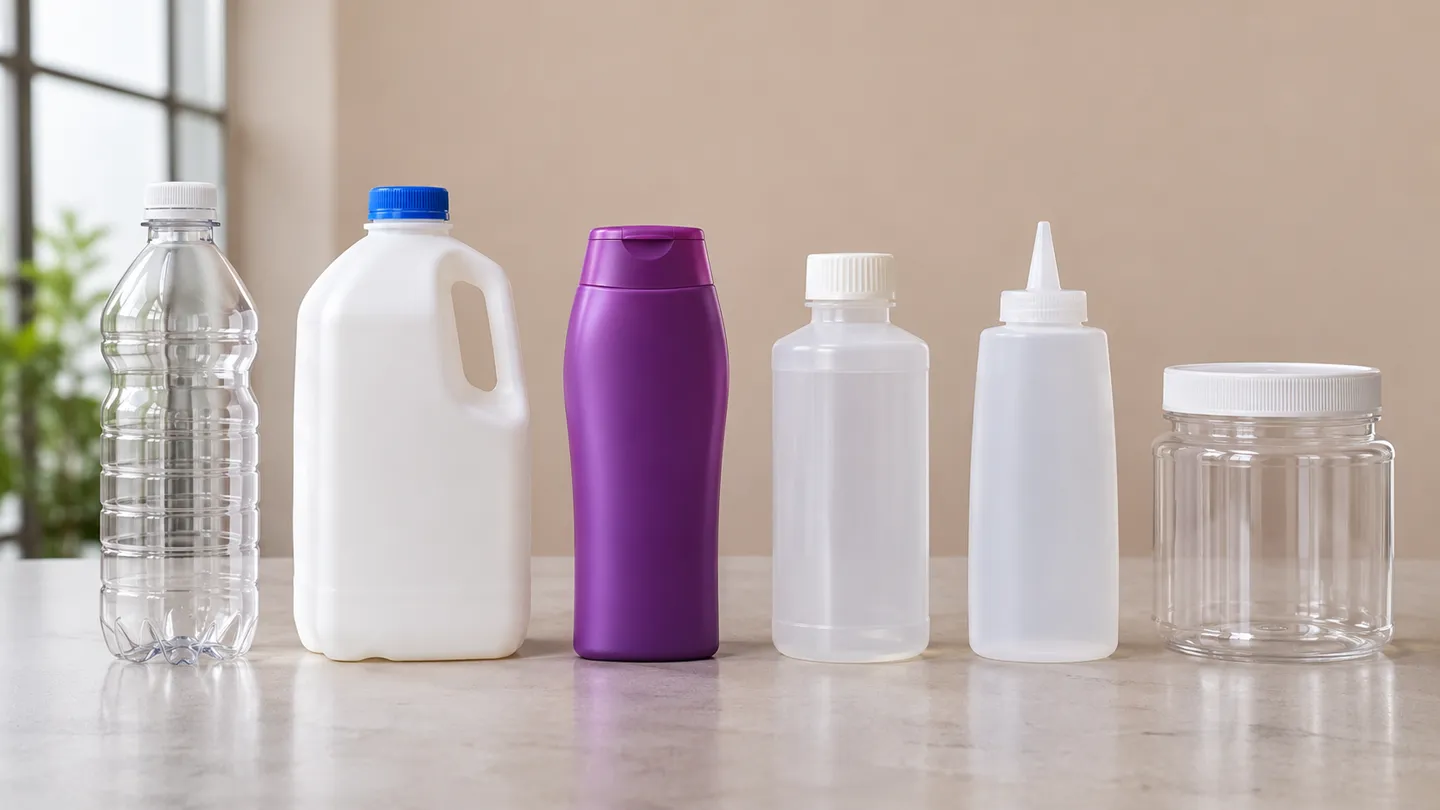
Every plastic bottle carries a number inside the chasing-arrows triangle, usually molded into the bottom. That numbering system is defined by the ASTM D7611 standard for resin identification codes, and it exists so that recycling facilities can sort streams efficiently. It was never designed as a safety ranking, even though it gets read that way constantly. A “food-safe” label does not belong to a number; it belongs to a specific resin, in a specific use, certified for a specific market.
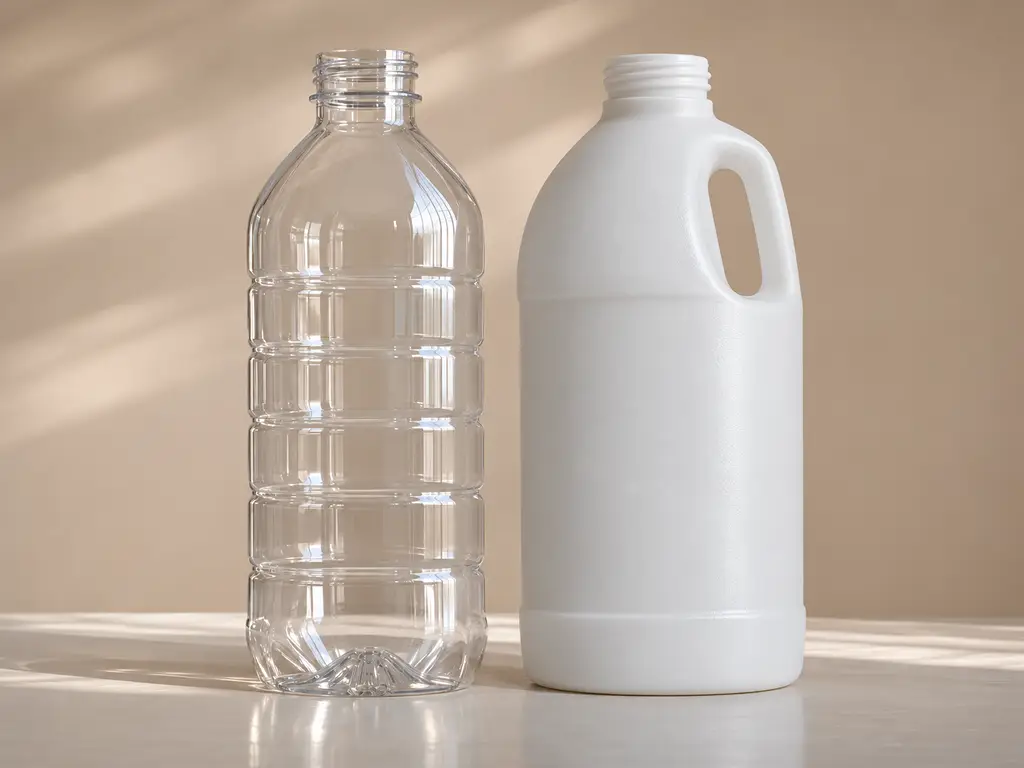
Here is the full field guide, including the resins that rarely reach store shelves.
The 7 Resin Codes and What They Mean for Buyers
| Code | Resin | Quick ID | Common bottles | Strengths | Think twice when |
|---|---|---|---|---|---|
| 1 (PET) | Polyethylene Terephthalate | Glass-clear, rigid, reads #1 on bottom | Juice and soda bottles, oil bottles, wide-mouth jars | Clarity, oxygen barrier, lightweight, widely recycled | Filling above 60-65 °C; long hot-chain transit |
| 2 (HDPE) | High-Density Polyethylene | Opaque, waxy feel, slightly soft | Milk jugs, detergent and shampoo bottles | Chemical resistance, moisture barrier, cheap | No product visibility; flavor-sensitive drinks |
| 3 (PVC) | Polyvinyl Chloride | Clear but heavier feel | Rare in food bottles today | Formable, cheap | Rarely chosen for food contact anymore; recycling stream rejects it |
| 4 (LDPE) | Low-Density Polyethylene | Very flexible, squeezable | Squeeze bottles, dispensers | Flexibility, squeeze recovery | Poor clarity; low stiffness for tall bottles |
| 5 (PP) | Polypropylene | Translucent, stiffer hinge action | Hot-fill containers, jar caps, syrup bottles | Highest heat tolerance among common bottle resins, microwave-safe | Less transparent than PET; colder impact brittleness |
| 6 (PS) | Polystyrene | Glassy and rigid or foamed | Rarely bottles; more cutlery and trays | Cheap, rigid | Softens near heat; declining in food use |
| 7 (Other, incl. PC, Tritan, PLA) | Polycarbonate, Tritan copolyester, PLA | Varies: PC is glassy, PLA is matte | Reusable drinkware, compostable cups | PC toughness and Tritan clarity; PLA compostability | PC carries BPA history; PLA is not heat tolerant |
One resin dominates the category. In the US, PET accounted for 44.7% of single-serve beverage packaging in 2021 (Polymers peer-reviewed review, PMC, 2022). Market analysts estimate PET resins command about 41.4% of the global plastic bottles market (Future Market Insights, 2026). The two figures measure different scopes, and that is itself a useful lesson: resin statistics shift with how you draw the boundary, so buy by application fit rather than by market share.
HDPE and PP divide the remaining work. HDPE owns the opaque, chemically aggressive jobs: detergents, shampoos, milk. PP owns heat: it tolerates filling temperatures that deform standard PET and survives microwave reheating, at the cost of some clarity. The rest fills niches. LDPE squeezes, and PC and Tritan serve reusable drinkware. PLA serves compostability claims. rPET is simply recycled PET, which brings its own compliance paperwork, covered in the certification section below.
Matching the Material to Your Product
The field guide tells you what exists. Your product decides what fits. The same PET that flatters a cold-pressed juice is the wrong answer for a chili sauce filled at 85 °C. The HDPE that shrugs off shampoo will dull the shelf appeal of a premium serum. The matrix below is the decision table most buyers actually need, organized by what is going inside the bottle rather than by resin name.
Scenario to Material Decision Matrix
| Your product | Recommended material | Why it fits | Where it fails |
|---|---|---|---|
| Cold-fill drinks (juice, tea, soda) | PET | Clarity shows the product; oxygen barrier holds carbonation and flavor; light weight cuts freight | CO2 and aroma fade over long shelf life; UV fades colored drinks in clear glass-clear walls |
| Hot-fill or heat-sensitive (sauces, jams, soups) | Heat-set PET or PP | Engineered crystallinity holds shape at 85 °C+ filling (heat-set PET); PP tolerates heat natively | Standard PET collapses: panels cave and necks warp |
| Oils and viscous products | PET with matched closure | Clarity sells color; viscosity needs wide necks or pumps | Essential oils can stress some resins and gaskets: verify compatibility first |
| Powders and dry goods (nuts, candy, grains, protein powder) | Wide-mouth PET jar | Moisture and oxygen barrier decides shelf life; wide mouth for filling and scooping | Seal quality decides everything: a weak foil seal turns a 12-month shelf life into 6 |
| Supplements and pharma (tablets, capsules, powders) | PET jar or bottle, pharma-grade line | GMP-grade production and batch traceability; moisture barrier for tablets | Compliance documents matter as much as the container itself |
| Home and personal care (detergent, shampoo, cosmetics) | HDPE, PP | Chemical resistance for surfactants; opacity or clarity by brand need | Essential-oil-heavy formulas can attack standard resins and liners |
Cold-fill drinks: why PET is the default
Cold-pressed juice, iced tea, soda, and milk tea all land on PET for three mechanical reasons, not fashion. Clarity lets the product sell itself through the wall, which measurably moves shelf conversion for colorful drinks. The resin’s oxygen and CO2 barrier keeps carbonation in the bottle and aromatics in the liquid longer than HDPE can. And its light weight cuts freight on every pallet: a meaningful number once you price ocean shipping by the container. The failure edge is time, not heat. Over a long shelf life, CO2 and aroma slowly permeate out, so carbonated drinks need the barrier performance of virgin PET rather than the cheapest available sheet.
Heat: the boundary that ruins batches
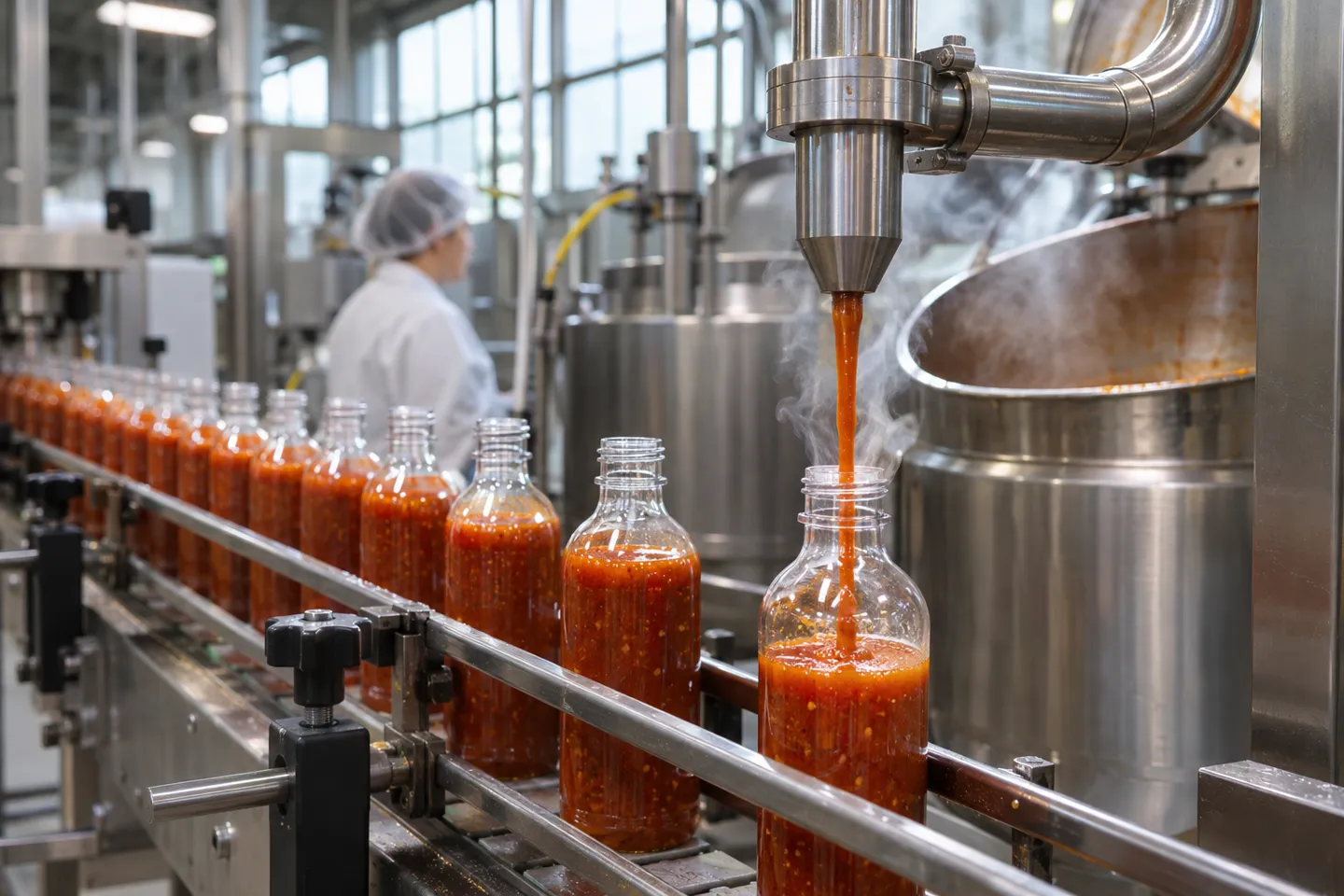
This is the highest-frequency failure point in the entire category. Standard PET is a semi-crystalline thermoplastic. It begins to soften as it approaches its glass transition, around 76 °C (Oberk Packaging Crash Course). Peer-reviewed work on hot-fill containers puts typical filling temperatures around 85 °C, above the heat distortion that unmodified PET tolerates (Shin et al., Food Bioscience, 2021). In practical service terms, standard PET packaging is rated for roughly 60-65 °C and is not recommended for hot filling (OUTSTANDING FAQs).
Filling hot product into standard PET does not fail politely. Panels cave inward as the contents cool, necks warp so caps no longer seal, and the deformation shows up after packing, when the whole batch is already cartoned.
The fixes are straightforward once the temperature question is asked early. Heat-set PET is blown with a thermal crystallization step that holds shape through 85 °C filling lines. PP containers natively tolerate the heat and trade away some gloss. And some products can simply change process: fill cool, pasteurize differently, or package in a jar instead. What is not fixable is ordering a standard PET bottle because the sample looked right, then discovering the fill temperature at production. Before ordering any bottle, write down your fill temperature and ask the supplier for the container’s rated temperature range in writing.
Powders, dry goods, and supplements
Nuts, candy, grains, protein powder, and vitamin tablets share one packaging physics problem: moisture and oxygen, over months, not minutes. This is wide-mouth PET jar territory, typically 280 ml to 1 L with foil or screw seals. Here the jar’s barrier properties and seal quality, not the resin choice alone, decide whether the product is still crisp at month nine. For supplements and pharma items, add a production-grade question to the mix: whether the containers come from a GMP-grade workshop line with batch traceability. The buyer’s own regulator may ask. Dairy sits half a step away: milk jugs are HDPE in most markets, a placement driven by opaque protection and cost rather than barrier limits.
Home, personal care, and oils
Surfactant-based products (shampoo, detergent, cleaners) are chemically aggressive toward many plastics, which is why HDPE owns this aisle. Cosmetic serums usually go back to PET for shelf clarity. The niche case worth flagging is essential-oil-heavy formulas. Concentrated oils can soften some resins and attack standard liner materials, so the closure and gasket specification matters as much as the bottle. Verify compatibility with your actual formula, not with a water simulant.
One trend note closes this section. Supplier catalogs are full of PET because the market is: roughly 41 to 45% of the category by the two calibers cited above. The “greener” options carry real trade-offs to verify rather than assume. PLA is compostable only under industrial composting conditions, and it is not heat tolerant. rPET bottles are recycled-content products, and their food-contact legitimacy depends on the recycled material being authorized for your market and your use. That authorization is exactly what the next section’s paperwork covers.
Certifications and Documents to Demand
“Food-grade” is not a property of plastic. It is a judgment about a material, in a use, for a market. The same PET bottle can be fully compliant in the US and under-documented for the EU, because the two markets run different rulebooks. A short stack of documents turns that judgment from a claim into evidence. Every one of them is cheaper to request at quotation time than to discover missing at customs.
Documents to demand, by market
- US: FDA food-contact compliance for the resin (PET is listed under 21 CFR 177.1630) plus a third-party lab report such as SGS on the finished bottle
- EU: compliance with Regulation (EU) No 10/2011 on plastic food-contact materials, evidenced by a Declaration of Compliance referencing the Union List of authorized substances
- System level: ISO 9001 certificate, which says the production process is managed and repeatable
- Environmental: RoHS and REACH statements for chemical content
- Pharma and supplements: GMP-grade workshop evidence and batch traceability records
The virgin versus recycled question lives inside this paperwork too. A 100% virgin PET bottle traces to resin batches with food-contact clearances from the resin producer. An rPET bottle is only as compliant as the recycling stream behind it. In the EU, recycled plastics must go through an authorized recycling process to earn their place in food contact. In the US, the FDA evaluates recycled PET processes for food-contact use. Neither is a reason to avoid rPET; both are reasons to ask for the traceability file instead of trusting a leaf logo.
It is worth separating the two families of documents, because suppliers tend to conflate them. System certifications like ISO 9001 say the factory’s process is stable and audited. Material compliance documents say this specific bottle may touch your specific product in your specific market. You need both: the first predicts consistency, the second predicts legality.
One boundary note, because certificates are paper. Certificates expire, and occasionally the certificate presented does not match the batch shipped. The practical check is to request test reports tied to recent production batches, and where the order justifies it, retention samples you can hold against future deliveries. Put the document list into the request-for-quotation itself, as the first step, not as a receiving-inspection surprise.
Where to Source: Stock, Light Custom, Full Custom
Once the material and documents are settled, the buying question becomes a volume question. There are three sourcing paths, and the fastest way to overspend is to enter at the wrong one. Commissioning a custom mold for a product whose scenario fit is still unproven wastes money. Hand-labeling stock bottles strangles a line that has already outgrown them.
The three sourcing paths
Stock and print
Buy an existing bottle mold and apply your brand with labels or printing. Fastest and cheapest entry; right for scenario validation, seasonal runs, and first orders.
Light custom
Keep an existing bottle, change color, cap style, or print your logo directly. MOQ commonly starts around 1,000 units; samples in about 48 hours; production often 3-5 days.
Full custom mold
A new bottle shape. MOQ typically 30,000-100,000 units; mold-based samples around 15 days; mold fees are sometimes split with the supplier, while non-standard neck finishes are usually at the buyer’s cost; lead times run longer.
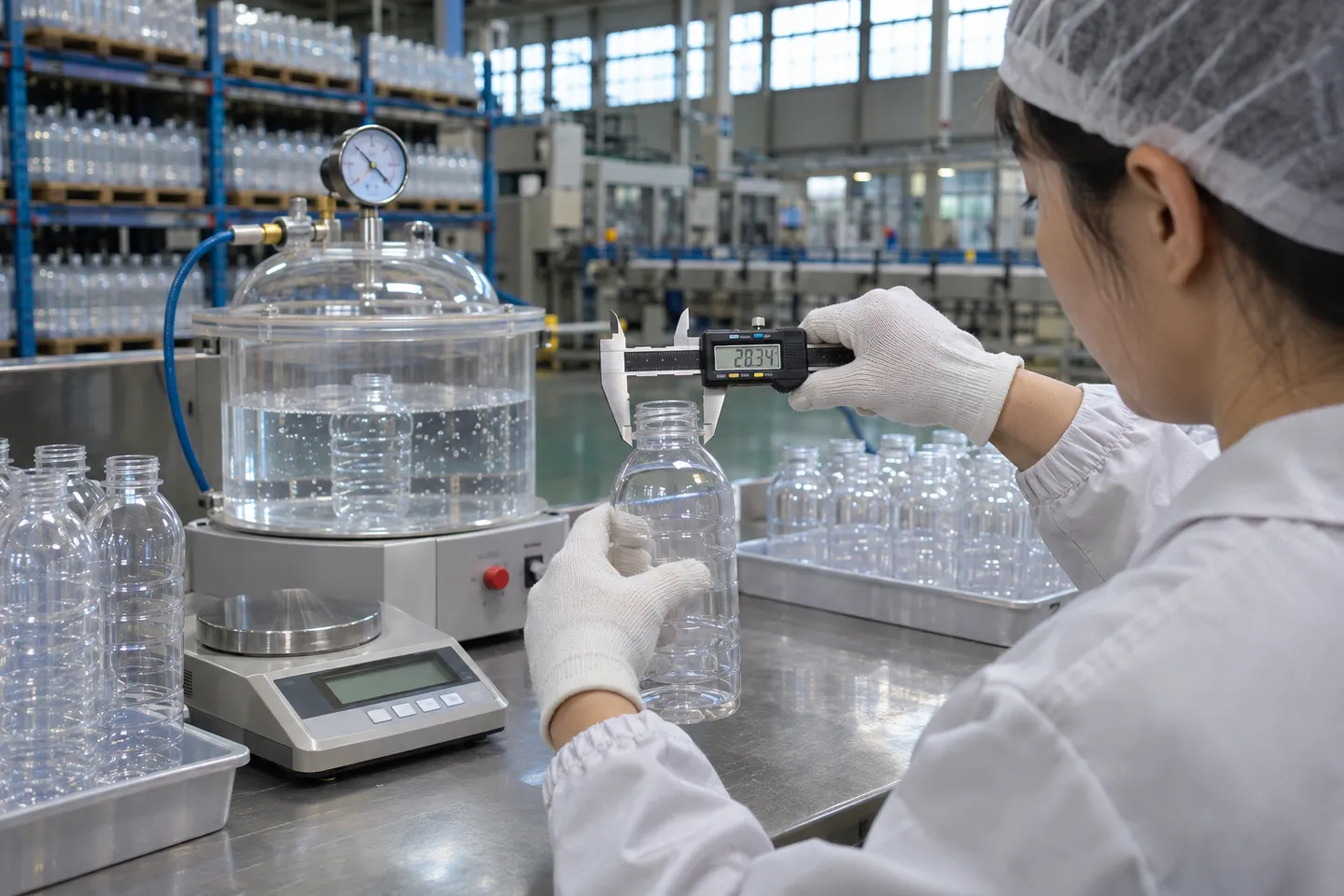
Two supplier-reading heuristics are worth more than any catalog page. First, sampling speed is a capacity probe. A supplier that turns a simple sample in 48 hours demonstrably has running lines and stock molds. One that quotes weeks for the same job is reselling someone else’s capacity. Second, ask what testing equipment sits in their own lab: weight scales, dimension gauges, seal testers, drop rigs. An in-house QC bench with named instruments predicts batch consistency better than a wall of certificates, and it foreshadows the acceptance specs in the next section.
The boundary on the cheap path: low MOQ light custom costs more per unit than stock, and printed colors can drift between batches when runs are small. Confirm in writing who owns the mold if you go custom, because mold ownership decides whether you can move production later. And regardless of path, validate the scenario first with the smallest order that produces real evidence: the mold decision should follow market data, not precede it.
At this point the question quietly changes. It is no longer “which bottle” but “which supplier can prove what they claim,” and that is an acceptance-spec conversation.
OutstandingPack quotes with the document stack attached: FDA and EU 10/2011 declarations, ISO 9001, and batch seal reports on request.
Request a documented quoteAcceptance Specs and How Bottles Fail
Bottles fail in predictable ways, and each failure mode has a checkable number behind it. This section is the acceptance sheet: the specifications worth writing into a purchase order, and the failure each one prevents.
Temperature failures: the silent batch-killer
Standard PET tops out around 60-65 °C in service, and past that rating it deforms: most bottle failures in real supply chains are material-to-scenario mismatches, not bad plastic. The trap is that the failure rarely happens at the factory. It happens inside a sea container crossing a summer lane, where internal temperatures exceed what the bottle would survive in a warehouse. It happens in a cold chain too, where PET grows more brittle toward its -30 °C rating and arrives more vulnerable to drops. The verifiable actions: state your fill temperature and transit lanes in the RFQ, and ask specifically how the supplier packs for ocean freight. Insulation liners inside cartons are a proven countermeasure for hot-lane shipments, and a supplier who has shipped to hot climates will know the term without explanation.
The number to remember
60-65 °C
Above it, standard PET deforms. If your product, your process, or your shipping lane can reach that range, the container specification must say so explicitly.
Sealing and shelf life
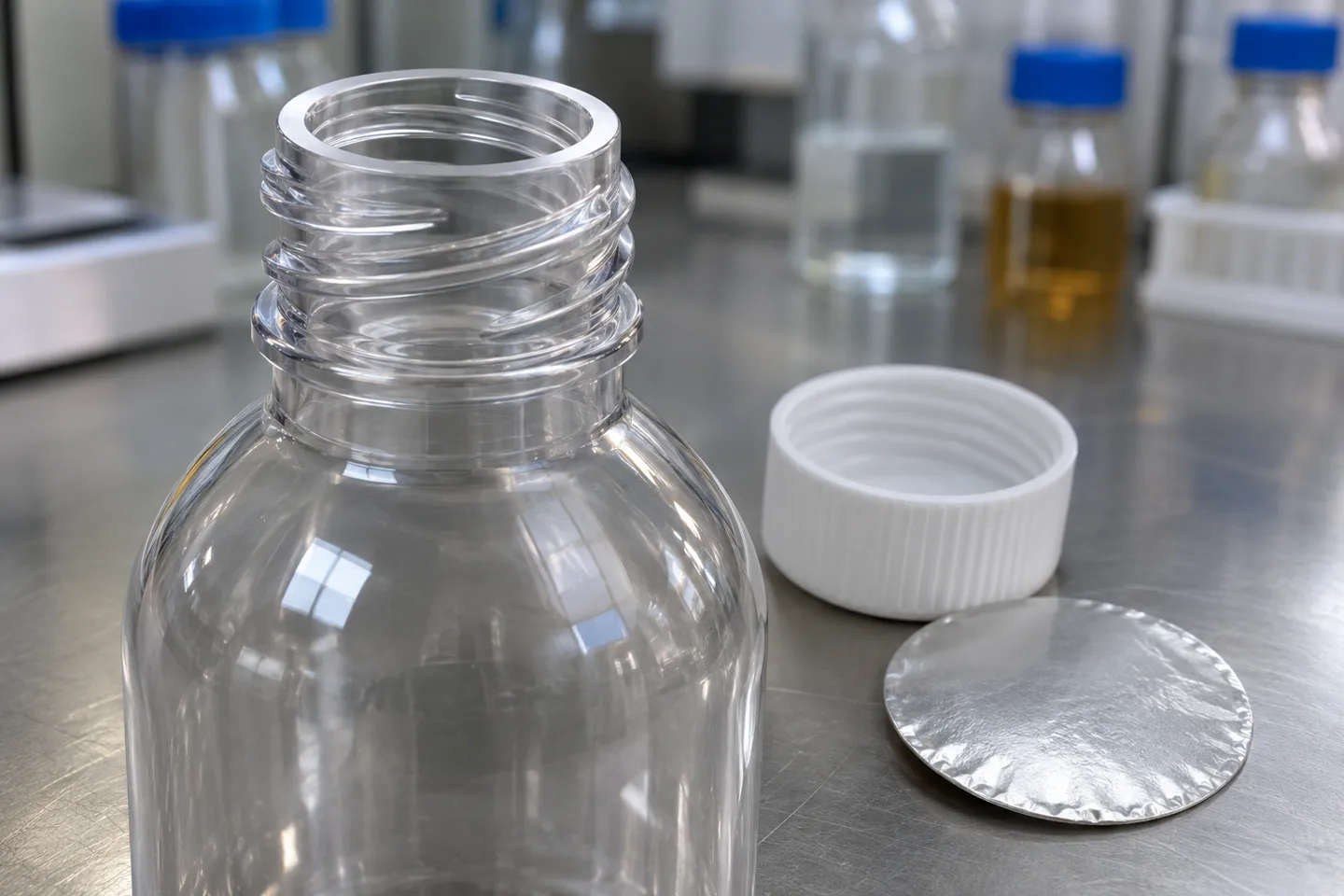
A bottle’s shelf life is decided at an area of a few square centimeters: the sealing face on the neck. Mouth flatness tolerance at the ±0.1 mm level is what lets a cap or foil seal do its job across thousands of units. The three sealing systems trade convenience against barrier. Screw caps reseal for multi-use products. Aluminum foil seals add tamper evidence and the longest shelf life for dry and powdered goods. Easy-open lids serve retail convenience for ready-to-drink formats. The verifiable request is a seal test report: vacuum or water-immersion leak testing on production batches, run on a defined cadence. Quarterly third-party laboratory testing is the cadence serious packaging suppliers work on, and reports should be available on request.
Transit and drop
Physical survival is a testable spec, not luck. A 1.8 m drop test with contents simulates the warehouse-to-truck reality, and packaging counts as part of the spec: thickened cartons, stretch wrap, palletization, and for machine shipments, wooden crates. E-commerce sellers should add the last mile to the conversation, because parcel handling is rougher than pallet handling. One geometry note with a freight bill attached: square and rectangular bottles pack tighter than round ones, and on a full container that difference is money.
Batch consistency: the tolerance chain
Consistency is a chain of small tolerances, and it starts before the bottle exists. Preform weight held to around ±0.1 g gives wall thickness its uniformity, with deviation kept at or below 0.05 mm. That uniformity keeps the mouth flat within about ±0.1 mm, which is what makes the seal pass rate land around 99.8%. Finished-dimension tolerance sits near ±0.2 mm on the outside envelope. The point of the chain is simple: each number is written on a measurement record somewhere, and a supplier who measures can show you.
Failure matrix: scenario, trigger, spec, prevention
| Failure scenario | When it triggers | Spec to check | Prevention action |
|---|---|---|---|
| Heat deformation | Hot-fill process or hot-climate sea freight | Rated temperature range in writing | Match container type to fill temp; request insulation packing for hot lanes |
| Seal leak | Poor neck flatness or wrong closure match | Mouth flatness ±0.1 mm; vacuum/water-immersion test report | Request batch seal reports and retention samples |
| Transit cracks and dents | Parcel or pallet handling shock | 1.8 m drop test with contents; packaging spec | Specify carton grade, wrap, palletization in the order |
| Batch color or weight drift | Small runs on weak process control | Preform weight ±0.1 g; wall deviation ≤0.05 mm | Ask for in-process QC records and batch retention |
| Compliance gap at customs | Market rules not documented at order time | FDA / EU 10/2011 declaration per market | Put document requirements into the RFQ first step |
The checklist version of all of the above, ready to paste into an RFQ or an inspection sheet:
Acceptance parameters at a glance
- Rated temperature range of the container, matched to your fill temperature
- Preform weight tolerance (±0.1 g class) and wall thickness deviation (≤0.05 mm class)
- Mouth flatness tolerance (±0.1 mm class) matched to your closure
- Seal test report (vacuum or water immersion) per production batch
- Drop test evidence (1.8 m with contents) and transit packaging spec
- Finished dimension tolerance (±0.2 mm class)
- Third-party lab testing cadence (quarterly) and report availability
- Food-contact documents per target market (FDA, EU 10/2011 declaration)
The Buying Math, Re-read
Read back through this article’s numbers and a buying principle falls out: the cheapest bottle per unit is rarely the cheapest bottle per order. A container that deforms at your fill temperature, weeps in transit, or stalls at customs will cost more than any per-unit saving. The bill arrives as returned batches, claims, and replays.
The RFQ is where the whole article compresses into one action. Three product conditions go in first: fill temperature, contents (including oil content and pH), and target market. The spec list follows: temperature rating, tolerances, seal and drop test reports, and the market’s food-contact documents. Ordering at that point stops being a gamble on samples and becomes a purchase against written criteria.
Scale changes the math, not the principle. Light customization at the 1,000-unit MOQ level is the cheap way to buy evidence: a real bottle, your label, on a real shelf, before any mold decision. Full mold customization at the 30,000-100,000-unit level is where unit prices drop and exclusivity begins, and it should follow demand data rather than optimism. Sampling speed tracks the same split: around 48 hours for simple samples against roughly 15 days for mold-based ones, a difference that reflects which path you are actually on.
And the material trend reads the same way. PET dominates because it fits the physics of most cold-fill products, not because catalogs are lazy. Paying a premium for an eco material without its compliance file buys a logo, not legality. Buy the scenario, verify the numbers, and the resin code on the bottom becomes what it always should have been: a sorting mark, not a decision.
RFQ checklist: send this with your inquiry
This checklist is not theoretical; it is how a working packaging order is actually run. At OUTSTANDING, light customization starts at 1,000 units, and samples turn around in 48 hours. Full mold customization runs from 30,000 to 100,000 units, with mold-based samples in about 15 days. Every production order passes through four QC stages, IQC through OQC, including vacuum and water-immersion seal testing and 1.8 m drop tests with contents. Quarterly third-party laboratory reports are available on request before shipment. Our custom packaging services page maps the paths side by side, and our quality control process page shows the test bench those numbers come from.
Simple samples leave in 48 hours, and light-custom orders ship in 3 to 5 days at OUTSTANDING. The quickest way to test this checklist is on a real bottle on your desk.
Send your fill sheet, get a matched bottle
Fill temperature, contents, and target market are the three inputs. OutstandingPack returns the resin choice, the tolerance sheet, and the compliance file with the quote.
Start your RFQReferences
- Benyathiar, P. et al. “Polyethylene Terephthalate (PET) Bottle-to-Bottle Recycling for the Beverage Industry: A Review.” Polymers, 2022. https://pmc.ncbi.nlm.nih.gov/articles/PMC9231234/
- Future Market Insights. “Plastic Bottles Market Size, Share, Trends.” 2026. https://www.futuremarketinsights.com/reports/plastic-bottles-market
- ASTM International. “ASTM D7611: Standard Practice for Coding Plastic Manufactured Articles for Resin Identification.” 2021. https://www.astm.org/d7611-21.html
- Oberk Packaging. “Heat Set PET Basics 101.” Packaging Crash Course. https://www.oberk.com/packaging-crash-course/heat-set-pet-101
- Shin, H. et al. “Applicability of newly developed PET/bio-based polyester blends for hot-fill containers.” Food Bioscience, 2021. https://www.sciencedirect.com/science/article/abs/pii/S2214289421001253
- US eCFR. “21 CFR 177.1630: Polyethylene Terephthalate Resins.” Current edition. https://www.ecfr.gov/current/title-21/part-177/subpart-B/section-177.1630
- EFSA. “Food contact materials.” Topic page, European Food Safety Authority. https://www.efsa.europa.eu/en/topics/topic/food-contact-materials